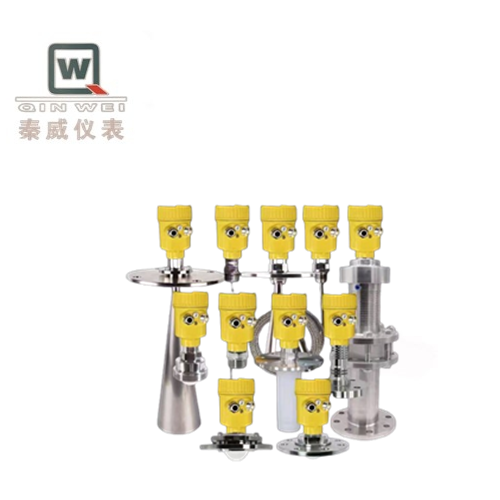
The rod-type guided wave radar level gauge is a contact-type level measurement instrument based on the time-domain reflectometry (TDR) principle. It transmits high-frequency microwave pulses through a rigid probe rod. When the pulse encounters the surface of the measured medium, it generates a reflection. By measuring the time difference between the transmission and the reflection, the liquid level height is precisely calculated.
Key Features
- Range and Structure: The maximum range is usually no more than 6 meters, as longer probes are inconvenient for transportation and installation. It uses a rigid probe with a sturdy structure.
- Interference Resistance: The rigid probe concentrates energy and has extremely strong interference resistance. It is particularly suitable for applications with liquid surface fluctuations, foam, boiling, or stirring, effectively suppressing false echoes caused by steam, dust, and liquid surface fluctuations.
- Applicable Media: It can measure liquids, slurries, and solid particles with a dielectric constant of ≥1.4. It is especially suitable for measuring media with low viscosity and low adhesion (generally viscosity ≤500cst).
- Measurement Accuracy: High accuracy, typically <0.1%, with a resolution of up to 1mm and repeatability of approximately ±3mm.
- Installation and Maintenance: Installation is relatively simple, requiring the probe to be vertical and avoiding obstacles. Daily maintenance is minimal, but it is necessary to check for any adhesions on the probe.
To help you see more clearly the differences between it and the "cable brothers", I have compiled a comparison table:
| Comparison Dimension |
Rod-type Guided Wave Radar (Your Focus) |
Cable-type Guided Wave Radar (Last Round Discussion) |
| Core Features |
Utilizes a rigid metal rod as the waveguide component, providing a stable structure. |
Employs a flexible steel cable as the waveguide component, with a weight at the bottom. |
| Range |
≤ 6 meters |
30 to 75 meters, and even longer. |
| Core Advantages |
- Good rigidity and resistance to lateral impact: Not prone to bending, suitable for installation in containers with stirring or lateral medium impact.
- Flexible installation: Particularly suitable for bypass pipe/guided wave pipe installation, allowing for precise measurement.
- Stronger signal: For low dielectric constant media (such as light oil, liquefied gas), the rod-type probe has a better waveguide effect than the cable type, and the reflected signal is more reliable.
- No swinging issue: No need for bottom fixation, making installation and maintenance simpler.
|
- Extremely large range, suitable for high towers and deep wells.
- Flexible cable can be coiled for transportation and shortened on-site.
- The bottom weight can resist medium impact and flow.
|
| Typical Limitations |
The range is limited by the rigidity and strength of the rod, generally not exceeding 6 meters. |
When the medium impact force is too large or there are many obstacles in the tank, the cable may swing, affecting measurement stability, and bottom fixation is required. |
| Best Applications |
Small and medium-sized storage tanks, reaction vessels, bypass pipe installation, low dielectric constant media, and stirred conditions. |
Super large storage tanks, deep wells, solid silos, and situations requiring interface measurement. |
Application scenarios
- Process industry: Small storage tanks, reactors, separators, etc. in petrochemical, pharmaceutical, food and beverage industries.
- Complex working conditions: Suitable for environments where the liquid surface has stirring, fluctuation, foam, or where there is steam or dust inside the tank.
- Low dielectric constant liquids: For liquids with a low dielectric constant, a double probe measurement method can be adopted to improve measurement accuracy and reliability.
The rod-type guided wave radar level gauge, with its outstanding anti-interference ability, high precision and reliability brought by the rigid probe, has become the ideal choice for medium and small range, liquid surface fluctuation or complex working conditions such as the presence of foam.