High-Toughness Water Treatment Membrane Bonding Epoxy Potting Compund
Product Overview
BZ-609-1 is a two-component epoxy resin formulated with enhanced toughness and impact resistance, specifically designed for bonding water treatment membrane components in dynamic or high-stress environments. It provides excellent stress distribution and membrane filament protection.
Core Advantages
- Ultra-Low Viscosity: Mixed viscosity as low as 20-80 mPa·s, ensuring excellent flowability and penetration into intricate structures
- Crystal Clear Transparency: Maintains high light transmittance after curing, suitable for applications requiring visual clarity
- Bubble-Free Curing: Special formulation eliminates air bubbles during curing, resulting in a smooth, defect-free surface
- Excellent Yellowing Resistance: Resists UV-induced yellowing, ensuring long-term optical performance
- Versatile Application: Suitable for both potting electronic components and coating decorative items
Technical Parameters
|
Parameters
|
Resin
BZ-609-1 A
|
Hardener
BZ-609-1 B
|
|
Before curing
|
Appearance
|
Clear liquid
|
Clear liquid
|
|
Viscosity(mPa·s.25℃)
|
2800-5200
|
60-1450
|
|
Initial mixed viscosity(mPa·s.25℃)
|
1800-2800
|
|
Density(g/cm³.25℃)
|
1.15±0.05
|
1.00±0.05
|
|
Mixing
&
Curing
|
Mix ratio(by weight)
|
A:B=3:1
|
|
Pot life 130±30g(min.25℃)
|
85-135min
|
|
Curing condition
|
Room temperature curing
|
|
Surface drying time 30g(H.25℃)
|
14-20H
|
|
Curing time 30g(H.25℃)
|
24-36H
|
|
Curing time 30g(Heated)
|
60℃ heated 1.5H
|
|
After curing
|
Color
|
Clear
|
|
Hardness (Shore D)
|
70±10
|
|
Temperature resistance(℃)
|
-40~85℃
|
|
Water absorption(24H)
|
≤0.25%
|
Target Applications
- Mobile Water Treatment Equipment: Seals membrane modules in vehicle-mounted and shipboard water purification systems, withstanding vibration and impact during transportation
- Seismic-Resistant Water Supply Systems: Used in earthquake-prone regions to ensure membrane module integrity during seismic events
- Cleanable Membrane Modules: Enables disassembly and cleaning of membrane modules, extending service life and reducing replacement costs
- Underground Mining Water Treatment: Bonds membrane modules in underground mining water purification systems, adapting to harsh working conditions
Critical Curing & Handling Precautions
- Temperature Control: Preheat materials when ambient temperature drops below 15°C to maintain optimal flowability
- Proper Mixing: Use mechanical stirrers for uniform mixing to ensure consistent toughness and performance
- Curing Time Management: Allow sufficient curing time (24-36 hours at 25°C) to achieve full mechanical properties before system operation
Directions for Use
- Pre-potting Preparation: Calibrate scales, prepare potting tools, cleaning tools, check machine settings, check vacuum pump force, etc.
- Product Pre-treatment: Place product on a level surface or fixture. Remove dust, clean, degrease, and dry if necessary.
- Accurate Proportioning: Manual operation requires precise mixing according to the specified ratio and recording. Machine potting requires calibrated ratios and first-article confirmation is recommended.
- Mixing & Stirring: Manual operation requires thorough stirring or using electric stirrers to ensure homogeneous mixing. Machine potting requires sufficient stirring speed, adjust as needed.
- Uniform Potting: Manual operation should be done in small, multiple batches to ensure uniformity. Machine potting should follow the programmed path for quantitative dispensing.
- Inspection or Secondary Potting: After potting, visually inspect as needed. Perform touch-up, bubble removal, or secondary potting if required.
- Curing: Allow the potted and inspected products to cure at room temperature or with heat assistance (recommended 60°C if needed), according to product and process requirements.
- Final Product Confirmation: Perform visual inspection and performance testing as required by the customer.
9. This series of products are room-temperature-curing, addition-cure two-component silicone. During the dispensing process, avoid contact with the following three types of materials to prevent reactions that may affect the curing effect:
a. Organotin compounds and organotin-containing silicone rubber.
b. Sulfur, sulfides, and sulfur-containing materials.
c. Amine compounds and amine-containing materials.
10. It should be noted that during manual operation, when vacuumizing the mixed A+B adhesive, the vacuum pressure must be controlled to ensure the adhesive is not completely sucked out of the container by the vacuum.
Packing & Shipping & Storage
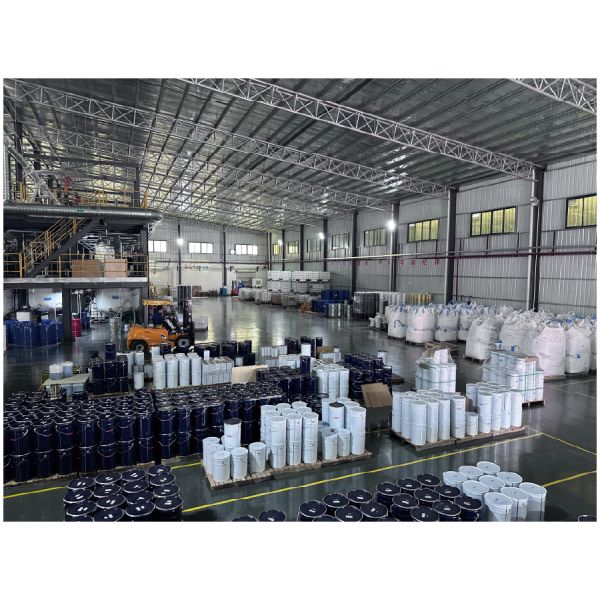
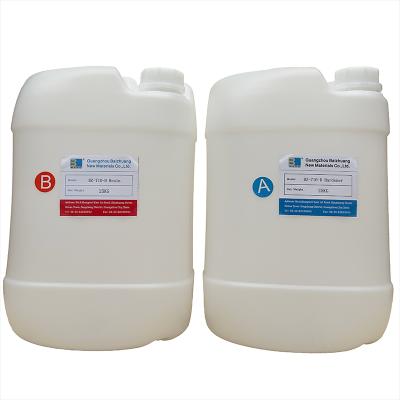
- Part A: Typically supplied in 10KG/20KG/25KG saled plastic drums.
- Part B: Typically supplied in10KG/20KG/25KG sealed plastic drums.
- Store and transport as a general chemical product.
- Store sealed, protected from light at room temperature. Shelf life varies from 6 to 12 months depending on packaging; please refer to the expiry date on the shipping package.
- When temperature drops to 15°C or lower, the hardener or resin should be stored in a warm place or heated before use for potting. Specific heating recommendations depend on the temperature drop; please communicate and consult with us.
FAQ:
Q1: What are the primary applications of Baizhuang Modified Epoxy Potting Compounds?
A1: Baizhuang's epoxy potting compounds serve diverse industrial needs, including:
- Water Treatment Systems: Sealing and bonding PVDF, UF, and RO membrane modules for municipal water purification, industrial wastewater treatment, and seawater desalination.
- Electronics & LED Manufacturing: Encapsulating precision sensors, LED pixel lights, and flexible strips to provide insulation, moisture protection, and mechanical stability.
- Craft & Signage: Creating crystal-clear photo frames, 3D LED signs, and decorative elements with glossy, durable finishes.
- Specialized Industrial Equipment: Protecting components in aerospace water systems, military-grade purification units, and high-pressure membrane separation systems.
Q2: What distinguishes "modified" epoxy potting compounds from standard epoxies?
A2: Baizhuang's modified formulations incorporate targeted additives to address specific application challenges:
- Flexibility Modifiers: Enhance impact resistance for mobile or seismic-prone equipment (e.g., BZ-609-1 for portable water treatment systems).
- Low-Temperature Curing Agents: Enable fast curing in cold environments without large heating facilities (e.g., EX605-45-2 for winter production).
- Filament-Safe Additives: Prevent damage to delicate PVDF membrane fibers during encapsulation (e.g., EX605 series for water treatment modules).
- UV Stabilizers: Resist yellowing in outdoor LED displays and craft applications (e.g., BZ-710-T for crystal photo encapsulation).
Q3: How do curing times vary across Baizhuang's epoxy product lines?
A3: Curing times are tailored to application needs, with options ranging from rapid to extended cycles:
- Fast-Curing Formulations: Cure in 2–6 hours at room temperature for high-volume production (e.g., BZ-710 series for LED modules).
- Standard Industrial Curing: Require 6–24 hours at room temperature for water treatment membrane modules (e.g., BZ-609, BZ-709 series).
- Extended Pot Life: Offer 4–6 hours of working time for complex assembly operations (e.g., EX605-35 for large-scale PVDF membrane systems).
- Heat-Accelerated Curing: Reduce cure time to 20 minutes–4 hours with temperatures between 60–80°C (e.g., BZ-306 for emergency repairs).
Q4: What chemical and environmental resistances do these compounds offer?
A4: Baizhuang's epoxies are engineered for harsh operating conditions:
- Moisture & Hydrolysis Resistance: Withstand continuous water immersion (IPX7 rating) and resist degradation in aqueous environments (e.g., EX605 series for membrane systems).
- Chemical Resistance: Resist acids, alkalis, organic solvents, and salt corrosion in industrial wastewater and marine applications (e.g., BZ-709 for landfill leachate treatment).
- UV & Weathering Resistance: Maintain color and mechanical properties in outdoor LED displays and craftworks (e.g., BZ-710-D for 3D signage).
- Thermal Stability: Perform reliably across -40°C to 85°C, with specialized formulations for high-temperature industrial processes.
Q5: How do temperature limits vary across different product lines?
A5: Temperature resistance is optimized for specific use cases:
- General Industrial Grade: Operate between -40°C to 85°C for most water treatment, electronics, and craft applications (e.g., BZ-604, BZ-710 series).
- High-Temperature Formulations: Withstand short-term exposure up to 120°C for industrial hot water treatment systems (e.g., EX605-35T for high-pressure RO pretreatment).
- Low-Tolerance Environments: Maintain flexibility and adhesion at -60°C for aerospace and polar exploration equipment (custom formulations available upon request).
- Thermal Shock Resistance: Endure rapid temperature cycles in mobile and military applications (e.g., BZ-609-1 for vehicle-mounted water purifiers).