Fast-Curing Water Treatment Membrane Epoxy Potting Compund
Product Overview
BZ-604 is a two-component epoxy resin optimized for rapid curing and excellent hydrolysis resistance, designed for sealing and bonding water treatment membrane components. Its low water absorption and fast curing cycle make it suitable for high-volume production lines in water treatment applications.
Core Advantages
- Rapid Curing Cycle: Fully cures in 9-12 hours at room temperature, supporting efficient production workflows
- Low Water Absorption: ≤0.25% water absorption ensures long-term performance in aqueous environments
- Excellent Hydrolysis Resistance: Resists degradation from continuous water exposure, extending membrane module lifespan
- Good Adhesion: Provides strong bonding to various membrane materials, including PVDF, PP, and ceramic membranes
- Balanced Viscosity: Mixed viscosity of 950-1550 mPa·s allows easy application while preventing excessive flow
Technical Parameters
|
Parameters
|
Resin
BZ-604 A
|
Hardener
BZ-604 B
|
|
Before curing
|
Appearance
|
Clear liquid
|
Light yellow
clear liquid
|
|
Viscosity(mPa·s.25℃)
|
1200-2000
|
250-750
|
|
Initial mixed viscosity(mPa·s.25℃)
|
950-1550
|
|
Density(g/cm³.25℃)
|
1.09±0.05
|
1.02±0.05
|
|
Mixing
&
Curing
|
Mix ratio(by weight)
|
A:B=3:1
|
|
Pot life 130±30g(min.25℃)
|
46-74min
|
|
Curing condition
|
Room temperature curing
|
|
Surface drying time 30g(H.25℃)
|
5-7H
|
|
Curing time 30g(H.25℃)
|
9-12H
|
|
Curing time 30g(Heated)
|
60℃ heated 1H
|
|
After curing
|
Color
|
Light yellow
|
|
Hardness (Shore D)
|
74±10
|
|
Temperature resistance(℃)
|
-40~85℃
|
|
Water absorption(24H)
|
≤0.25%
|
Target Applications
- Residential Water Purifier Cartridge Sealing: Seals end caps of PP cotton and activated carbon filters in household water purifiers, ensuring filtration efficiency and longevity
- Industrial RO Membrane Module Bonding: Bonds end plates of reverse osmosis (RO) and nanofiltration (NF) membranes, withstanding high-pressure water flow
- Ultrafiltration (UF) Membrane Assembly: Secures hollow fiber UF membranes, maintaining uniform filament spacing and improving filtration performance
- Laboratory Membrane Column Preparation: Enables rapid encapsulation of small-scale membrane separation columns for research applications
Critical Curing & Handling Precautions
- Temperature Sensitivity: Preheat materials when working below 15°C to maintain optimal flowability and curing speed
- Proper Mixing: Ensure thorough mixing of resin and hardener to avoid incomplete curing and performance degradation
- Clean Surface Preparation: Remove dust, grease, and moisture from membrane surfaces before application to ensure strong adhesion
-
Directions for Use
- Pre-potting Preparation: Calibrate scales, prepare potting tools, cleaning tools, check machine settings, check vacuum pump force, etc.
- Product Pre-treatment: Place product on a level surface or fixture. Remove dust, clean, degrease, and dry if necessary.
- Accurate Proportioning: Manual operation requires precise mixing according to the specified ratio and recording. Machine potting requires calibrated ratios and first-article confirmation is recommended.
- Mixing & Stirring: Manual operation requires thorough stirring or using electric stirrers to ensure homogeneous mixing. Machine potting requires sufficient stirring speed, adjust as needed.
- Uniform Potting: Manual operation should be done in small, multiple batches to ensure uniformity. Machine potting should follow the programmed path for quantitative dispensing.
- Inspection or Secondary Potting: After potting, visually inspect as needed. Perform touch-up, bubble removal, or secondary potting if required.
- Curing: Allow the potted and inspected products to cure at room temperature or with heat assistance (recommended 60°C if needed), according to product and process requirements.
- Final Product Confirmation: Perform visual inspection and performance testing as required by the customer.
9. This series of products are room-temperature-curing, addition-cure two-component silicone. During the dispensing process, avoid contact with the following three types of materials to prevent reactions that may affect the curing effect:
a. Organotin compounds and organotin-containing silicone rubber.
b. Sulfur, sulfides, and sulfur-containing materials.
c. Amine compounds and amine-containing materials.
10. It should be noted that during manual operation, when vacuumizing the mixed A+B adhesive, the vacuum pressure must be controlled to ensure the adhesive is not completely sucked out of the container by the vacuum.
Packing & Shipping & Storage
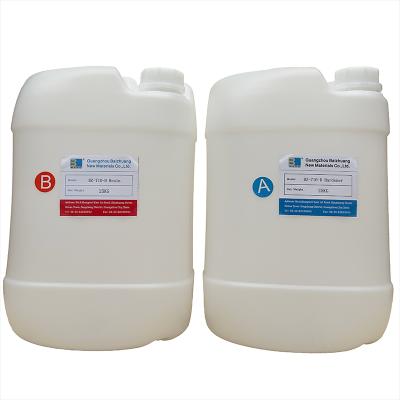
- Part A: Typically supplied in 10KG/20KG/25KG saled plastic drums.
- Part B: Typically supplied in10KG/20KG/25KG sealed plastic drums.
- Store and transport as a general chemical product.
- Store sealed, protected from light at room temperature. Shelf life varies from 6 to 12 months depending on packaging; please refer to the expiry date on the shipping package.
- When temperature drops to 15°C or lower, the hardener or resin should be stored in a warm place or heated before use for potting. Specific heating recommendations depend on the temperature drop; please communicate and consult with us.
FAQ:
Q1: What are the primary applications of Baizhuang Modified Epoxy Potting Compounds?
A1: Baizhuang's epoxy potting compounds serve diverse industrial needs, including:
- Water Treatment Systems: Sealing and bonding PVDF, UF, and RO membrane modules for municipal water purification, industrial wastewater treatment, and seawater desalination.
- Electronics & LED Manufacturing: Encapsulating precision sensors, LED pixel lights, and flexible strips to provide insulation, moisture protection, and mechanical stability.
- Craft & Signage: Creating crystal-clear photo frames, 3D LED signs, and decorative elements with glossy, durable finishes.
- Specialized Industrial Equipment: Protecting components in aerospace water systems, military-grade purification units, and high-pressure membrane separation systems.
Q2: What distinguishes "modified" epoxy potting compounds from standard epoxies?
A2: Baizhuang's modified formulations incorporate targeted additives to address specific application challenges:
- Flexibility Modifiers: Enhance impact resistance for mobile or seismic-prone equipment (e.g., BZ-609-1 for portable water treatment systems).
- Low-Temperature Curing Agents: Enable fast curing in cold environments without large heating facilities (e.g., EX605-45-2 for winter production).
- Filament-Safe Additives: Prevent damage to delicate PVDF membrane fibers during encapsulation (e.g., EX605 series for water treatment modules).
- UV Stabilizers: Resist yellowing in outdoor LED displays and craft applications (e.g., BZ-710-T for crystal photo encapsulation).
Q3: How do curing times vary across Baizhuang's epoxy product lines?
A3: Curing times are tailored to application needs, with options ranging from rapid to extended cycles:
- Fast-Curing Formulations: Cure in 2–6 hours at room temperature for high-volume production (e.g., BZ-710 series for LED modules).
- Standard Industrial Curing: Require 6–24 hours at room temperature for water treatment membrane modules (e.g., BZ-609, BZ-709 series).
- Extended Pot Life: Offer 4–6 hours of working time for complex assembly operations (e.g., EX605-35 for large-scale PVDF membrane systems).
- Heat-Accelerated Curing: Reduce cure time to 20 minutes–4 hours with temperatures between 60–80°C (e.g., BZ-306 for emergency repairs).
Q4: What chemical and environmental resistances do these compounds offer?
A4: Baizhuang's epoxies are engineered for harsh operating conditions:
- Moisture & Hydrolysis Resistance: Withstand continuous water immersion (IPX7 rating) and resist degradation in aqueous environments (e.g., EX605 series for membrane systems).
- Chemical Resistance: Resist acids, alkalis, organic solvents, and salt corrosion in industrial wastewater and marine applications (e.g., BZ-709 for landfill leachate treatment).
- UV & Weathering Resistance: Maintain color and mechanical properties in outdoor LED displays and craftworks (e.g., BZ-710-D for 3D signage).
- Thermal Stability: Perform reliably across -40°C to 85°C, with specialized formulations for high-temperature industrial processes.
Q5: How do temperature limits vary across different product lines?
A5: Temperature resistance is optimized for specific use cases:
- General Industrial Grade: Operate between -40°C to 85°C for most water treatment, electronics, and craft applications (e.g., BZ-604, BZ-710 series).
- High-Temperature Formulations: Withstand short-term exposure up to 120°C for industrial hot water treatment systems (e.g., EX605-35T for high-pressure RO pretreatment).
- Low-Tolerance Environments: Maintain flexibility and adhesion at -60°C for aerospace and polar exploration equipment (custom formulations available upon request).
- Thermal Shock Resistance: Endure rapid temperature cycles in mobile and military applications (e.g., BZ-609-1 for vehicle-mounted water purifiers).