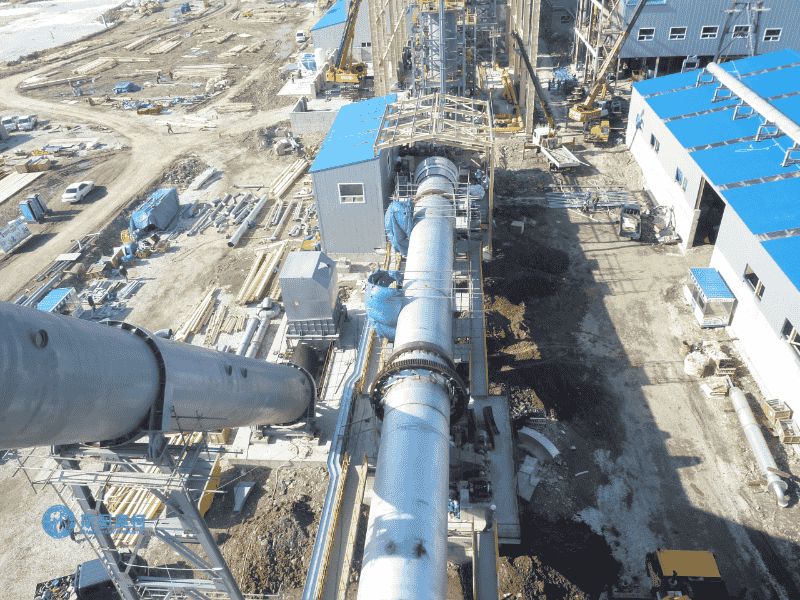
Steam activation rotary kiln for coconut shell activated carbon
1.Product Introduction Calcination Rotary Kiln
The Steam Activation Rotary Kiln is a high-temperature thermal processing system specifically designed for the continuous, large-scale production of coconut shell activated carbon. Utilizing high-quality coconut shells as raw material, the equipment employs a two-step process of carbonization and steam activation. In a high-temperature (typically 900–1,000°C), anaerobic or low-oxygen environment, water steam is used to deeply activate the carbonized material. This process carves out a highly developed porous structure within the carbon skeleton. Featuring an inclined rotating cylinder, precise temperature control, and advanced sealing, the kiln ensures uniform heating and continuous discharge for industrial-grade production of premium activated carbon.
2.Application Calcination Rotary Kiln
- Drinking Water Purification: The produced carbon is widely used in residential and industrial water filters to efficiently remove residual chlorine, odors, and organic pollutants (such as trihalomethanes).
- Gold Extraction: Due to its superior adsorption capacity for gold-cyanide complexes, it is the core adsorbent used in Carbon-in-Pulp (CIP) and Carbon-in-Leach (CIL)processes in gold smelting.
- Air Purification: Utilized in HVAC systems, refrigerators, automotive deodorizers, and industrial off-gas treatment to adsorb formaldehyde, benzene series, and hazardous gases.
- Food & Pharmaceutical Refining: Used for decolorization, deodorization, and solvent recovery in the MSG, beverage, and pharmaceutical industries.
- Environmental Remediation: Treating industrial wastewater and waste gases containing heavy metals and organic pollutants to support emission reduction.
3.Working Principle Calcination Rotary Kiln
- Raw Material Pretreatment: Coconut shells are crushed and screened before being fed into a carbonization furnace, where initial pyrolysis generates the carbonized intermediate.
- Rotary Kiln Activation: The carbonized material enters the inclined rotary kiln. As the kiln shell rotates slowly, the material moves from the high end toward the discharge end. High-temperature water steam is introduced from the lower end, achieving counter-current contact with the carbon.
- Steam Activation Reaction: At 900–1,000°C, the steam reacts with carbon . This chemical etching of the carbon skeleton creates a vast network of micropores and mesopores, significantly increasing the specific surface area to over 1,100 m²/g.
- Cooling & Collection: The activated carbon is cooled via a dedicated system before being screened and packaged as the final product.
4.Advantages Calcination Rotary Kiln
- Continuous Production: The rotary kiln supports 24/7 continuous operation with high automation (PLC control), drastically increasing capacity and batch stability.
- Uniform Activation: The rotation of the kiln shell ensures even heat distribution. Combined with precise temperature and steam regulation, this achieves consistent and repeatable pore structures.
- Energy Saving Eco-Friendly: Modern units are equipped with waste heat recovery systems that can preheat secondary air to over 700°C, lowering energy consumption. The sealed design minimizes off-gas leakage.
- Sustainable Raw Material: By utilizing coconut shells—a renewable resource—the process turns agricultural waste into high-value products, aligning with green manufacturing trends.
5.Technical Specifications
| Model |
Speed (r/min) |
Inclination (%) |
Capacity (t/h) |
Gearbox Model |
Ratio |
Motor Model |
Motor Power (kW) |
Motor Speed (r/min) |
Thrust Roller Type |
Support Count |
Weight (t) |
| Φ1.9/1.6x36 |
0.53-1.59 |
4 |
2.5-3 |
JZQ750-1 |
48.58 |
JZT-72-4 |
30 |
1200/400 |
Mechanical |
3 |
53 |
| Φ2.1/1.8x36 |
0.5-1.51 |
4 |
4 |
UT2-110 |
163.38 |
JZS-81 |
30/10 |
1410/470 |
.. |
3 |
75 |
| Φ1.2x25 |
0.5-1.6 |
3 |
|
PM650 |
40.17 |
JZTY71-4 |
22 |
1200/120 |
.. |
3 |
34 |
| Φ1.6x32 |
0.158-0.258 |
3 |
|
PM750 |
48.57 |
JZJY61-4 |
15 |
1200/120 |
.. |
3 |
46.82 |
| Φ1.8x45 |
0.66-1.98 |
4 |
3.5 |
UT2-110 |
163.38 |
JZS-81 |
30/10 |
1410/470 |
.. |
3 |
80 |
| Φ2.2x50 |
0.125-1.25 |
3.5 |
4 |
ZS145-11 |
157 |
YCT280-4A |
30 |
1320/132 |
.. |
3 |
130.71 |
| Φ2.5x50 |
0.516-1.549 |
3.5 |
5.5 |
ZS165-7 |
99.96 |
YCT355-4A |
55 |
1320/440 |
.. |
3 |
167.5 |
| Φ3x48 |
0.3309-3.309 |
3.5 |
35 |
ZL130-14 |
32.11 |
ZSN4-250-21B |
90 |
1000/100 |
.. |
3 |
237 |
| Φ3.2x50 |
0.398-3.975 |
3.5 |
50 |
ZL130-16 |
40.85 |
ZSN4-280-11B |
190 |
1500/150 |
.. |
3 |
263 |
| Φ3.3x52 |
0.391-3.91 |
3.5 |
50 |
ZSY500-28 |
27.707 |
ZSN4-315-082 |
190 |
1000/100 |
.. |
3 |
280.8 |
| Φ4x60 |
0.396-3.96 |
3.5 |
104 |
ZSY630-35.5 |
34.601 |
ZSN4-355-092 |
315 |
1000/100 |
Hydraulic |
3 |
487.5 |
| Φ4.2x60 |
0.4165-4.165 |
3.5 |
116 |
ZSY710-35.5 |
35.526 |
ZSN4-355-12 |
420 |
1000/100 |
.. |
3 |
576.1 |
| Φ4.3x62 |
0.398-3.98 |
3.5 |
125 |
ZSY710-35.5 |
35.714 |
ZSN4-355-12 |
420 |
1000/100 |
.. |
3 |
598.5 |
| Φ4.8x74 |
0.35-4 |
4 |
208 |
JH710C-SW305-40 |
42.226 |
ZSN4-400-092 |
630 |
1500/130 |
.. |
3 |
841 |
6.Our Solutions