Type S Thermocouple Wire (0.35mm Diameter)
Product Overview
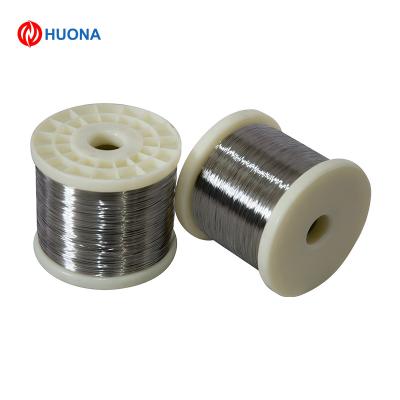
Type S thermocouple wire (as shown) from Huona New Material is a high-precision noble metal temperature sensing wire, composed of Platinum-Rhodium 10% (Positive) and Pure Platinum (Negative). Manufactured with ultra-fine drawing process and strict quality control, it provides stable thermoelectric output and high accuracy at high temperature. Ideal for high-temperature furnace monitoring, laboratory research, ceramic sintering, heat treatment and precision temperature measurement, it offers excellent oxidation resistance, high temperature stability and long service life.
Standard Designations & Core Material Foundation
- Thermocouple Type: Type S (PtRh10-Pt; compliant with IEC 60584-2 Class 1)
- Key Specification:
- Diameter: 0.35mm; tolerance: ±0.01mm
- Conductor structure: Solid single wire
- Core Material:
- Positive (SP): PtRh10 (Platinum 90%, Rhodium 10%)
- Negative (SN): Pure Platinum (Pt ≥99.99%)
- Compliant Standards: IEC 60584-2, ASTM E230, GB/T 4989, RoHS 2.0
- Manufacturer: Huona New Material, certified to ISO 9001 and IATF 16949
Key Core Advantages (Centered on Noble Metal & High Precision)
1. Ultra-High Temperature Stability
- Continuous Operation: Up to 1400℃, short-term up to 1600℃, suitable for extreme high-temperature industrial environments.
- Thermoelectric Stability: Stable EMF output with minimal drift under long-term high-temperature exposure, ensuring reliable measurement data.
2. High Precision & Excellent Linearity
- Class 1 Accuracy: Thermoelectric potential error ≤±1.0℃ (0–1100℃) / ±0.1% t (1100–1400℃), meeting the highest precision requirements for temperature measurement and calibration.
- Good Linearity: Consistent thermoelectric characteristics across the entire temperature range, simplifying data processing and system calibration.
3. Superior Oxidation & Corrosion Resistance
- Noble Metal Advantage: Platinum-based composition provides excellent oxidation resistance in oxidizing and inert atmospheres, preventing performance degradation in high-temperature environments.
- Low Contamination: High-purity materials ensure minimal contamination, suitable for high-purity processes such as semiconductor manufacturing and ceramic sintering.
4. Fine Diameter & Flexible Processability
- Ultra-Fine Diameter: 0.35mm diameter enables fast thermal response (τ₅₀ ≤0.5s in air at 1000℃) and installation in narrow spaces.
- High Flexibility: Good bending performance, not easy to break during winding, welding, and assembly into sensors.
5. Consistent Mechanical Properties
- Uniform Diameter: Strict tolerance control ensures consistent diameter and surface finish across batches, reducing processing variability.
- High Surface Quality: Bright, clean, oxide-free surface ensures reliable soldering and contact performance.
Technical Specifications
| Attribute |
Value (Typical) |
| Thermocouple Type |
Type S (PtRh10-Pt) |
| Diameter |
0.35mm, Tolerance ±0.01mm |
| Conductor Type |
Solid wire |
| Continuous Operating Temperature |
0 ~ 1400℃ |
| Short-term Temperature |
Up to 1600℃ |
| Accuracy Class |
Class 1 (IEC 60584-2) |
| Thermoelectric Potential Error |
±1.0℃ (0–1100℃); ±0.1% t (1100–1400℃) |
| Thermal Response Time (τ₅₀) |
≤0.5s (in air at 1000℃) |
| Insulation |
Uninsulated (bare wire) |
| Surface Condition |
Bright, clean, oxide-free |
| Tensile Strength (25℃) |
≥180MPa |
| Elongation (25℃) |
≥25% |
Product Specifications
| Item |
Specification |
| Supply Form |
Spool / Coil |
| Length |
Customizable, MOQ 200 meters |
| Surface |
Bright bare wire |
| Packaging |
Anti-oxidation bag + carton box (prevents oxidation and damage during shipping) |
| Customization |
Diameter (0.2–1.0mm); insulated version (ceramic/fiberglass insulation); custom length; spool size |
| Processability |
Suitable for winding, welding, crimping, and assembly into thermocouple probes and sensors |
Typical Application Scenarios
- High-Temperature Industrial Furnaces: Temperature monitoring in ceramic kilns, sintering furnaces, and metal melting furnaces (1400℃ continuous operation).
- Laboratory & Calibration: Precision temperature measurement and standard calibration in research institutes and metrology laboratories.
- Metal Heat Treatment: Temperature control in forging, annealing, and quenching processes for high-alloy steels and special metals.
- Aerospace & Defense: High-temperature sensor applications in rocket engines, hypersonic vehicles, and aerospace testing.
- Semiconductor & Advanced Manufacturing: High-purity temperature monitoring in semiconductor wafer processing and advanced material synthesis.