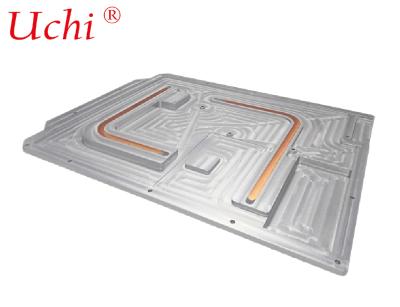
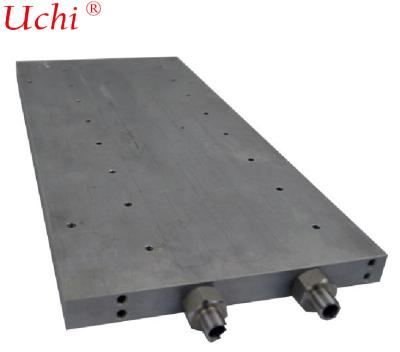
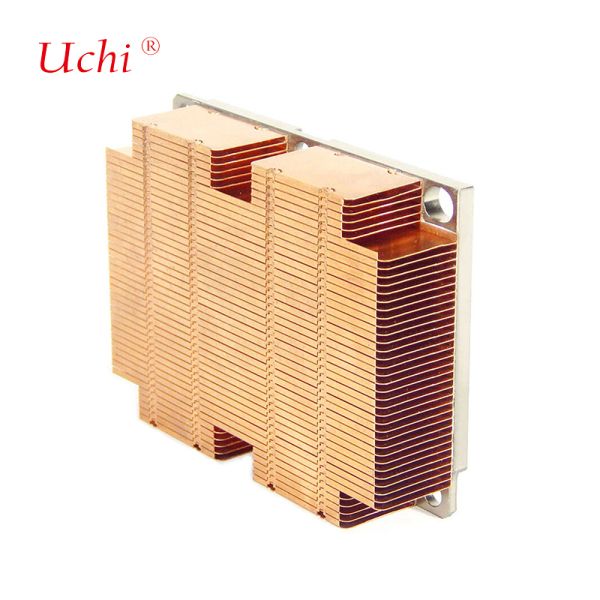
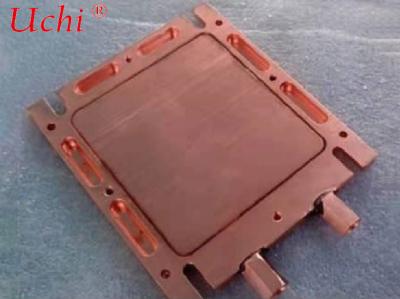
Vacuum Brazed Liquid Cold Plate Heat Exchanger Hard Anodizing for Optical Module
Brand Name: YY Thermal
Size: Custom size
Process: Vacuum Brazing
Material: AL6063
Shape: Square
Finish: Hard anodizing
Quality control: 100% test before shipping
Extra process: CNC Machining
Application: Liquid Cold Plate
Certificate: ISO 9001:2015, ISO 14001:2015
Packing: Fiber Optic Disc Carton, EPE, wooden pallet
Vacuum brazed liquid cold plate is a high-performance liquid cooling component manufactured via vacuum brazing technology, mainly used for high-efficiency heat dissipation in high-power-density equipment. By circulating coolant through sealed internal channels to directly remove heat from heat sources, it has become a mainstream solution in high-end thermal management thanks to its core advantages: oxidation-free, high tightness, low deformation, and excellent corrosion resistance.
Core Manufacturing Principle & Process
Vacuum brazing is a welding process performed in a vacuum environment (10⁻³~10⁻⁵ mbar):
- Assembly: Precisely stack the base plate with machined flow channels, brazing foil (Al‑Si, Cu‑P, etc.), and cover plate.
- Vacuum Heating: Place the assembly into a vacuum furnace, evacuate the air, then heat to the melting point of brazing filler metal (approx. 577℃-600℃), which is lower than the melting point of the base metal (aluminum/copper).
- Capillary Filling: The molten brazing filler fills all gaps between the base plate, cover plate, and internal fins via capillary action.
- Metallurgical Bonding: Atomic diffusion occurs between liquid brazing filler and base metal; upon cooling, it forms high-strength, high-thermal-conductivity, fully sealed integrated joints.
- Cooling & Forming: Slow cooling under vacuum minimizes thermal stress and ensures zero workpiece deformation.
Core Material Options
- Aluminum Alloy (6061/6063): Most widely used — high thermal conductivity, lightweight, low cost, and easy to machine.
- Copper (C1100/T2): Best thermal performance, ideal for ultra-high heat flux applications such as AI chips and IGBTs.
- Stainless Steel / Titanium Alloy: Used for special harsh environments requiring high corrosion and temperature resistance (aerospace, chemical industry).
Key Performance Advantages
- Ultra-Clean & Oxidation-Free: Vacuum environment eliminates oxidation, flux residue, porosity, and corrosion risks.
- Strong Sealing & Pressure Resistance: Monolithic structure with zero leakage; typical pressure rating 1-10 MPa.
- Extremely Low Thermal Resistance & High Efficiency: Near‑zero welding thermal resistance; combined with microchannels/fins, thermal resistance can reach as low as 0.02℃*cm²/W.
- Precise Structure & Minimal Deformation: Uniform overall heating ensures high flatness, suitable for precision electronic components.
- High Design Flexibility: Supports complex channels, multi-path layouts, microchannels (0.5 mm), embedded fins, etc.
- Long Service Life & High Reliability: Corrosion‑free and loosening‑free; industrial service life exceeds 10 years.
Typical Internal Flow Channel Structures
- Single-Layer Grooved Channel: Base plate with machined grooves + cover plate; simple structure for low‑to‑medium power.
- Offset / Louvered Folded Fins: Embedded corrugated or serrated fins greatly increase heat exchange area and fluid turbulence; preferred for AI and high-performance computing.
- Skived Fin: Fins integrally cut from the base plate, eliminating contact thermal resistance for extremely high thermal conductivity.
- Microchannel Structure: 50-150 μm scale channels, heat flux > 350 W/cm², ideal for SiC/GaN power modules.
Main Application Fields
- AI & Data Centers: Liquid cooling plates for GPUs (NVIDIA H100/H200, A100, etc.) and server cold plates.
- New Energy Vehicles: Power battery pack cold plates, motor control units (MCU), OBC, and IGBT cooling.
- Energy Storage & Power Electronics: PCS, SVG, photovoltaic inverters, high-voltage inverters.
- Aerospace & Defense: High-reliability cooling for radar, laser equipment, and satellite payloads.
- Medical & Lasers: Precision temperature control for CT, MRI, and high-power lasers.
Vacuum Brazing vs. Other Processes
| Properties |
Vacuum Brazing |
Friction Stir Welding (FSW) |
TIG Welding |
Adhesive / Mechanical Seal |
| Seal Performance |
Excellent (zero leakage) |
Good |
Fair (prone to leakage) |
Poor (aging issues) |
| Internal Structure |
Complex channels / fins |
Simple channels |
Simple channels |
Simple channels |
| Thermal Resistance |
Extremely low |
Low |
High |
Extremely high |
| Temp./Pressure Res. |
High |
Medium |
Low |
Low |
| Surface Quality |
Bright, no oxidation |
Average |
Weld marks visible |
Poor |
| Cost |
Medium‑high |
Medium |
Low |
Low |
Summary
Vacuum brazed liquid cold plate represents the gold standard for high-performance thermal management, perfectly balancing thermal conductivity, structural strength, sealing reliability, and design flexibility.