Tailored for Laboratory Use
The FES200 is specifically engineered to meet the unique needs of laboratory environments, where the presence of fumes and particles can be a major concern. Its efficient filtration system is designed to handle hazardous airborne substances commonly found in labs.
Customizable Extraction Power
With adjustable suction power, the FES200 ensures that it can be tailored to specific lab applications, whether dealing with minimal fume production or heavy emissions, providing consistent and effective extraction.
Health-Conscious Design
The FES200 prioritizes the health and safety of lab personnel by removing harmful contaminants from the air, contributing to a cleaner and safer work environment for researchers and technicians.
Quiet and Efficient
Its low noise operation ensures that the FES200 can be used in environments where peace and concentration are essential, such as research labs, without compromising on its efficiency in fume extraction.
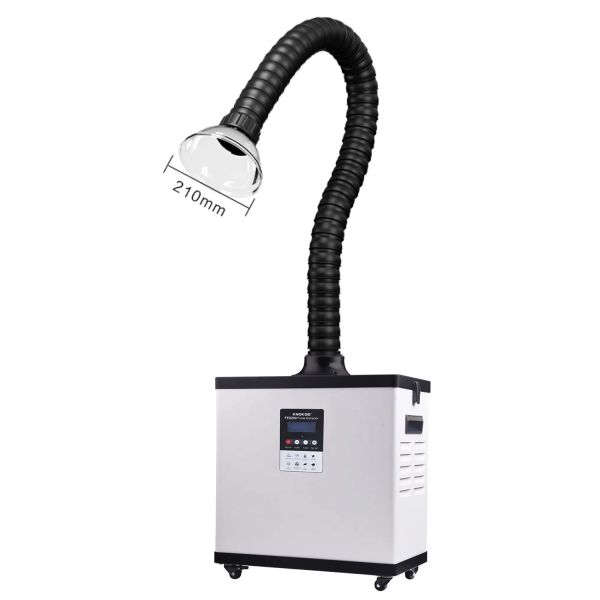
| Product Name | Lab Fume Extractors |
| Model | FES200 |
| Cover type | 8 In Acrylic Cover |
| Colour | white |
| Air Intake | ∅75mm |
| Vac | AC220V 50Hz |
| Power | 200W |
| Filtering Efciency | 0.3um 99.99% |
| Noise | <60dB |
| Length of Duct | ∅75mm X 1.3m |
| Air Volume | 310M³/h |
| Warranty | 1 Years |
| Dimensions | 420x240x450mm |
| Weight(No Smoking Arm) | 16 kg |
The FES200 Lab Fume Extractor is suitable for a wide range of laboratory environments where fumes, gases, or particles need to be removed for health,
safety, and comfort. Common applications include:
Chemical Laboratories
In chemical research labs, where reactions or experiments produce fumes, vapors, or gases, the FES200 ensures that harmful substances do not accumulate in the air, protecting both the staff and the integrity of the experiments.
Forensic and Material Testing Labs
Laboratories that conduct forensic testing or material analysis often produce fumes from chemical tests or combustion processes.
The FES200 helps ensure that toxic gases and particles are captured before they enter the air.
Educational and Research Institutions
The FES200 is ideal for use in educational institutions and research facilities where labs are frequently used for experiments and chemical testing, ensuring a safe environment for students and staff alike.
Manufacturing and Production Labs
Labs in manufacturing settings, such as those involved in product development or quality control, benefit from the FES200 by removing airborne contaminants generated during product testing or chemical processing.
1. What laboratory applications is the KNOKOO FES200 suitable for?
The KNOKOO FES200 can be considered for localized fume and particle extraction during laboratory soldering, electronics prototyping, and selected sample preparation tasks. Suitability depends on the materials, pollutant concentration, and operating conditions.
2. How does the FES200 filtration system work?
The filtration system combines high-efficiency particle filtration with activated carbon adsorption. The particle filter captures airborne particles, while activated carbon helps reduce certain gaseous pollutants and odors. Filter selection should match the specific laboratory process.
3. Can the FES200 extract chemical vapors and solvent odors?
Suitability must be assessed for each chemical. Please provide the chemical names, safety data sheets, quantities used, and operating temperatures. Activated carbon does not capture every gas, and a standard filter configuration should not be assumed suitable for all laboratory vapors.
4. Can the FES200 replace a laboratory fume hood?
No. The FES200 is a localized extraction unit and should not be treated as a replacement for a laboratory fume hood, biological safety cabinet, or other required containment equipment. Choose extraction equipment according to your laboratory’s process risk assessment.
5. How should the extraction hood be positioned?
Place the hood close to the emission source without obstructing the procedure. Arrange it so fumes move toward the hood without passing through the operator’s breathing zone. Keep the duct short and minimize sharp bends to support effective capture.
6. Can one unit support multiple laboratory workstations?
This depends on simultaneous airflow demand, pollutant types, and duct layout. Please provide the number of extraction points and operating details for assessment. Processes involving incompatible substances should not share an extraction system.
7. When should laboratory users replace the filters?
Replacement frequency depends on pollutant loading, chemical properties, and operating hours. Check for reduced airflow and follow the supplied maintenance instructions. For gaseous pollutants, use an assessed replacement schedule rather than relying on odor alone.
8. Does KNOKOO offer OEM/ODM customization for laboratory projects?
Yes. KNOKOO can review customization requests for branding, housing appearance, extraction hoods, duct connections, filter configurations, and control functions. Available options, minimum order quantities, and lead times depend on engineering assessment.
9. What warranty and technical support are available?
KNOKOO provides a one-year warranty, excluding filter consumables, subject to the agreed warranty terms. After-sales support includes installation guidance, maintenance advice, remote troubleshooting, and replacement part assistance.
10. What certifications and documents can KNOKOO provide?
Contact KNOKOO to confirm applicable CE, RoHS, and FCC documentation, relevant MSDS/SDS documents, and the manufacturer’s ISO 9001 quality management certificate. Document availability and scope depend on the exact FES150D configuration and destination market. These documents do not establish suitability for every laboratory chemical or process.