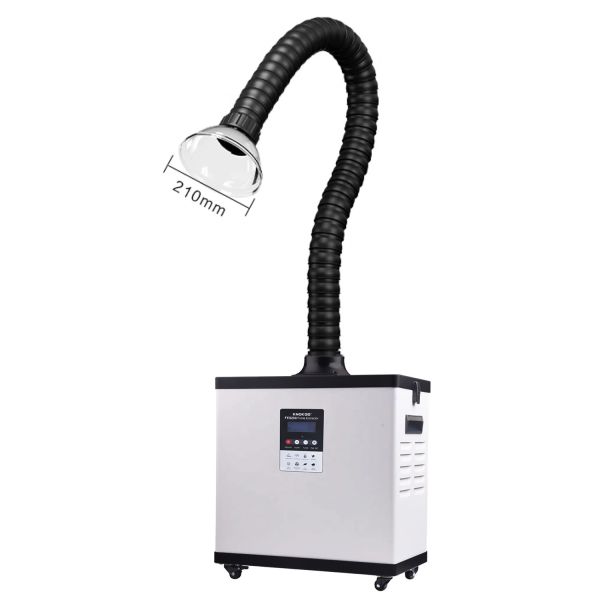
The laboratory smoke purifier uses advanced air purification technology to effectively remove smoke, harmful gases, particles and other pollutants in the laboratory air through physical filtration, chemical adsorption or biological purification, ensuring that the air quality in the laboratory is safe. standard. These equipment are widely used in various laboratories such as chemistry, biology, and physics to provide a clean and safe working environment for scientific researchers.
| Model | FES150D |
| Color | Azure |
| Cover type | 8 inch acrylic round cover |
| Noise | <55dB |
| Filtering Efficiency | 0.3um 99.99% |
| Vac | AC220V 50Hz |
| Power | 150W |
| Air Volume | 278m³/h |
| Filter Layer | 3 Stage |
| Controls | LCD display |
| Dimensions(mm) | 280*240*315(L*W*H) |
| Weight | 13Kg |
Package contents:
1*Host
1*Bamboo tube
1*6 inch acrylic round cover
5*Primary effect cotton
1*Middle Filter
1*Main filter
1*Instruction manual
1*Power cord
Chemical laboratory: removal of harmful gases and fumes produced during chemical reactions.
Biological laboratory: The removal of bacteria, viruses and other microbial aerosols produced during biological experiments.
Physics laboratory: Remove smoke and particles generated during laser experiments, high-energy physics experiments, etc.
Medical laboratory: to remove the smoke and harmful gases generated in the process of surgery, laser treatment, etc., to ensure the health of patients and medical staff
1. What laboratory applications is the KNOKOO FES150D suitable for?
The KNOKOO FES150D can be considered for localized fume and particle extraction during laboratory soldering, electronics prototyping, and selected sample preparation tasks. Suitability depends on the materials, pollutant concentration, and operating conditions.
2. How does the FES150D filtration system work?
The filtration system combines high-efficiency particle filtration with activated carbon adsorption. The particle filter captures airborne particles, while activated carbon helps reduce certain gaseous pollutants and odors. Filter selection should match the specific laboratory process.
3. Can the FES150D extract chemical vapors and solvent odors?
Suitability must be assessed for each chemical. Please provide the chemical names, safety data sheets, quantities used, and operating temperatures. Activated carbon does not capture every gas, and a standard filter configuration should not be assumed suitable for all laboratory vapors.
4. Can the FES150D replace a laboratory fume hood?
No. The FES150D is a localized extraction unit and should not be treated as a replacement for a laboratory fume hood, biological safety cabinet, or other required containment equipment. Choose extraction equipment according to your laboratory’s process risk assessment.
5. How should the extraction hood be positioned?
Place the hood close to the emission source without obstructing the procedure. Arrange it so fumes move toward the hood without passing through the operator’s breathing zone. Keep the duct short and minimize sharp bends to support effective capture.
6. Can one unit support multiple laboratory workstations?
This depends on simultaneous airflow demand, pollutant types, and duct layout. Please provide the number of extraction points and operating details for assessment. Processes involving incompatible substances should not share an extraction system.
7. When should laboratory users replace the filters?
Replacement frequency depends on pollutant loading, chemical properties, and operating hours. Check for reduced airflow and follow the supplied maintenance instructions. For gaseous pollutants, use an assessed replacement schedule rather than relying on odor alone.
8. Does KNOKOO offer OEM/ODM customization for laboratory projects?
Yes. KNOKOO can review customization requests for branding, housing appearance, extraction hoods, duct connections, filter configurations, and control functions. Available options, minimum order quantities, and lead times depend on engineering assessment.
9. What warranty and technical support are available?
KNOKOO provides a one-year warranty, excluding filter consumables, subject to the agreed warranty terms. After-sales support includes installation guidance, maintenance advice, remote troubleshooting, and replacement part assistance.
10. What certifications and documents can KNOKOO provide?
Contact KNOKOO to confirm applicable CE, RoHS, and FCC documentation, relevant MSDS/SDS documents, and the manufacturer’s ISO 9001 quality management certificate. Document availability and scope depend on the exact FES150D configuration and destination market. These documents do not establish suitability for every laboratory chemical or process.