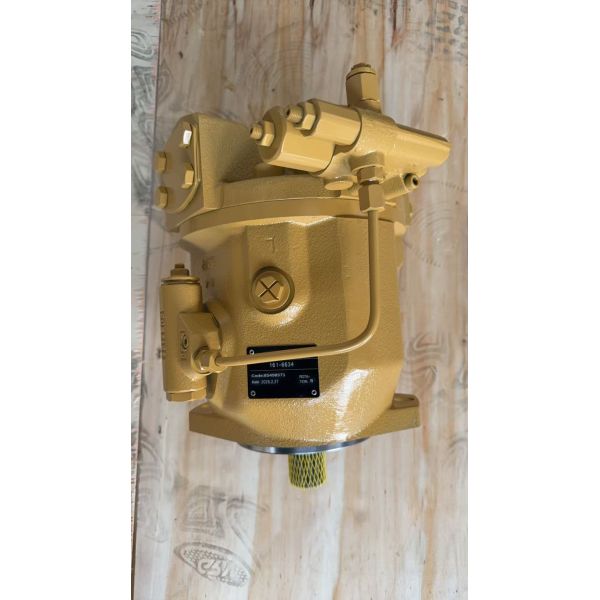
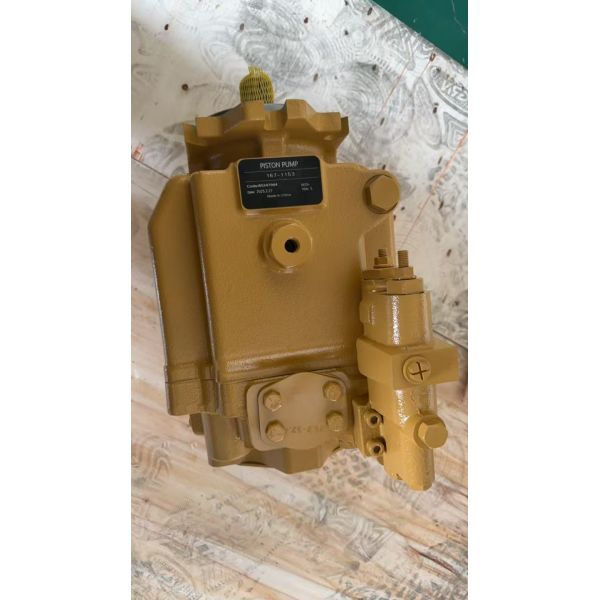
The 168-9027 (superseding 0R-0858 reman designation) hydraulic pump is a compact-form-factor gear pump purpose-built for CCAT's small-frame wheel loader family: the 924G, 924GZ, 924H, and 924HZ. These 2.2-2.5 m³ bucket capacity loaders are the workhorses of urban construction, landscaping, agricultural material handling, and small-scale quarry support. The 168-9027 pump must deliver full implement hydraulic flow within a significantly tighter engine bay compared to larger loaders, where space constraints limit pump envelope dimensions while the hydraulic demand remains proportionally high relative to the machine's engine power (the 924H's 128 HP engine drives a hydraulic system that requires pump efficiency above 90% to avoid robbing power from the drivetrain during combined travel-and-lift operations).
ProblemThe defining failure signature of the 168-9027 pump in 924-series loaders is a phenomenon fleet managers call "power sag"—a simultaneous loss of both hydraulic speed and travel acceleration when the operator commands lift while driving. Because the 924-series uses a single hydraulic pump driven from the engine PTO, a pump with reduced volumetric efficiency (below 85%) diverts a disproportionate share of engine power to maintain hydraulic pressure, starving the torque converter of available horsepower. The operator experiences this as: the loader bucket lifts slowly AND the machine decelerates at the same time. On 924H models equipped with the Advanced Productivity Electronic Control System (APECS), this power sag triggers the transmission control module to downshift aggressively to compensate, creating a jerky, non-productive operating cycle. Compact loader operators—who are typically less specialized than quarry loader operators—often attribute power sag to "the engine getting tired" and defer investigation, compounding the problem. By the time the pump is diagnosed, the torque converter may have accumulated 500-800 hours of operation under power-starvation conditions, significantly accelerating converter stator clutch wear and potentially adding a USD 6,000-8,000 torque converter rebuild to what should have been a USD 2,000 pump swap.
CauseThe 168-9027 pump's compact design—while necessary for the 924-series engine bay—creates inherent thermal challenges. The pump housing has approximately 30% less external surface area per unit of internal displacement than an equivalent pump in a larger loader, reducing its ability to reject heat to the surrounding engine compartment air. Compact loaders in agricultural and landscaping applications often operate in high-ambient conditions (35-40°C / 95-104°F) with airborne organic debris (chaff, grass clippings, wood chips) that accumulates on the engine bay surfaces, further insulating the pump and reducing convective cooling. Pump case temperature measurements in 924-series loaders show sustained operating temperatures of 95-105°C, approximately 15-20°C higher than the equivalent pump in a 950-series loader under the same duty cycle. At these elevated temperatures, the hydraulic oil viscosity drops to 8-12 cSt (compared to the optimal 20-30 cSt), reducing the oil film thickness in the gear-to-housing clearance gap from approximately 2.5 microns to below 1 micron. At film thicknesses below 1 micron, the lubrication regime transitions from full-film hydrodynamic to boundary lubrication, where metal-to-metal contact between gear teeth and the housing bore becomes inevitable. This boundary-contact wear is the primary driver of the accelerated clearance growth that causes the power-sag symptom.
SolutionOur 168-9027 replacement pump addresses the thermal challenge through materials engineering and internal geometry optimization. The gear tooth flanks are coated with a tungsten disulfide (WS₂) solid lubricant film applied via a low-temperature PVD process to a thickness of 0.5-0.8 microns. WS₂ has a lamellar crystal structure similar to graphite but with superior thermal stability—its coefficient of friction remains below 0.05 up to 450°C, well beyond the pump's maximum operating temperature. This solid lubricant layer provides effective lubrication even when the oil film thickness drops below the boundary regime threshold at elevated temperatures, preventing metal-to-metal contact during the high-temperature operating window. The housing incorporates internal oil galleries that direct a small bleed flow (approximately 0.5 L/min taken from the outlet side) through drilled passages in the housing wall adjacent to the bearing journals, creating a targeted cooling circuit that reduces bearing zone temperature by 8-12°C during sustained full-load operation. This internal cooling circuit is entirely passive—no external lines or modifications required—and the bleed flow is returned to the inlet side of the pump with zero net flow loss. Each pump undergoes a thermal endurance test: 8 hours of continuous operation at 2,000 RPM and 3,000 PSI with the pump case temperature held at 105°C via external heating, followed by a volumetric efficiency measurement. The acceptance criterion is >90% efficiency after thermal soak, which exceeds the OEM specification for this pump class.
Key Features| Parameter | Specification |
|---|---|
| Part Number | 168-9027 (Supersedes 0R-0858 Reman) |
| Pump Type | External Gear Pump (Compact Loader-Spec) |
| Displacement | Refer to OEM Specification (Approx. 40-50 cc/rev) |
| Continuous Operating Pressure | 3,000 PSI (207 bar) |
| Rated Speed Range | 600-2,400 RPM |
| Gear Surface Coating | WS₂ (Tungsten Disulfide), 0.5-0.8 μm, Friction Coeff. < 0.05 |
| Internal Cooling | Passive Bearing-Zone Bleed Circuit (0.5 L/min) |
| Housing Material | High-Strength Cast Iron (HT250) |
| Gear Material | 20CrMnTi Case-Hardened Alloy Steel (HRC 58-62) |
| Seal Material | FKM with High-Temp Backup Ring |
| Net Weight | Approx. 8-12 kg |
| Certification | ISO 9001:2015, Thermal Endurance Test Certificate Included |
The 168-9027 hydraulic pump is designed for the following CCAT compact wheel loader platforms:
Each 168-9027 pump is packaged in a compact export-grade plywood case with custom-fit closed-cell foam inserts. The pump is vacuum-sealed in VCI barrier film with integrated humidity indicator. All ports receive desiccant-loaded plugs with tamper-evident seals. Documentation includes: serial-numbered quality certificate, thermal endurance test report (8-hour 105°C protocol with pre/post efficiency data), CMM dimensional verification, and installation instructions. Digital records with 5-year traceability. Emergency same-day dispatch is available from regional warehouse stock for verified breakdown situations.