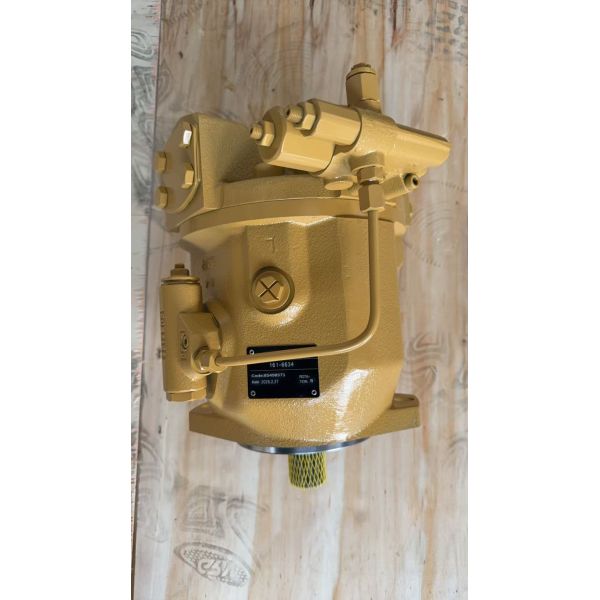
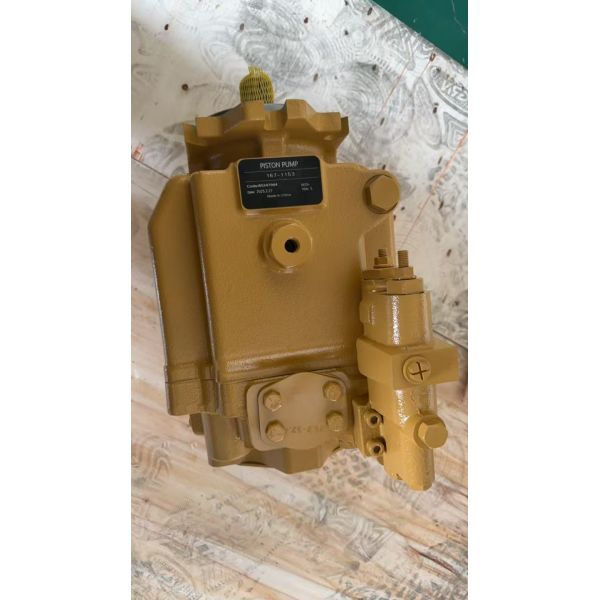
The 297-6999 hydraulic pump is a multi-application gear pump engineered for CCAT industrial and petroleum engine platforms spanning the C9, C9.3, C11, C13, C15, and C18 engine families. Unlike machine-mounted pumps that power implement hydraulics, this pump serves as the engine-driven auxiliary hydraulic power source for industrial engine applications including generator sets, industrial power units, petroleum drilling rigs, frac pump drives, and marine propulsion auxiliary systems. The pump is driven from the engine's front accessory drive (FAD) or rear PTO and provides hydraulic flow for cooling fan drives, lubrication oil circulation, fuel transfer, and other engine-mounted auxiliary functions in continuous-duty industrial and petroleum applications.
ProblemThe defining operational challenge for the 297-6999 pump is continuous-duty reliability in unmanned or remotely-monitored installations. Unlike construction equipment where an operator can detect early pump symptoms, industrial engine installations—particularly petroleum wellhead pump drives and remote generator sets—operate 24/7/365 with only periodic walk-around inspections. A pump failure in these applications often goes undetected until the secondary system it supports (cooling fan, lube oil circulation, fuel transfer) fails, triggering an engine shutdown. In a petroleum wellhead application, an unplanned engine shutdown can stop production at 500-2,000 barrels per day, representing USD 35,000-140,000 in lost revenue per day at current oil prices. The pump's failure mode in continuous-duty applications is almost always bearing failure: the sustained high-speed operation (typically 2,200-2,400 RPM with no idle periods) generates continuous bearing load with no thermal cycling relief. Unlike cyclic-duty pumps that experience a damaging-but-recoverable wear pattern, continuous-duty bearing wear is inexorable and accelerates after approximately 85% of the bearing's design life is consumed.
CauseContinuous-duty bearing failure in industrial engine pumps is driven by the absence of thermal cycling. In cyclic-duty applications (excavators, loaders), the pump cools during idle periods, allowing the oil film in the bearing to re-establish full thickness and transport wear debris out of the bearing clearance. In continuous-duty applications, the bearing operates at steady-state temperature (85-95°C) with oil viscosity at the lower end of its range (8-12 cSt), and the hydrodynamic bearing clearance never has an opportunity to recover from the slight eccentricity that develops under sustained radial load. This sustained loading causes a phenomenon called "bearing creep"—the outer race of the bearing slowly rotates within the housing bore due to the continuous friction torque from the rotating shaft. Creep rates of 0.01-0.05 mm per 1,000 hours gradually wear the housing bore oversize, increasing bearing clearance and accelerating the wear rate. By the time the bearing clearance reaches 0.08-0.10 mm (typically at 8,000-10,000 hours in continuous duty), the increased clearance allows the gear set to shift radially, causing gear tooth tip contact with the housing bore and initiating the rapid linear-to-exponential wear transition.
SolutionOur 297-6999 industrial-duty replacement pump incorporates bearing retention and monitoring features designed for continuous-duty reliability. The bearing outer races are secured with a high-strength retaining compound (anaerobic adhesive rated for 150°C continuous and 30 MPa shear strength) applied to the housing bore during assembly, eliminating bearing creep as a failure mechanism. The bearing specification is upgraded from standard ABEC-1 (ISO P0) to ABEC-3 (ISO P6) precision grade, reducing radial runout from 10 microns to 5 microns and providing more uniform load distribution across the bearing's rolling elements. The pump housing includes a permanently-installed vibration sensor mounting pad (M8 threaded boss with flat-bottom surface finish of Ra 1.6 μm) at the bearing location, enabling the customer to install a 4-20 mA loop-powered accelerometer for continuous vibration monitoring. Trending the bearing's vibration signature (overall velocity in mm/s RMS, ISO 10816-3 compliant) provides a reliable leading indicator of bearing condition: a velocity increase from the baseline 2-3 mm/s to above 7 mm/s indicates incipient bearing degradation, typically appearing 400-600 hours before functional failure. Each pump undergoes a 100-hour continuous-duty endurance test at 2,300 RPM and rated pressure with bearing temperature and vibration continuously logged to establish the unit-specific performance baseline provided to the customer.
Key Features| Parameter | Specification |
|---|---|
| Part Number | 297-6999 |
| Pump Type | External Gear Pump (Industrial Engine Auxiliary-Spec) |
| Displacement | Refer to OEM Specification |
| Continuous Operating Pressure | Refer to OEM Specification |
| Rated Speed Range | 800-2,400 RPM (Continuous Duty Rated) |
| Bearing Grade | ABEC-3 (ISO P6), Radial Runout < 5 μm |
| Bearing Retention | Anaerobic Retaining Compound, 150°C / 30 MPa Rated |
| Vibration Monitoring Pad | M8 Threaded, Ra 1.6 μm, ISO 10816-3 Compatible |
| Housing Material | High-Strength Cast Iron (HT250) with Epoxy External Coating |
| Gear Material | 20CrMnTi Case-Hardened Alloy Steel (HRC 58-62) |
| External Coating | Two-Component Epoxy, 150 μm DFT, Offshore-Rated |
| Seal Material | FKM with HNBR Backup (Broad Fluid Compatibility) |
| Net Weight | Refer to OEM Specification |
| Certification | ISO 9001:2015, 100-Hour Continuous-Duty Endurance Certificate with Baseline Data |
The 297-6999 pump is validated for CCAT industrial and petroleum engine platforms:
Each 297-6999 pump is packaged in an export-grade plywood case with CNC-machined foam inserts. Vacuum-sealed in VCI barrier film with desiccant pouches and humidity indicator. All ports sealed with tamper-evident caps. Documentation: serial-numbered quality certificate, 100-hour continuous-duty endurance test report with bearing temperature and vibration baseline data, CMM dimensional verification, and installation manual. Five-year digital traceability. Petroleum-rated variants include ATEX/IECEx Certification Dossier.