Safe Grounding Conductive Casters Anti-static Wheels Sensitive Equipment Protection Electronics Manufacturing
Conductive casters are specially designed wheels that provide a controlled path for static electricity to flow from the equipment to the ground. Unlike standard casters, which can accumulate static charge through friction, conductive casters are made from materials with specific electrical resistance (typically 10⁶–10⁹ ohoms). This ensures that any static buildup is safely and gradually discharged, protecting both the equipment being moved and the surrounding environment. They are essential in industries where electrostatic discharge (ESD) can lead to product defects, data loss, or safety hazards.
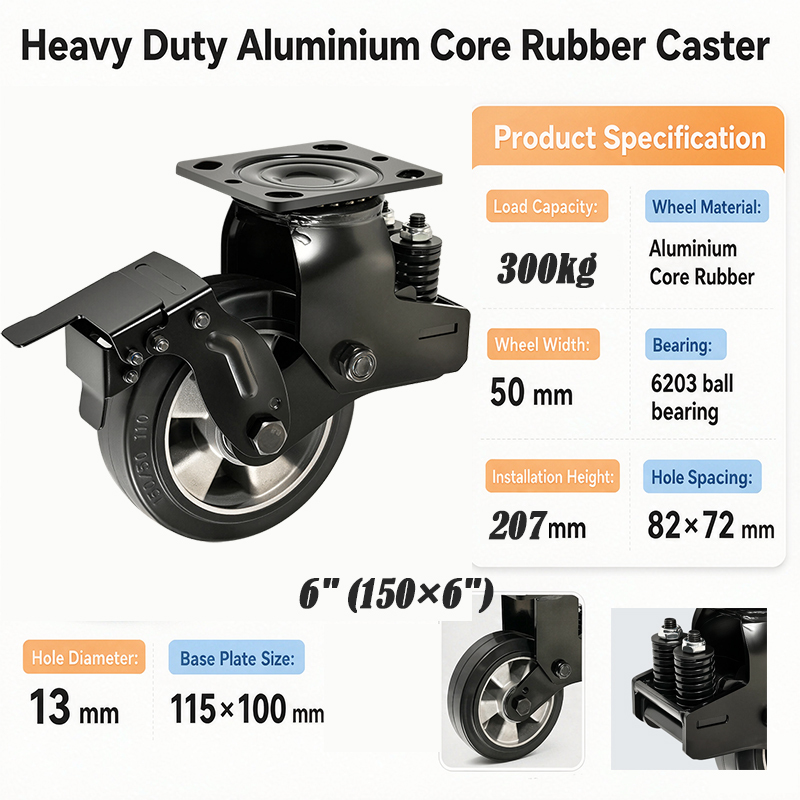
Product Specifications
| Braking/Activation/Orientation |
Braking / Swivel / Fixed |
| Size |
6 inches |
| Wheel Material |
TPR |
| Base Plate Support Material |
Q235 |
| Bearing |
6202 Bearing |
| Installation Height |
190 |
| Base Plate Size |
115*100 |
| Hole Distance |
82*72 |
| Box Size |
49*28.5*25cm |
Matching Specifications
- Set 1: 2 brakes + 2 fixed
- Set 2: 2 swivel + 2 fixed
1. Material Types and Conduction Mechanisms
| Caster Type |
Core Material |
Conduction Mechanism |
Resistance Range (Ohms) |
| Conductive Caster |
Carbon fiber-filled polyurethane, conductive rubber |
Conductive pathways are formed by carbon fibers or metal particles, allowing charges to be quickly conducted to the ground. |
10³–10⁵ |
| Anti-static Caster |
Polymer with anti-static additives (e.g., carbon black) |
Higher material resistance allows for slow discharge of static charges, avoiding sudden discharges. |
10⁶–10⁹ |
| Standard Caster |
Ordinary rubber / nylon |
Insulating material, no conductive pathways, easily accumulates static. |
>10¹² |
- Key Difference: Conductive casters must ensure a low-resistance pathway, while anti-static casters focus on controlling the speed of charge release. For example, the graphite microcrystal structure in carbon fiber allows π electrons to move freely, forming an efficient conductive network. In contrast, the electrons in ordinary plastics are bound by covalent bonds and cannot conduct electricity.
-
2. Causes of Material Differences
- Conductivity Requirements: In environments where rapid current conduction is needed (e.g., power supply for bumper cars), conductive casters use low-resistance materials (e.g., carbon fiber composites). Anti-static casters, which only need to release weak static charges, can use high-resistance polymers.
- Durability and Environmental Adaptability:
- Conductive casters often incorporate wear-resistant polyurethane to ensure long-term use on epoxy floors without shedding.
- Standard casters, without special formulations, are prone to slipping or aging in damp or oily environments.
Application Scenarios
-
Electronics Manufacturing
- Transporting PCB assembly carts, server racks, and semiconductor handling equipment in ESD-protected areas (EPAs).
-
Medical & Laboratory Equipment
- Moving diagnostic machines, analytical instruments, and mobile medical carts in hospitals and labs.
-
Automotive EV Battery Production
- Used in battery module assembly lines to prevent static damage to battery management systems (BMS) and cells.
-
Aerospace & Defense
- Handling avionics, communication systems, and other sensitive electronic assemblies in cleanroom environments.

3. Performance Comparison and Selection Recommendations
| Feature |
Conductive Caster |
Anti-static Caster |
Standard Caster |
| Static Discharge Speed |
Discharges charges in milliseconds |
Slow discharge (seconds) |
No capability, accumulates static |
| Suitable Applications |
Semiconductor workshops, EV battery assembly lines |
Medical equipment, general electronics assembly |
Non-sensitive environments |
| Cost |
Higher (special materials and processes) |
Moderate |
Low |
Selection Principles:
- If direct current conduction is required (e.g., equipment grounding) → Choose conductive casters (resistance 10³–10⁵Ω).
- If only static prevention is needed → Anti-static casters (resistance 10⁶–10⁹Ω) are more cost-effective.
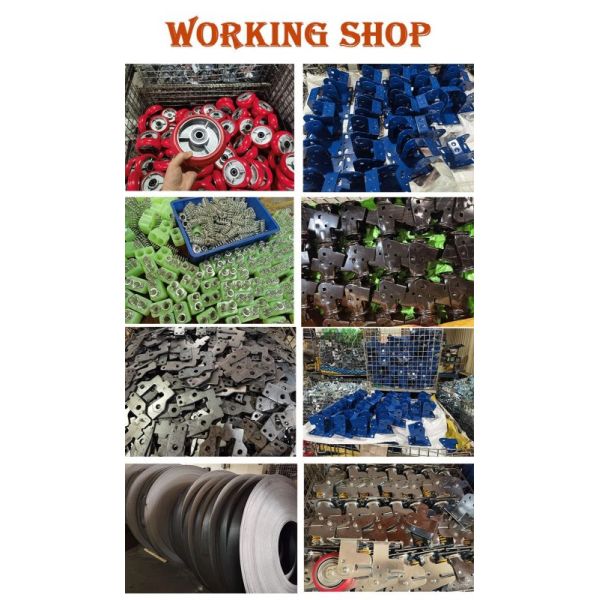
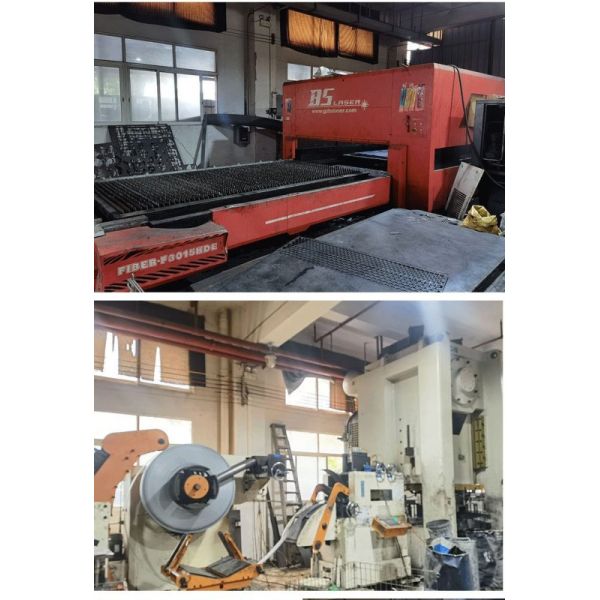
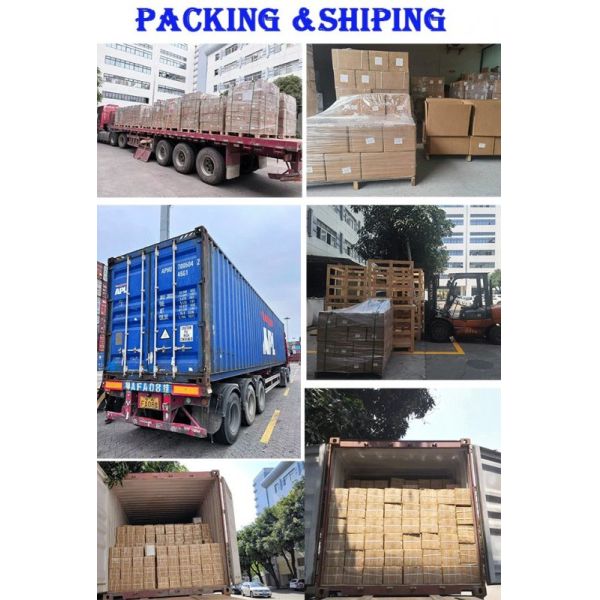
Company Services & Process Overview