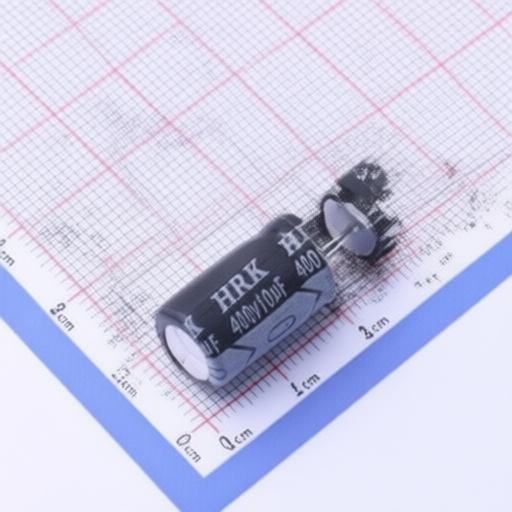
The HRK CD110 series is a standard plug-in type aluminum electrolytic capacitor designed for general-purpose applications. It features a black sleeve with white lettering, a rated capacitance of 33uF, and a rated voltage of 400V. With a wide operating temperature range of -40 to +105 and a long-life expectancy of 2,000 hours at 105, these capacitors offer reliable performance. They are suitable for applications requiring stable capacitance and low leakage current.
| HRK P/N | Series | Rated Capacitance (uF) | Rated Voltage (V) | Capacitance Tolerance (%) | Dissipation Factor (Max, %) | Leakage Current (uA, Max) | Surge Voltage (V) | Equivalent Impedance (, 20, 100KHz) | Rated Ripple Current (mA rms, 105, 100KHz) | Durability (Hrs, at 105) | Diameter (mm) | Height (mm) | Lead Diameter (mm) |
|---|---|---|---|---|---|---|---|---|---|---|---|---|---|
| CD110 | CD110 | 33 | 400 | -20~+20 | 24 | 436 | 450 | 190 | 2,000 | 13 | 17 | 0.6 |
| Item | Test Condition/Method | Judgment Standard |
|---|---|---|
| Capacitance (CAP) | Test Circuit: Series Equivalent Circuit, Test Frequency: 120Hz, Test Voltage: Rated Voltage | Within rated capacitance tolerance (See Table-1) |
| Dissipation Factor (DF) | Less than or equal to the dissipation factor value in Table-1 | |
| Leakage Current (LC) | Apply rated DC voltage across the capacitor in series with a 100010 resistor for 2 minutes, then measure leakage current. | Less than or equal to the leakage current value in Table-1 |
| Surge Voltage | At 15~35, apply surge voltage through a protective resistor of (10050)/CR (K), charge for 305 sec, discharge for 5.50.5 min per cycle, for 1000 cycles. | Capacitance change rate: Within 15% of initial value. Dissipation factor: Not greater than specification value. Leakage current: Not greater than specification value. Appearance: No visible abnormal appearance. |
| Temperature Characteristics | Tests at 255, -253, -403, +1053 after thermal stabilization. | Impedance ratio (Stage 2, 3 vs Stage 1): Not exceeding values in the table. Capacitance change rate (vs Stage 1): Within 25%. Dissipation factor: Not exceeding 5 times specification value. Leakage current: Not exceeding specification value. |
| Lead Tensile Strength | Apply tensile force to capacitor leads for 101 sec. | Lead Diameter (mm): 0.45, 0.5, 0.6, 0.8, 1.0. Tensile Strength (N {kgf}): 5 {0.51}, 10 {1.0}, 20 {2.0}. |
| Lead Bending Strength | Fix capacitor vertically on a jig, apply bending force as per table, rotate 90 degrees in one direction and return, then 90 degrees in the opposite direction and return, one cycle. | No obvious appearance change, no lead breakage or loosening. |
| Vibration Test | 2 hours in each direction on a vibration tester, total 6 hours. Frequency Range: 10~55Hz, Amplitude: 1.5mm, Sweep rate: approx. 1 min from 10 to 55 and back to 10 Hz. | Capacitance test: Stable value. Capacitance change: Within 5% of initial value. Appearance: No abnormal appearance. |
| Solderability | Dip capacitor terminals in rosin solution (25% by weight) for 5~10 sec, then dip in solder at 2455 until about 1.5~2.0mm from the capacitor body. | Approximately 90% of the immersed lead surface area should be covered with new solder. |
| Soldering Heat Resistance | Dip terminals below 1.5~2.0mm from the body into solder solution at 2605 or 35010 for 101 sec or 3~4 sec respectively, then remove. Measure after 1~2 hours at normal temperature and humidity. | Capacitance change rate: Within 10% of initial value. Dissipation factor: Not greater than specification value. Leakage current: Not greater than specification value. Appearance: No significant abnormal appearance. |
| Damp Heat (Steady State) | Place in an environment of 405 and 90~95% relative humidity for 2408 hours, then measure after 1~2 hours at normal temperature and humidity. | Capacitance change rate: Within 20% of initial value. Dissipation factor: Not exceeding 1.2 times specification value. Leakage current: Not greater than specification value. Appearance: No significant abnormal appearance. |
| Rapid Temperature Change | Place capacitor in a thermal shock chamber, cycle temperature as: +25 (3min) -40 (30min) +25 (3min) +105 (30min) +25 (3min), for 5 cycles. Measure after 1~2 hours at normal temperature and humidity. | Capacitance change rate: Within 10% of initial value. Dissipation factor: Not greater than specification value. Leakage current: Not greater than specification value. Appearance: No significant abnormal appearance. |
| Endurance | Apply rated voltage and ripple current at the upper limit temperature for the rated life, then place in standard environment for 1~2 hours. | Capacitance change rate: Within 20% of initial value. Dissipation factor: Not exceeding 2 times specification value. Leakage current: Not greater than specification value. Appearance: No significant abnormal appearance. |
| High Temperature Storage | Store in an environment of 1052 without voltage for 1000+48/-0 hours, then recover for 16 hours before measurement. | Capacitance change rate: Within 20% of initial value. Dissipation factor: Not exceeding 2 times specification value. Leakage current: Not greater than specification value. Appearance: No significant abnormal appearance. |
| Anti-explosion | a) AC Power Test: Apply 0.7 times rated voltage or 250V AC (whichever is smaller) at 50 or 60 Hz across the capacitor. b) DC Power Test: Apply 1A current for diameter 22.4mm, or 10A current for diameter > 22.4mm, with reverse DC voltage. | Explosion vent opens, no flame should occur. If the internal explosion vent does not open after 30 minutes of applied voltage, the performance is considered satisfactory. |
We hereby guarantee that all or part of the products, including but not limited to products and packaging, directly or indirectly delivered to your company (including your company's subsidiaries and affiliated companies) do not contain the following substances: