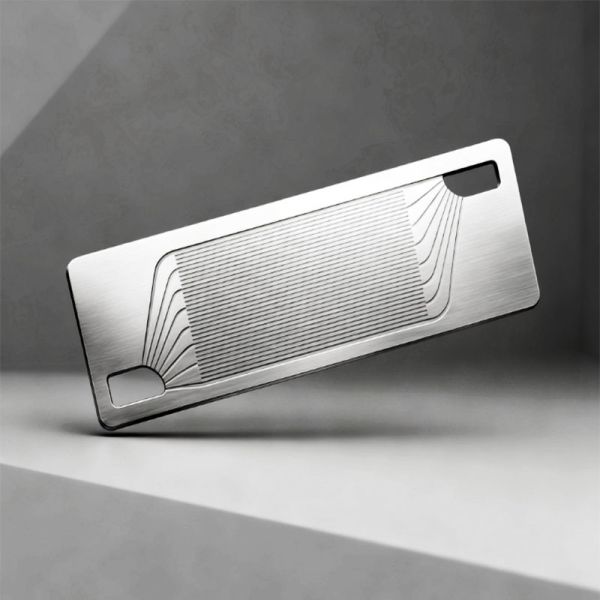
Customized Etched Fuel Cell Bipolar Plates with Multi-Material Compatibility for Japan Market
Bipolar Plate Overview
Xinhaisen specializes in the high-precision chemical etching of metallic bipolar plates, a critical component in fuel cells and electrolyzers. Our advanced etching technology enables the mass production of complex, ultra-fine flow field patterns on thin metal sheets with exceptional consistency and speed, meeting the demanding requirements of next-generation energy applications.
Manufacturing Process
-
Material Preparation: Selection and cleaning of premium metal substrates (e.g., stainless steel, titanium).
-
Photoresist Application: Coating with a light-sensitive film.
-
Precision Exposure: Transferring the digital flow field design onto the plate using UV light.
-
Chemical Etching: Controlled etching to remove unprotected areas, forming precise channels and features.
-
Cleaning & Finishing: Thorough cleaning, followed by optional post-processing (e.g., coating for enhanced conductivity/corrosion resistance).
-
Quality Inspection: 100% dimensional and visual inspection using advanced measurement systems.
Bipolar Plate Features
-
Ultra-High Precision: Capable of producing extremely fine flow channels, micro-features, and uniform geometries.
-
Burr-Free & Stress-Free: The etching process creates smooth surfaces and edges without mechanical stress or burrs, crucial for sealing and performance.
-
Design Flexibility: Rapid prototyping and design changes without costly tooling modifications. Ideal for complex, multi-scale flow field patterns.
-
Material Versatility: Processes various corrosion-resistant alloys suitable for harsh fuel cell/electrolyzer environments.
-
Scalability & Speed: Seamlessly scales from prototypes to ultra-high-volume orders with fast lead times.
Bipolar Plate Specification
| Parameter |
Specification |
| Common Materials |
Stainless Steel (316L, etc.), Titanium, Aluminum, etc. |
| Standard Thickness |
0.5mm – 3.0mm |
| Surface Finish |
Smooth etched finish, Ra < 0.4µm (as-etched, material dependent) |
| Tolerance |
±0.01mm |
| Standard Lead Time |
3-5 days for prototypes; Rapid turnaround for volume production |


Bipolar Plate Applications
Our etched bipolar plates are essential components in:
-
Proton Exchange Membrane Fuel Cells (PEMFCs)
-
Solid Oxide Fuel Cells (SOFCs)
-
Water Electrolyzers (PEM, AEM)
-
Flow Batteries
-
Other advanced energy conversion and storage systems
Our Advantages
-
Unmatched Speed: From design to delivery, we excel in rapid response and fast mass production.
-
High Precision & Consistency: Industry-leading tolerances and uniformity across high-volume batches.
-
High-Volume Capacity: Reliably handle sudden, large-volume orders without compromising quality.
-
Comprehensive Expertise: Deep knowledge in etching for diverse sectors (communications, medical, automotive, optics) ensures robust problem-solving for energy applications.
-
Established Reputation: Trusted by clients for high quality, precision, variety, and reliable service.
FAQ
-
What file format do you require for the flow field design?
We prefer CAD files (e.g., .dxf, .dwg) or Gerber files for optimal precision.
-
Can you provide coated or treated bipolar plates?
Yes. We offer post-etching processes, including precious metal coatings (e.g., gold, silver) and other conductive/corrosion-resistant treatments through trusted partners.
-
What is your minimum order quantity (MOQ) for prototypes?
We support low-MOQ prototype projects to help you test and validate designs.
-
How do you ensure quality control?
Every batch undergoes strict in-process and final inspection using optical measuring equipment, profilometers, and other gauges to verify all dimensional and surface specifications.
-
What are your main material recommendations for PEMFC bipolar plates?
316L stainless steel is a common, cost-effective choice. We also highly recommend and process titanium for superior corrosion resistance in demanding environments.


Welcome to contact us at any time!