Specifications
MOQ :
10
Delivery Time :
5-10 work days
Tolerance :
+/- 0.05mm
Model Number :
Customize
Material :
Stainless Steel,Titanium or Customized
Payment Terms :
T/T
Price :
50-100USD
Min Line Width :
0.01 mm
Supply Ability :
10000-100000PCD / week
Brand Name :
XHS/Customize
Product Name :
Bipolar Platers
Certification :
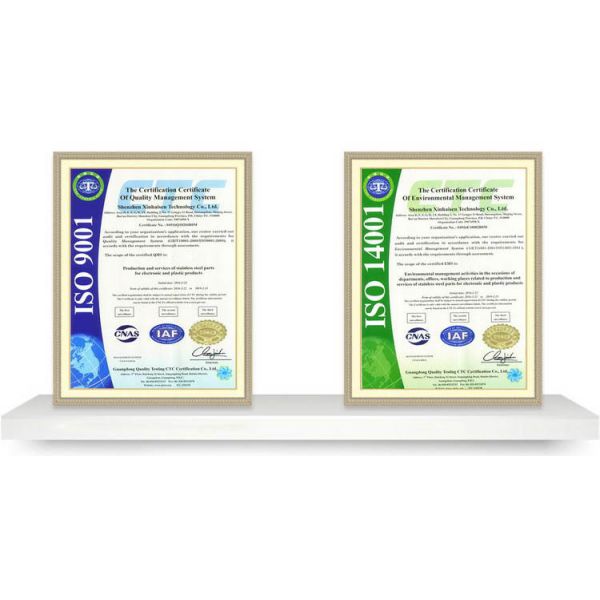
ISO 9001, ISO 14001, IATF 16949
Processing Technology :
Photo Chemical Etching
Place of Origin :
China
Thickness :
0.5 mm - 3.0 mm
Packaging Details :
PE bags and Carton
Description

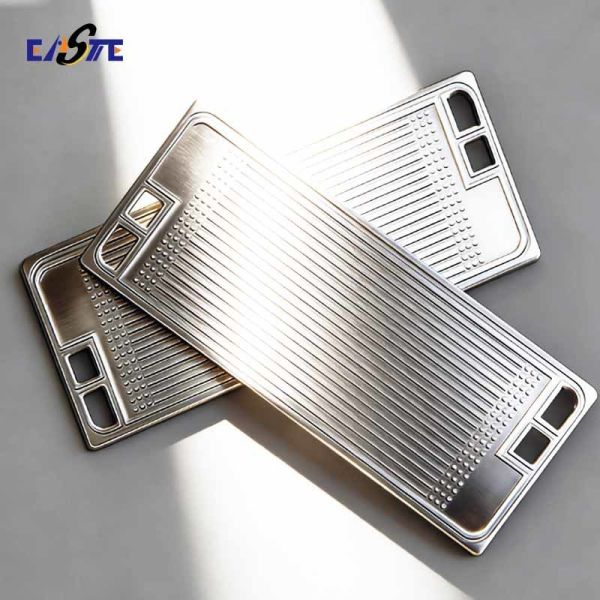
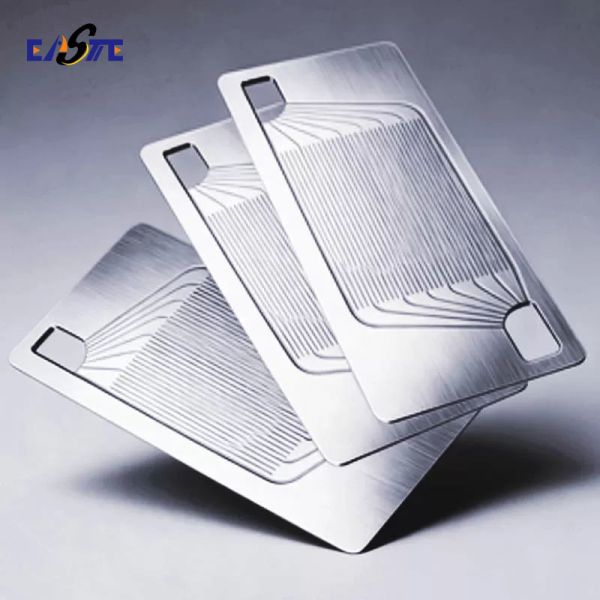
Stainless Steel Fuel Cell Bipolar Plates Precision Etched for PEM Systems


Bipolar plates are critical components in PEM fuel cells and hydrogen electrolyzers. Xinhaisen manufactures precision etched bipolar plates with high flow field accuracy, excellent conductivity, and superior corrosion resistance.

Our bipolar plates are widely used in:

  • PEM Fuel Cells
  • Hydrogen Electrolyzers
  • Fuel Cell Stacks
  • Renewable Energy Systems
  • Automotive Fuel Cell Applications


What is Chemical Etching?

Chemical etching (also known as photochemical machining) is a subtractive manufacturing process that uses chemical solutions to dissolve metal precisely. Unlike traditional stamping or machining, etching creates burr-free, stress-free plates without mechanical force. This allows for complex micro-flow channel designs, tight tolerances, and rapid prototyping, making it ideal for the intricate structures required in bipolar plates.


Product Features

  • High Precision: Achieve micro-channel widths as fine as 0.015mm and uniform flow field depths with an accuracy of ±0.03mm.

  • Burr-Free & Stress-Free: Unlike mechanical punching, our process leaves no burrs or micro-cracks, ensuring the longevity and safety of the membrane electrode assembly (MEA).

  • Ultra-Thin Capabilities: Process metals as thin as 0.5mm, enabling lighter stacks and higher power density.

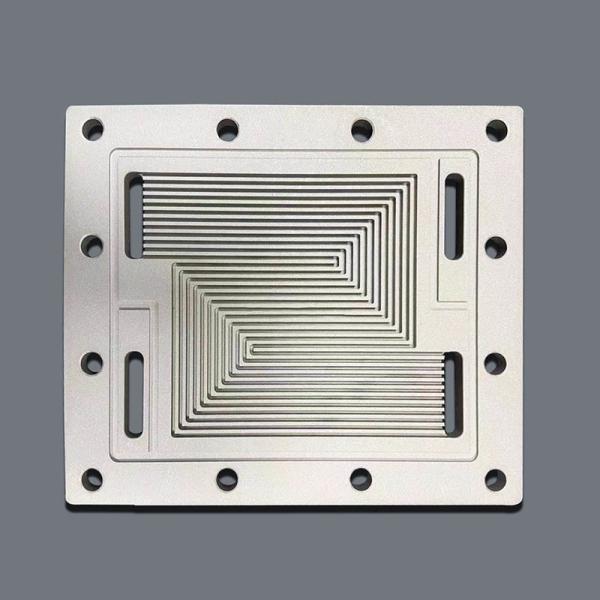
  • Complex Geometries: Capable of producing intricate flow field patterns (e.g., serpentine, parallel, pin-type) to suit specific gas diffusion requirements.

  • Material Versatility: Compatible with various metals including stainless steel (304, 316L), titanium, and other corrosion-resistant alloys.

  • Consistency: High-volume repeatability ensures that every plate in your stack performs identically.


Product Specifications

Parameter Specification
Material Options Stainless Steel (304, 316L), Titanium, Copper, Alloy
Material Thickness 0.02 mm – 1.5 mm
Min. Line Width 0.015 mm
Min. Aperture (Hole) 0.03 mm
Dimensional Tolerance ±0.03 mm (Uniformity)
Lead Time Fast prototyping (5-7 days); Mass production available
Surface Finish As etched, passivated, or custom surface treatment


Note: Custom specifications are available upon request.


Stainless Steel Fuel Cell Bipolar Plates Precision Etched for PEM Systems Stainless Steel Fuel Cell Bipolar Plates Precision Etched for PEM Systems Stainless Steel Fuel Cell Bipolar Plates Precision Etched for PEM Systems

Our Advantages

  • Rapid Turnaround: With an efficient production setup, we handle urgent orders and large-volume demands without compromising quality.

  • Cost Efficiency: Our chemical etching process eliminates high tooling costs (no expensive hard tooling required), making it cost-effective for both prototyping and mass production.

  • Expertise in Thin Metals: Specializing in thicknesses down to 0.5mm, we offer solutions for lightweight stack designs that maximize energy density.

  • Quality Assurance: We ensure high uniformity across thousands of pieces, critical for stable stack performance.


Applications

Bipolar plates manufactured by Xinhaisen are suitable for:

  • Proton Exchange Membrane Fuel Cells (PEMFC): Used in automotive (cars, trucks), drones, and stationary power systems.

  • Water Electrolyzers: For green hydrogen production.

  • Portable Power Systems: Compact, high-efficiency energy devices.

  • Aerospace & Aviation: Lightweight components for air mobility.


FAQ

  • Q: What materials do you recommend for bipolar plates?
    A: We typically recommend Stainless Steel (316L) for its excellent corrosion resistance and cost-effectiveness, or Titanium for applications requiring higher strength-to-weight ratios.
  • Q: Can you achieve the tight tolerances required for sealing?
    A: Yes. Our etching process maintains a uniformity of ±0.01mm, ensuring that the plates mate perfectly with gaskets to prevent gas leakage.
  • Q: Do you charge high tooling fees for custom designs?
    A: No. One of the major benefits of chemical etching is the low tooling cost. We use digital tooling, allowing us to adjust flow field designs quickly without expensive physical molds.
  • Q: What is the lead time for a prototype?
    A: Typically, prototypes can be delivered within 5 to 7 days after design confirmation.
  • Q: Can you handle large-scale production?
    A: Absolutely. We are equipped to handle massive, high-volume orders while maintaining strict consistency across all plates.

Stainless Steel Fuel Cell Bipolar Plates Precision Etched for PEM Systems

Stainless Steel Fuel Cell Bipolar Plates Precision Etched for PEM Systems

Welcome to contact us at any time!

Send your message to this supplier
Send Now

Stainless Steel Fuel Cell Bipolar Plates Precision Etched for PEM Systems

Ask Latest Price
Watch Video
MOQ :
10
Delivery Time :
5-10 work days
Tolerance :
+/- 0.05mm
Model Number :
Customize
Material :
Stainless Steel,Titanium or Customized
Payment Terms :
T/T
Contact Supplier
video
Stainless Steel Fuel Cell Bipolar Plates Precision Etched for PEM Systems

Shenzhen Xinhaisen Technology Limited

Verified Supplier
2 Years
guangdong, shenzhen
Since 2012
Business Type :
Manufacturer, Exporter
Total Annual :
4000000-6000000
Employee Number :
260~300
Certification Level :
Verified Supplier
Contact Supplier
Submit Requirement