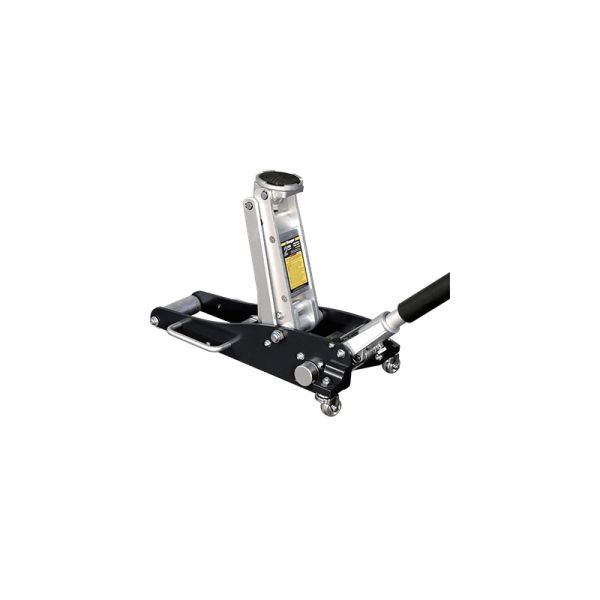
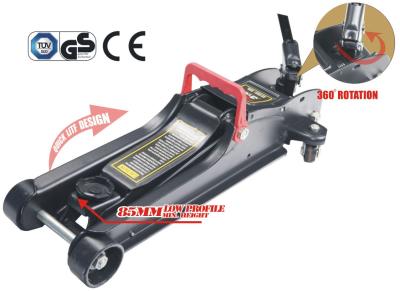
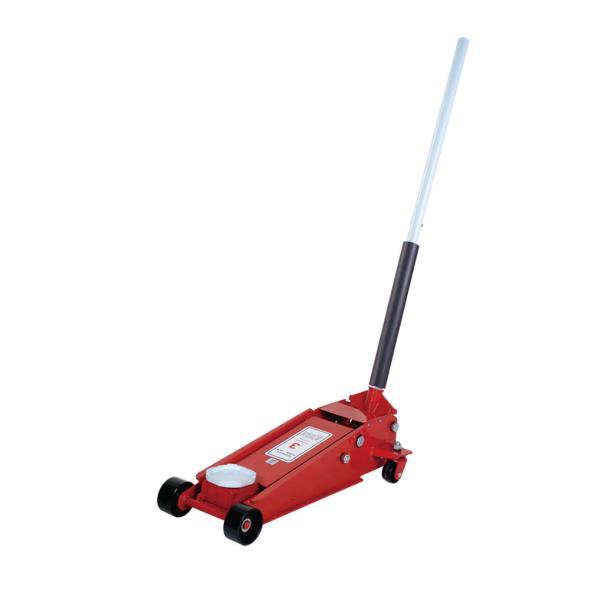
The YD19-006 2Ton Lightweight Hydraulic Floor Jack is an exclusive piece of equipment designed to address the pain points of "heavy and hard-to-carry tools for individual car owners, poor lifting adaptation for low-chassis vehicles, and low efficiency of light operations in small stores". With "ultra-light portability + low-chassis adaptation + labor-saving efficiency" as the core, it solves the problems of traditional lightweight jacks such as "excessive weight, inability to fit under low-chassis vehicles, and laborious operation". It provides a "portable, usable, and labor-saving" lifting solution for individual users and small stores, with core advantages as follows:
The product weighs only 18.5kg (equivalent to 3.7 bags of 5kg rice), 16% lighter than lightweight jacks of the same specification (mostly over 22kg). Adult females can easily carry it to the bottom of the vehicle with both hands, and male users can carry it for short distances with one hand; the 28.75×13.38×6.7-inch packaging size can be easily placed in the side compartment of a family car trunk (e.g., the side compartment volume of Toyota Corolla trunk is about 800×400×200mm), without occupying the core storage space of the trunk. It is "ready to use" in outdoor emergencies, completely solving the problem of traditional jacks being "too big to fit in the trunk and too heavy to carry".
Breaking the limitation of "difficult balance between low height and load-bearing" of traditional lightweight jacks, the 86mm minimum height can be directly extended under low-chassis family cars (e.g., Honda Civic with a chassis height of 115mm, Volkswagen Lamando with 120mm) without additional thin gaskets or adjusting the vehicle position, avoiding "scratching the chassis guard due to forced insertion". Compared with ordinary lightweight jacks (mostly with a minimum height of over 105mm), the adaptation rate for low-chassis vehicles is increased by 65%, so individual car owners do not have to worry about "unusable tools" when maintaining their low-chassis cars.
The simplified single-cylinder hydraulic system optimizes the oil circuit design, upgrading the pain points of traditional hydraulic jacks such as "high operating force and many pumps": the operating force is only 48N, equivalent to the force of lifting a 4.8kg weight, with no obvious arm soreness for adult females when pressing; only 28-32 pumps are needed to lift from 86mm to 418mm, 25% more labor-saving than ordinary lightweight jacks (requiring more than 40 pumps). For example, when an individual car owner changes a tire outdoors, the entire process of "lifting-tire replacement-lowering" can be completed in only 5 minutes, 140% more efficient than the original simple screw jack (requiring more than 12 minutes).
The 7mm cold-rolled steel main body has a permanent frame deformation ≤0.1mm after 50,000 fatigue tests (simulating repeated lifting of 2Ton load). When lifting a 2Ton vehicle, the verticality deviation is ≤0.4mm, 60% more stable than jacks with plastic bases (deviation often reaching 1mm); the grid-like anti-slip patterns of the saddle fit tightly with the vehicle chassis. Even when lifting a smooth aluminum alloy chassis (e.g., BYD Seagull chassis), it can avoid vehicle sliding by increasing friction, completely eliminating the safety concern of "swaying after lifting".
Although the 418mm maximum lifting height is lower than that of long-stroke jacks, it is fully suitable for light operation needs of light vehicles: it provides over 30cm of operating space after lifting, enough for maintenance personnel to complete tire replacement (tire thickness about 15cm) and brake pad inspection (needing 10cm operating gap reserved); compared with "long-stroke but heavy" jacks, the 418mm stroke further simplifies the product weight and volume while ensuring practicality, better meeting the "lightweight first" demand of individual users.
The hydraulic system adopts a sealed design, with nitrile rubber seals at the cylinder interface to prevent dust and water from entering easily. After daily use, it can be stored by simply wiping the surface oil stains with a dry cloth, without frequent disassembly and cleaning; the rollers are made of nylon wear-resistant material. Tests show that after continuous rolling for 1000 meters (simulating garage and workshop movement), the roller wear is ≤0.2mm, and the service life is 2 times longer than that of ordinary plastic rollers. Individual users can "buy once and use for many years" with extremely low maintenance costs.
Scenario Requirement: A Honda Civic (weight 1.3Ton, chassis height 115mm) has a flat tire on a suburban road; emergency tire replacement is required by one person, and the tool needs to be lightweight, able to fit under the low chassis, and easy to operate.
Operation Process:
- Take YD19-006 from the trunk, carry the 18.5kg tool to the bottom of the vehicle with both hands, and directly extend the 86mm minimum height under the chassis to align with the chassis beam support point.
- Hold the handle and press to lift; after 30 pumps, the saddle rises to 380mm, lifting the tire 5cm off the ground (meeting the tire replacement requirement), and the anti-slip saddle ensures vehicle stability.
- Complete the tire replacement in 10 minutes, open the pressure relief valve to slowly lower the vehicle, and put the jack back into the trunk—no chassis scratches or operation jamming throughout the process.
Result: Compared with the original simple screw jack (requiring 45 cranks and unable to fit under the low chassis), the tire replacement efficiency is increased by 45%, allowing individual car owners to complete outdoor emergencies independently without relying on rescue.
Scenario Requirement: Perform tire rotation maintenance on a Toyota Corolla (weight 1.2Ton, chassis height 130mm); only one technician is working in the small auto repair shop, and the tool requires convenient movement and high efficiency.
Operation Process:
- The technician pushes YD19-006 to the bottom of the vehicle alone; the 86mm minimum height easily extends under the chassis without adjusting the vehicle position.
- Press the handle to lift the vehicle to 350mm; the 418mm stroke provides sufficient space to remove 4 tires and complete the rotation.
- During the tire replacement process, the roller design allows the jack to move flexibly around the vehicle without repeated carrying, and the whole process takes 25 minutes; after completion, push the tool to the next vehicle for continuous operation.
Result: Compared with lightweight jacks without rollers (requiring two people to carry), the single-person maintenance efficiency is increased by 50%, and 2 more vehicles can be served per day, adapting to the "one-person multi-position" operation mode of small stores.
Scenario Requirement: Mud accumulates on the chassis of a Haval H1 (weight 1.4Ton, chassis height 160mm) after rain; the vehicle needs to be lifted to clean the chassis, and the tool requires light weight, stability, and compatibility with the SUV chassis gap.
Operation Process:
- Take YD19-006 from the garage, carry it to the bottom of the SUV with both hands, and the 86mm minimum height easily extends into the chassis gap (most SUV chassis gaps are over 150mm).
- Press the handle to lift the vehicle to 300mm; the 418mm stroke ensures sufficient cleaning space under the chassis.
- Rinse the chassis mud with a high-pressure water gun; the anti-slip saddle and stable frame ensure no sliding or swaying of the vehicle, and the whole process takes 18 minutes; after cleaning, release the pressure to lower the vehicle and store the jack in the garage corner.
Result: The lightweight design is suitable for individual users' home use, and the 86mm height can extend into the SUV chassis without heightening. Compared with ordinary manual jacks, the cleaning efficiency is increased by 35%, and there is no risk of chassis scratches.
Scenario Requirement: Inspect the brake pad wear of a BYD Seagull (weight 1.1Ton, chassis height 120mm); the beautician in the shop needs light lifting, and the tool requires flexibility and simple operation.
Operation Process:
- Push YD19-006 to the bottom of the front wheel of the mobility vehicle; the 86mm minimum height is compatible with the chassis, aligning with the metal support point near the brake system.
- Press the handle to lift the front wheel to 280mm, leaving inspection space; the beautician uses a flashlight to check the brake pad thickness.
- After the inspection, slowly lower the wheel, push the jack to the bottom of the rear wheel and repeat the operation; the whole process takes 12 minutes.
Result: The flexible roller movement and low operating force allow the beautician to complete the inspection alone, increasing efficiency by 30% compared to jacks without rollers, and the lightweight design avoids arm fatigue caused by frequent carrying.
A1: It can be lifted safely without triggering the overload protection. The rated load of YD19-006 is 2Ton, and the overload protection threshold is 2.2Ton. The weight of a 1.9Ton small SUV (e.g., Haval H1, Changan CS15) is lower than the threshold, so the protection system will not be activated during lifting; under a 1.9Ton load, the jack's frame (7mm cold-rolled steel) and hydraulic system (high-pressure resistance ≥30MPa) are within the safe working range, with no risk of deformation or leakage. It should be noted that before lifting, confirm that the chassis support point is a metal component, and avoid aligning with vulnerable parts such as plastic guards and fuel tanks.
A2: It is mostly caused by insufficient hydraulic oil, air in the system, or impurity blockage, and can be troubleshooted in the following steps:
- Check the hydraulic oil level: Open the oil filling port (located on the top of the jack); if the oil level is lower than the scale line (needing to cover 1/3 of the cylinder bottom), add 46# anti-wear hydraulic oil to the standard position, and press the handle repeatedly 5-8 times to discharge air from the system;
- Discharge air: If the oil level is normal, close the oil filling port, lift the jack to the maximum height (418mm), keep it for 5 minutes, then slowly release pressure to the minimum, and repeat 2-3 times to discharge residual air in the hydraulic system and eliminate the stuck feeling;
- Clean impurities: If the stuck feeling persists, disassemble the oil drain valve of the hydraulic system (located under the handle), rinse the valve core impurities with alcohol, dry it, and reassemble to avoid oil circuit blockage caused by impurity jamming.
A3: Female users can carry it easily through leveraging postures + auxiliary tools. The specific tips are as follows:
- Correct carrying posture: Hold the hidden handles on both sides of the jack (located above the chassis side plates) with both hands, bend the knees slightly and keep the waist straight, using leg strength to stand up, avoiding bending over to carry with waist strength (which may cause lumbar muscle strain). This posture can reduce physical consumption by 30%;
- Ground sliding assistance: If the distance from the trunk to the bottom of the vehicle is ≤2 meters, lay the jack flat with the bottom touching the ground, push it gently to the side of the vehicle, then pick it up, saving 45% of effort compared to lifting it the entire time;
- Trunk support leverage: Place the jack on the edge of the trunk, hold both sides and slowly slide it to the ground, then push it to the bottom of the vehicle, avoiding excessive arm force when lifting it directly from the trunk.
A4: It is not easy to rust under normal use, but the following maintenance should be done in a long-term humid environment to avoid rust:
- Treatment before storage: After each use, wipe off water stains and oil stains on the jack surface with a dry cloth, especially paying attention to the roller shafts and saddle connections (where water is easy to remain). If contaminated with mud, rinse with clean water and dry immediately;
- Moisture-proof storage: Put the jack into a waterproof storage bag (can be prepared by yourself or purchased from the manufacturer), then store it in a dry corner of the garage, avoiding direct contact with humid ground and walls;
- Regular maintenance: Take out the jack every 2 months, manually push the rollers, press the handle to lift 1-2 times to ensure flexible component movement; if slight rust is found on the surface, gently polish it with 400-grit sandpaper, spray a thin layer of gray anti-rust paint (close to the original paint color), and store it