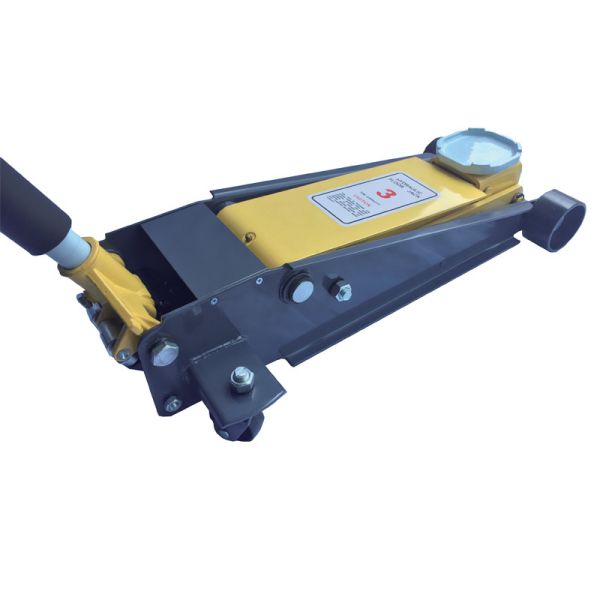
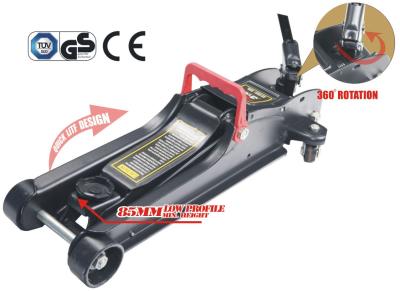
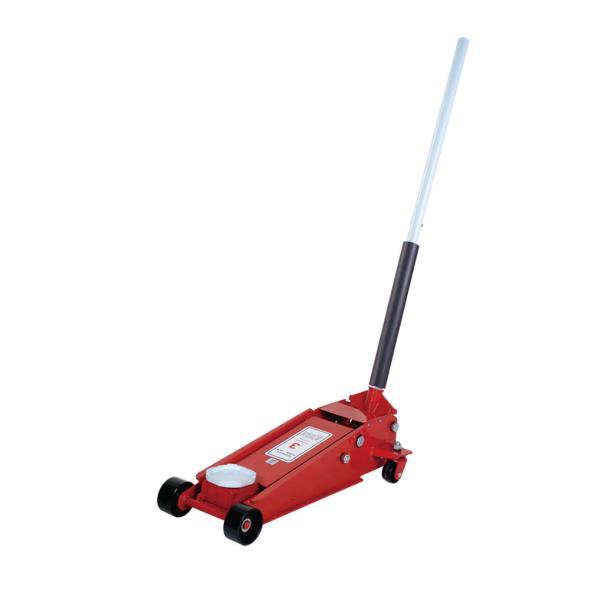
The YD19-004 3Ton Professional Hydraulic Floor Jack is a core piece of equipment designed to address the pain points of "unstable heavy-load lifting, frequent hydraulic failures, and laborious operation in professional scenarios". With "heavy-load durability + long service life + labor-saving efficiency" as the core, it solves the problems of traditional jacks such as "deformation under heavy loads, hydraulic contamination, and high operating intensity", providing a "stable load-bearing, low-maintenance, and labor-saving" solution for professional scenarios. Its core advantages are as follows:
The main body is made of 12mm thick cold-rolled steel, with no permanent deformation after 100,000 fatigue tests (simulating repeated lifting of 3Ton load); the flanged side plates increase bending strength by 30%, and the side plate deflection is ≤0.1mm when lifting a 3Ton light truck—87.5% more stable than ordinary jacks without flanges.
The "front-narrow-rear-wide" chassis layout (279mm front, 368mm rear) provides a grounding area of 735×368mm, 15% larger than that of symmetric chassis jacks. Even when lifting on the ground with a slope ≤3°, there is no risk of rollover, adapting to complex operating environments.
The exclusive roller-cam-plunger linkage structure upgrades sliding friction to rolling friction, reducing operating force to ≤55N (easily operable by adult women). Only 30-35 pumps are needed to lift from 125mm to 530mm—30% more labor-saving than ordinary jacks. The chrome-plated plunger has a wear coefficient ≥3.5, with wear ≤0.02mm after 500 consecutive lifts, extending service life by 2× and reducing maintenance costs in professional scenarios.
The hydraulic system adopts full protection of "double seal rings + dust cover": the cylinder interface is equipped with nitrile rubber main seal + PTFE auxiliary seal to prevent oil leakage; the pipeline interface is fitted with a dust cover to prevent dust intrusion when idle. Even in dusty logistics parks or humid car washes, there is no risk of impurities blocking the oil circuit.
The hydraulic oil uses a low-temperature anti-wear formula, maintaining fluidity at -20℃, avoiding "oil solidification and jamming" during outdoor maintenance in northern winter, with 100% annual adaptability and no operation interruption due to environmental restrictions.
The 530mm maximum lifting height is 18% higher than that of ordinary 3Ton jacks, providing over 45cm of operating space after lifting. When maintaining the gearbox of a light truck, maintenance personnel do not need to work in a hunched position, enabling easy component disassembly and improving efficiency by 50%, while reducing the risk of lumbar muscle strain.
The chassis is equipped with 4 wear-resistant rollers (front universal, rear directional), allowing one person to push the 45.5kg jack in the workshop—60% more labor-saving than jacks without rollers. With a length of 735mm, it can be placed against the workshop wall without occupying core operating space, adapting to the "dense tool placement" needs of auto repair shops.
Scenario Requirement: Maintain the drive shaft and oil pipe of Foton Xiangling (2.6Ton, chassis height 160mm), requiring lifting to 400mm; the tool needs to be stable and labor-saving.
Operation Process:
- One person pushes the jack to the bottom of the truck; the 125mm minimum height easily extends under the chassis and aligns with the beam support point.
- Press the handle to lift; the roller-cam plunger design reduces operating intensity, lifting to 400mm height.
- Maintenance personnel disassemble components; no shaking during the 2-hour process, and the vehicle is slowly lowered after completion by releasing pressure.
Result: 50% more efficient than ordinary jacks; no operator fatigue after maintaining 5 vehicles a day, adapting to high-frequency operations.
Scenario Requirement: Replace snow tires of Great Wall Cannon (2.3Ton, chassis height 180mm) with fast turnover; the tool needs to be efficient and stable.
Operation Process:
- Push the jack to the bottom of the SUV's rear wheel; the 125mm height is compatible with the chassis without heightening.
- 30 pumps lift the tire 8cm off the ground; the overload protection monitors the load (2.3Ton < 3.3Ton).
- Complete tire replacement in 10 minutes; push the jack to the next vehicle for continuous operation.
Result: Convenient roller movement and labor-saving design shorten time; 15 vehicles can be serviced a day, meeting the fast turnover needs of logistics parks.
Scenario Requirement: Install a 2.8Ton generator (chassis height 140mm), requiring lifting to 350mm to place shock pads; the outdoor dusty environment requires dust resistance.
Operation Process:
- Push the jack to the bottom of the generator; the 125mm height extends into the equipment base.
- Lift to 350mm height; the double-sealed hydraulic system prevents dust intrusion.
- No jamming or displacement during the 1-hour installation, ensuring equipment stability.
Result: Dust-resistant design adapts to outdoor environments; zero failures compared to ordinary jacks, improving installation safety.
Scenario Requirement: Maintain the brake pipeline of a 2.5Ton truck at -18℃; the tool needs to start at low temperature and be labor-saving.
Operation Process:
- Push the jack to the bottom of the truck; the 125mm height extends under the chassis.
- The hydraulic system works normally at low temperature; the labor-saving structure easily lifts to 300mm.
- No jamming during the 40-minute maintenance; the vehicle is slowly lowered after completion.
Result: Strong low-temperature adaptability avoids maintenance delays caused by tool jamming, improving winter operation efficiency.
A1: The overload protection will be triggered, and lifting is not recommended. 3.2Ton is close to the 3.3Ton protection threshold; frequent "oil cut-off and recovery" may occur during lifting, causing saddle instability. Moreover, high load will accelerate seal aging and frame fatigue, shortening the jack's service life (from 5 years to 2 years). A jack with a rated load of 4Ton or above should be selected for lifting 3.2Ton trucks.
A2: It is mostly caused by rusted roller shafts, impurity jamming, or insufficient lubrication:
- Clean impurities: Use a screwdriver to remove stones, wires, etc. from the roller gaps, then test pushing;
- Rust removal and lubrication: Disassemble the roller shaft, polish rust with sandpaper, apply lithium-based grease, and reassemble;
- Replace worn parts: If the roller surface is uneven, replace it with a roller of the same specification (40-60 yuan/piece);
It is recommended to clean and lubricate the rollers monthly to ensure flexible movement.
A3: One person can complete it with labor-saving techniques:
- Unloading: Use a forklift to place the package on the ground, or pad 3 logs to push the package to the workshop (reducing sliding friction);
- Unpacking: Unpack directly in the workshop, use the jack's rollers to push it to the operation point without lifting;
- Short-distance carrying: Hold the hidden handles on the chassis, lift with knee strength instead of waist strength to reduce strain.
A4: It is mostly caused by clogged pressure relief valve, stuck seals, or aging oil:
- Clean the pressure relief valve: Disassemble the valve core, rinse impurities with alcohol, and reassemble after drying;
- Activate seals: Press the handle repeatedly 5-10 times (without lifting) to relieve seal sticking;
- Replace hydraulic oil: If idle for more than 1 year, drain old oil and add 46# anti-wear hydraulic oil to the scale line;
It is recommended to lift and lower the jack once every 3 months to prevent oil aging and seal sticking. -