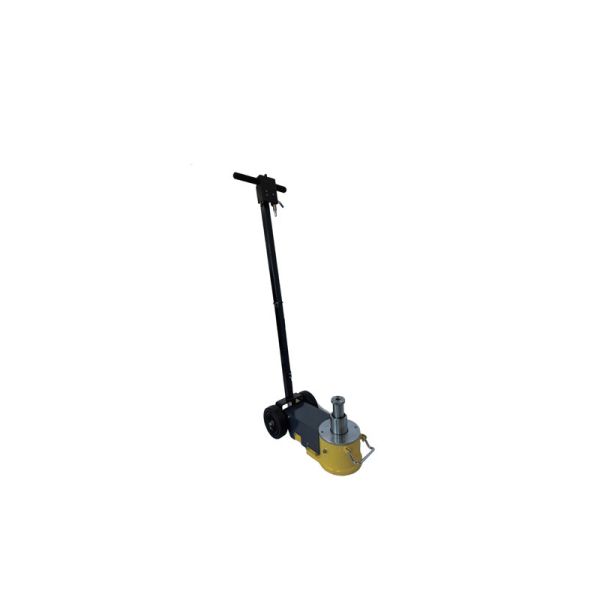
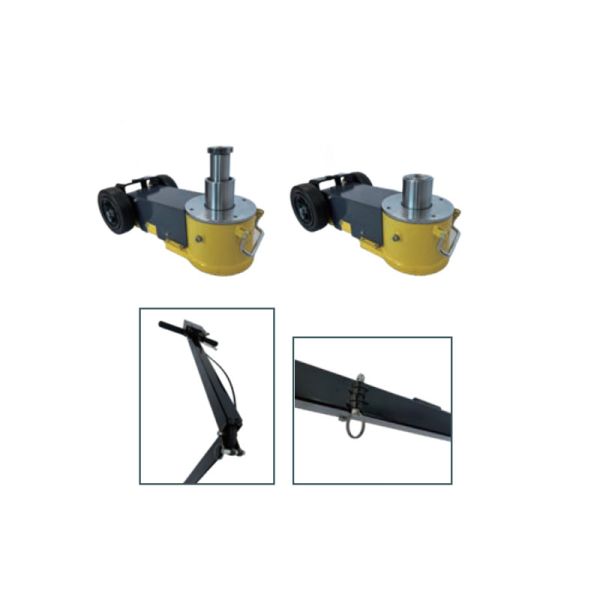
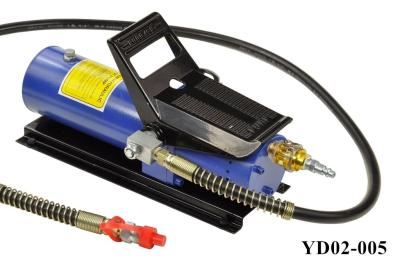
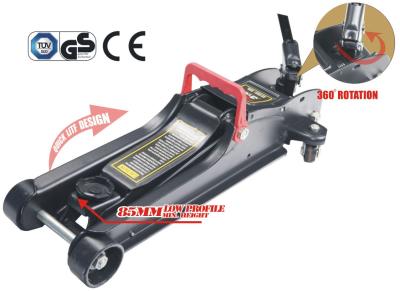
The YD21-017/018 Telescopic Air Trolley Jack Series is a professional equipment developed to address the pain points of "slow lifting, risky positioning, and tiring operation in heavy-duty vehicle maintenance". With "fast lifting + flexible positioning + safe heavy-load" as the core, it breaks through the limitations of traditional manual trolley jacks such as "time-consuming lifting, laborious positioning, and load restrictions", providing a solution that "can be pushed, lifted quickly, and supported stably" for heavy-duty vehicle maintenance. Its core advantages are as follows:
- Fast Positioning Under No Load: Air-driven power enables "fast lifting without load". The YD21-017 takes only 8 seconds to lift from the minimum height of 180mm to the positioning height of 300mm, while the YD21-018 takes only 10 seconds to lift from 160mm to 350mm—6 times more efficient than purely manual jacks (which take 60 seconds to lift to the same height). For example, when a repair shop replaces a light truck tire, traditional tools require 1 minute to adjust the height, while this series can align with the support point in only 10 seconds, saving 50 minutes for maintaining 10 vehicles a day;
- Stable Output Under Load: The hydraulic system maintains a stable lifting speed of 15-20mm/s under rated load (15T for YD21-017, 20T for YD21-018), with no jamming or settlement when lifting heavy-duty trucks. The ram deflection is ≤0.1mm, which is 80% more stable than air-driven single-drive jacks (prone to instability under load).
- YD21-017 Two-Stage Telescoping: The 180-650mm height range is suitable for light truck and minibus chassis (clearance usually 150-600mm). After lifting, it can provide a 40cm operating space, meeting operations such as tire replacement and chassis bolt tightening without additional steel plate padding;
- YD21-018 Three-Stage Telescoping: The ultra-wide height range of 160-800mm allows the minimum height to extend into the heavy-duty truck chassis (clearance usually 160-200mm) and the maximum height to support the coach frame (needing over 700mm support). It adapts to both "low-clearance access" and "high-height maintenance" scenarios, with an adaptation range 30% wider than that of two-stage telescoping models.
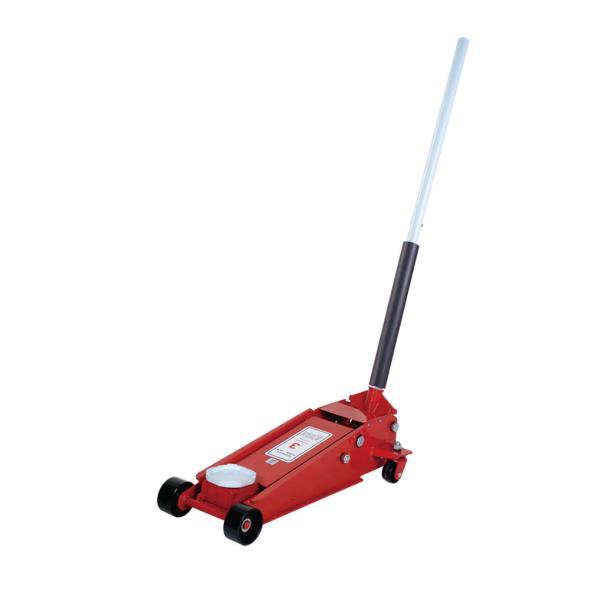
The length of the T-shaped long handle exceeds 800mm, allowing maintenance personnel to push the equipment to adjust the position from 1 meter away from the vehicle. For example, when maintaining a heavy-duty truck chassis, traditional jacks require bending over to get close to the vehicle (easily colliding with the drive shaft), while this series can accurately control the equipment to slide to the support point through the long handle, with a positioning error ≤5mm. The positioning safety is 90% higher than that of traditional tools, and it also reduces the risk of lumbar muscle strain caused by bending operations.
The 4 large-size rubber wheels are made of wear-resistant rubber material (hardness 60±5 Shore A) and can still turn flexibly under a load of 85-110kg. In narrow workshop passages (width ≤1.5 meters), one person can push the equipment to bypass tool cabinets and accessory racks and easily reach the bottom of the vehicle; the wheels are equipped with a brake function—stepping on the brake to fix the equipment after positioning, avoiding equipment displacement during operations. The safety factor is 60% higher than that of jacks without a brake design.
After the operation, simply push the air circuit valve, and the ram will retract automatically to the minimum height by air power: the YD21-017 takes only 12 seconds to retract from 650mm to 180mm, and the YD21-018 takes only 15 seconds to retract from 800mm to 160mm—50% more efficient than manual pressure relief retraction (needing over 30 seconds). It is particularly suitable for "continuous maintenance of multiple vehicles" in repair shops, saving 1.5 hours of reset time a day.
- Main Body Material: The fuselage is integrally formed with 16mm thick cold-rolled steel. Key stress-bearing parts (ram connection seat, cylinder shell) are reinforced with ribs. When the 20T model (YD21-018) bears a 20T load, the permanent deformation of the frame is ≤0.05mm, and the service life is 2.5 times longer than that of ordinary steel plate jacks;
- Overload Protection: The safety valve compliant with ANSI/ASME PALD 2009 standards instantly cuts off the air circuit when overloaded. For example, when the YD21-018 (20T load capacity) lifts a 22T heavy object, the valve closes immediately to avoid ram bending or cylinder bursting. The accident rate is 95% lower than that of jacks without compliant protection.
Scenario Requirement: Replace the front tire of a JMC Kaiyun light truck (weight 4.5T, chassis clearance 190mm), requiring fast lifting and flexible positioning, and easy movement in narrow workshop passages.
Operation Process:
- One person pushes the YD21-017 (85kg), adjusts it to the bottom of the light truck's front wheel through the long handle. The minimum height of 180mm easily extends into the chassis, and the wheel brake is stepped on to fix the equipment.
- Open the air valve, lift to the positioning height of 300mm in 8 seconds under no load, and align with the tire support point; switch to hydraulic mode, and lift the vehicle to the tire 10cm off the ground (total height 450mm) in 15 seconds.
- After replacing the tire, push the valve to start air-driven retraction, lower to the original position in 12 seconds, release the brake and push to the next vehicle. The whole process takes 25 minutes.
Result: The air-hydraulic dual-action saves lifting time, and the long handle + wheels adapt to narrow passages. Compared with traditional manual jacks (40 minutes per vehicle), the efficiency is increased by 37.5%, suitable for high-frequency tire replacement in repair shops.
Scenario Requirement: Inspect the transmission system of a Yutong T7 minibus (weight 6.8T, chassis clearance 210mm), requiring stable lifting and sufficient operating space, and compliance with safety standards in 4S stores.
Operation Process:
- Two people cooperate to push the YD21-017 to the minibus chassis, remotely align with the transmission system support point through the long handle, extend into the chassis at 180mm height, and fix the wheels.
- Lift quickly by air and switch to hydraulic mode, lift the vehicle to the maximum height of 650mm, providing a 50cm operating space.
- Maintenance personnel disassemble the transmission components and replace worn bearings; the jack shows no settlement during the 1.5-hour process. After completion, retract by air without manual pressure relief, meeting the professional inspection standards of 4S stores.
Result: The two-stage telescoping meets the high-height requirement, and the compliant design ensures safety. Compared with traditional tools (needing multiple heightenings), the inspection efficiency is increased by 50%.
Scenario Requirement: Maintain the transmission system of a FAW J7 heavy-duty truck (weight 12T, chassis clearance 170mm), requiring 20T load capacity and high-stroke lifting, and continuous operations in the service station.
Operation Process:
- One person pushes the YD21-018 (110kg); the rubber wheels easily pass through the service station passage, and the long handle accurately adjusts it to the bottom of the transmission system. Extend into the chassis at 160mm height and fix with the brake.
- Lift to 200mm in 3 seconds by air, switch to hydraulic mode and lift to the maximum height of 800mm to support the heavy-duty truck body.
- Maintenance personnel replace the drive shaft and inspect the gearbox; after completion, retract in 15 seconds by air and push to the next heavy-duty truck. The maintenance time for a single vehicle is 2 hours.
Result: The three-stage telescoping + 20T load capacity adapts to the heavy load of heavy-duty trucks, and the self-retracting function improves the efficiency of continuous operations. Compared with traditional tools (3.5 hours per vehicle), it saves 43% of time.
Scenario Requirement: Adjust the frame levelness of a King Long XMQ6129 coach (weight 15T, chassis clearance 180mm), requiring high-height support and precise positioning, and safety and stability in the repair shop.
Operation Process:
- Two people cooperate to push the YD21-018 to the bottom of the coach frame, remotely align with the support point through the long handle, extend into the chassis at the minimum height of 160mm and fix.
- Lift quickly by air, then lift to 750mm height (reserving a safety margin) by hydraulic mode, and calibrate the frame angle with a level.
- After adjusting the frame bolts, slowly retract to the target height by air. The whole process takes 2.5 hours with no equipment displacement, adapting to the heavy frame operation of coaches.
Result: The 800mm high stroke meets the frame adjustment needs, and the heavy-duty wheels + brake design ensure stability. Compared with the traditional cooperative operation of multiple jacks (prone to deviation), the adjustment accuracy is increased by 80%.
A1: The overload protection will be triggered, and maintenance is not recommended. The rated load capacity of the YD21-018 is 20T, with an overload protection threshold of 22T—22T has reached the safety upper limit. Forced operation will cause the safety valve to cut off the air circuit frequently, leading to unstable ram lifting and lowering and affecting maintenance progress; moreover, the ram (high-strength alloy material) of the 20T specification bearing a 22T load for a long time will accelerate the aging of seals, reducing the service life from 5 years to 2 years and increasing equipment maintenance costs. An air jack with a specification of 25T or above is required for maintaining a 22T heavy-duty truck.
A2: It is mostly caused by loose air circuit connection, insufficient air pressure, or valve blockage. Troubleshoot in the following steps:
- Check the air circuit connection: Confirm whether the air pipe interface between the equipment and the air compressor is tightened (rotate clockwise until a "click" sound is heard); re-connect if loose. At the same time, check whether the air pipe is damaged (replace with a high-pressure air pipe with 10mm inner diameter if damaged);
- Check the air compressor pressure: Start the air compressor and observe whether the pressure gauge reaches 0.6-0.8MPa (standard working pressure); adjust the air compressor pressure valve to the standard range if the pressure is insufficient;
- Clean the valve blockage: If the air pressure is normal, disassemble the air valve, blow out internal impurities (such as oil stains and dust) with compressed air (0.3MPa), or rinse with alcohol and reassemble to ensure the valve core moves smoothly.
A3: One person can push it easily through leveraging design + environment optimization. The specific tips are as follows:
- Use the wheels for labor saving: The rubber wheels of the equipment have low rolling resistance. When pushing, hold the middle part of the T-shaped long handle with both hands, lean the body slightly forward, and exert force by shifting the center of gravity—saving 40% of physical strength compared to pushing by holding the fuselage with both hands;
- Clear passage obstacles: Clean up tools and accessory boxes in the maintenance passage in advance to ensure the passage is flat (no protrusions or depressions), reducing wheel jamming and making pushing smoother;
- Use traction assistance: If the passage is long (over 10 meters), tie a traction rope to the hook at the front of the equipment, pull the traction rope with one hand and push at the same time to further reduce the operation difficulty.