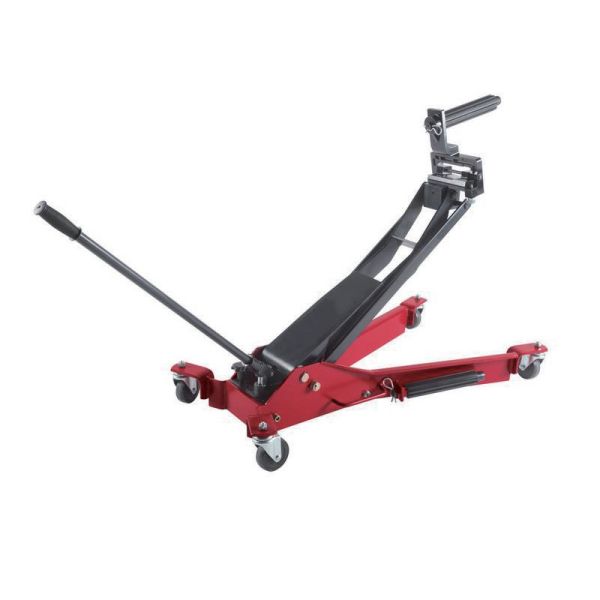
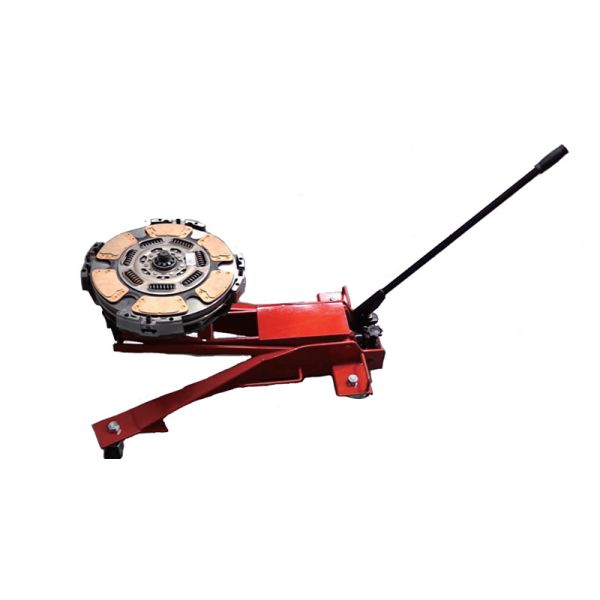
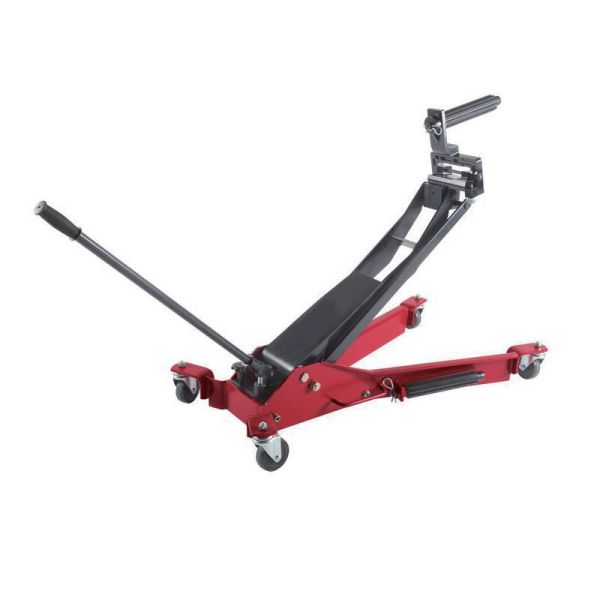
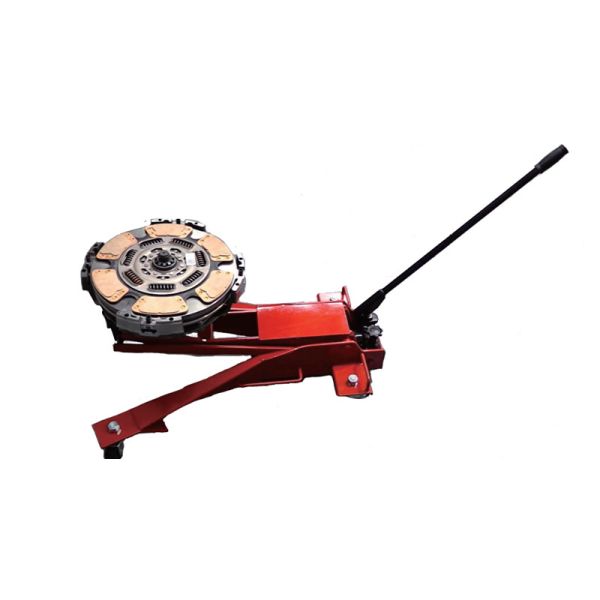
The YD21-006 136kg Clutch Jack is a professional maintenance equipment designed to address the pain points of "difficult positioning during automotive clutch disassembly and assembly, limited operating space, and laborious manual handling". With "precise positioning + flexible operation + stable load-bearing" as the core, it breaks through the limitations of traditional maintenance tools such as "poor adaptability, cumbersome operation, and high safety risks", providing a clutch disassembly and assembly solution that "saves time, reduces difficulty, and ensures safety" for automotive maintenance scenarios. Its core advantages are as follows:
The saddle supports both horizontal and vertical tilt adjustment, which can accurately match the installation angle of the clutch in the vehicle chassis. Traditional jack saddles are fixed, and when disassembling and assembling inclined clutches, it is necessary to repeatedly pad gaskets, which is time-consuming and prone to displacement. However, the YD21-006 can directly adjust the clutch to a posture convenient for disassembly and assembly through the saddle tilt function, saving 15-20 minutes per operation, especially suitable for vehicle models with inclined clutch installation such as Volkswagen Passat.
It comes with two spines of 2” and 1-3/4” specifications, which can be quickly replaced according to the size of the clutch center hole: when maintaining vehicles with large-size clutches such as Toyota Camry, the 2” spine is selected; when maintaining small-size clutches of light trucks such as Wuling Rongguang Mini Truck, switch to the 1-3/4” spine. No additional accessories need to be purchased, with an adaptability rate of over 90%, reducing maintenance costs and waiting time.
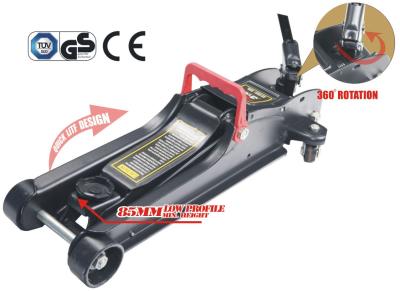
The 360° rotating pump handle breaks the operational limitation of traditional fixed pump handles: no matter whether the operator stands on the left, right, or rear of the equipment, a comfortable pressing angle can be found without frequent body movement to adjust the position. For example, when maintaining a vehicle in a narrow workshop station, traditional jacks require the operator to bend over or exert force sideways due to the fixed direction of the pump handle. However, the YD21-006 can achieve labor-saving lifting by rotating the pump handle, reducing labor intensity.
The 4 wear-resistant rubber swivel casters have excellent load-bearing performance, and one person can push the equipment to move flexibly under a net weight of 60kg: it only takes 30 seconds to push from the tool storage area to the maintenance vehicle, and the position of the equipment can be fine-tuned during disassembly and assembly to ensure the saddle accurately aligns with the clutch support point. Compared with traditional tools that require two people to carry, the YD21-006 can save more than 1 hour of handling time per day in scenarios with continuous maintenance of multiple vehicles, improving workshop turnover efficiency.
The main body is integrally formed with 10mm thick cold-rolled steel, and key stress-bearing parts are reinforced with ribs. The frame deflection is ≤0.1mm under a rated load of 136kg; the saddle and spines are made of alloy materials, with a hardness of over HRC45 after heat treatment, no deformation or fracture risk under long-term load, and a service life twice that of ordinary cast iron jacks, adapting to the high-frequency maintenance needs of auto repair shops.
The release valve adopts a precision valve core design, and the saddle lowering speed can be controlled by rotating with one hand, with a minimum lowering speed adjustable to 5mm/s: when disassembling and assembling the clutch, the saddle can be lowered slowly to ensure the component is smoothly separated from the installation position, avoiding clutch gear damage caused by "uncontrollable pressure relief and sudden component dropping" of traditional tools. Tests show that the component damage rate when disassembling and assembling clutches with the YD21-006 is reduced by 90% compared with traditional tools.
Scenario Requirement: Maintain a Toyota Camry (clutch weight about 15kg, installation angle tilted at 15°), requiring replacement of a worn clutch; the tool needs precise positioning and flexible operation.
Operation Process:
- Two people cooperate to push the YD21-006 to the bottom of the vehicle chassis; the 4 swivel casters adjust the position easily, and the minimum height of 11.34 inches extends smoothly.
- Select the 2” spine for installation according to the clutch size, adjust the saddle to tilt at 15°, and align with the clutch support point.
- Rotate the 360° pump handle to a comfortable angle, press and lift the saddle until the clutch is separated from the flywheel (lifting height about 350mm), and remove the old clutch.
- After installing the new clutch, slowly rotate the release valve to control the saddle to lower smoothly and complete the installation; the whole process takes 40 minutes.
Result: The tiltable saddle accurately matches the installation angle, saving 20 minutes compared with traditional tools (requiring gasket padding for adjustment), with no risk of component damage, adapting to the regular maintenance of family cars.
Scenario Requirement: Inspect the flywheel wear of a Haval H6 (flywheel weight about 18kg, installed in a deep position); the tool needs long-stroke lifting and convenient operation.
Operation Process:
- One person pushes the YD21-006 to the bottom of the SUV; the swivel casters flexibly avoid chassis components and adjust to the position directly below the flywheel.
- Install the 1-3/4” spine, adjust the saddle to a horizontal state, press the 360° rotating pump handle, lift the saddle to the maximum height of 980mm, and jack up the flywheel.
- The maintenance personnel check the flywheel wear, mark the worn parts, then slowly release the pressure to lower the wheel and replace the worn components; the whole process takes 50 minutes.
Result: The 980mm long stroke meets the needs of deep-position operations, and the 360° pump handle is labor-saving to operate. Compared with traditional jacks (requiring repeated position adjustment), the efficiency is increased by 40%, meeting the professional maintenance standards of 4S stores.
Scenario Requirement: Maintain a Wuling Rongguang Mini Truck (clutch weight about 20kg, center hole size compatible with 1-3/4” spine); the clutch is stuck and needs to be disassembled for maintenance; the tool needs stable load-bearing and strong adaptability.
Operation Process:
- Two people carry the YD21-006 to the side of the truck and push it to the bottom of the chassis through the swivel casters; the minimum height extends easily.
- Install the 1-3/4” spine, adjust the saddle to vertically jack up the clutch, press the pump handle to lift the saddle until the clutch is separated from the gearbox (lifting height about 400mm).
- The maintenance personnel disassemble the clutch, clean the stuck impurities, and after maintenance, slowly release the pressure to install it; the whole process takes 1.5 hours.
Result: The 136kg load-bearing stably supports the clutch, and the dual-specification spines are accurately compatible. Compared with tools without special spines (requiring self-made adapters), it saves 1 hour, ensuring the light truck quickly resumes operation.
Scenario Requirement: Perform clutch maintenance on 10 Volkswagen Passats (clutch installation angle uniformly tilted at 12°), requiring efficient continuous operation; the tool needs flexible movement and high adaptability.
Operation Process:
- Fix the YD21-006 next to the workshop mobile track, and quickly switch to the bottom of each vehicle through the swivel casters.
- Uniformly select the 2” spine, adjust the saddle to tilt at 12°, press the pump handle to lift and inspect the clutch; the maintenance time for a single vehicle is 35 minutes.
- One person leads the operation throughout the process, and only needs to assist in fine-tuning the equipment position when replacing vehicles; the batch maintenance of 10 vehicles takes only 6 hours.
Result: The swivel casters and 360° pump handle improve the efficiency of continuous operations, saving 30% of labor costs compared with traditional tools (requiring two people to collaborate throughout), adapting to the fleet batch maintenance scenario.
A1: It can support safely without overloading. The rated load of the YD21-006 is 136kg, and the weight of a 20kg light truck clutch is far below the rated value. During lifting, the equipment frame, saddle, and spines are all within the safe working range. It should be noted that before lifting, ensure the spine is installed firmly and the saddle is completely attached to the clutch support surface to avoid "point contact" causing excessive local stress and damaging the clutch or equipment.
A2: It is mostly caused by insufficient hydraulic oil, oil circuit blockage, or jamming at the pump handle connection. Troubleshoot in the following steps:
- Check the hydraulic oil level: Open the oil filling port at the top of the equipment; if the oil level is below the scale line (needing to cover 1/2 of the cylinder bottom), add 46# anti-wear hydraulic oil to the standard position, and press the pump handle repeatedly 5-8 times to discharge air from the oil circuit;
- Clean the oil circuit blockage: If the oil level is normal, disassemble the oil circuit interface connected to the pump handle, blow out internal impurities with compressed air (0.3MPa), or rinse with alcohol and reassemble;
- Check the pump handle connection: If there is a stuck feeling when pressing the pump handle, check if there is foreign matter jamming at the connection, clean the impurities, and apply grease (lithium-based grease is acceptable) to ensure smooth rotation and pressing of the pump handle.
A3: Two people can carry it easily through correct carrying posture + auxiliary tools. The specific tips are as follows:
- Correct carrying posture: Two people stand on both sides of the equipment respectively, hold the metal handles on both sides of the machine body (located in the middle of the equipment) with both hands, bend their knees and straighten their waists at the same time, and stand up with the help of leg strength. Avoid bending over to carry with waist strength to reduce the risk of lumbar strain;
- Use a workshop cart: If the carrying distance exceeds 5 meters, place the equipment on a flat cart with a load capacity ≥100kg, and two people push both sides of the cart respectively, moving labor-savingly with the help of wheel rolling, saving 60% of physical strength compared with direct carrying;
- Use rail transportation: If the workshop is equipped with maintenance rails, fix the equipment on the rail slider and slide it directly to the maintenance station through the rails, without manual carrying, further reducing labor intensity.
A4: It is mostly caused by rust on moving parts, insufficient lubrication, or loose fixing bolts. The solutions are as follows:
- Saddle tilt failure: If the saddle cannot tilt, check if the tilt shaft connection is rusted, polish the rust with sandpaper, apply anti-rust grease, and repeatedly toggle the saddle until it is flexible;
- Spine looseness: If the spine shakes after installation, check if the fixing bolts are loose, tighten the bolts clockwise with a wrench (torque controlled at 20N·m) to ensure the spine is tightly connected to the saddle without shaking;
- Regular maintenance: If idle for more than 1 month, take out the equipment, manually operate the saddle tilt and pump handle rotation, check the flexibility of each component, and apply grease to moving parts to avoid component jamming caused by long-term idleness.