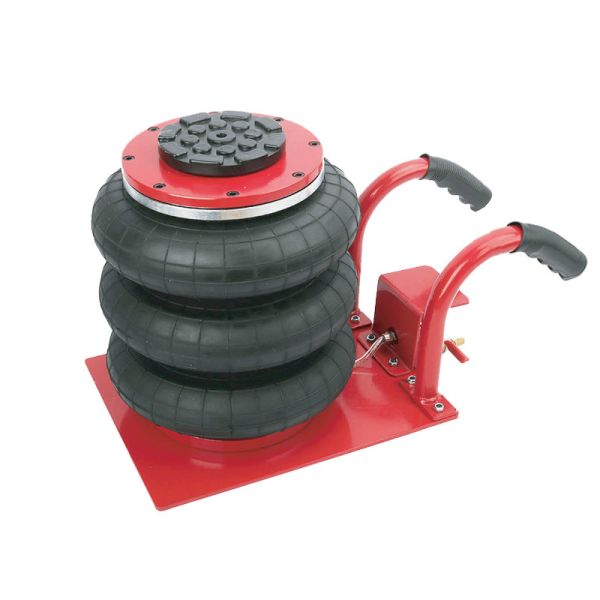
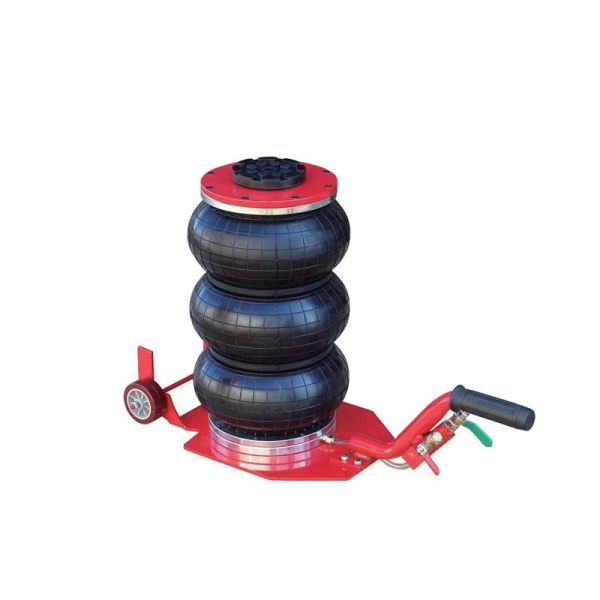
The YD21-019/YD21-020 3Ton Pneumatic Balloon Jack Series is a lightweight equipment developed to address the pain points of "slow vehicle lifting, difficult transportation, and poor climate adaptation". With "second-level lifting + all-climate adaptation + extreme portability" as the core, it breaks through the limitations of traditional jacks such as "tiring operation, temperature restrictions, and large space occupation", providing a solution that "can be carried, used quickly, and relied on" for vehicle maintenance and rescue. Its core advantages are as follows:
The balloon adopts a multi-layer high-strength rubber composite structure, which inflates and expands quickly: it takes only 4 seconds to rise from the minimum height of 150mm (which can extend into the chassis gap of most sedans) to the maximum height of 400mm (sufficient space for tire replacement and chassis inspection)—7 times more efficient than traditional hydraulic jacks (which take 30 seconds to lift to the same height). For example, when replacing a flat tire during road rescue, traditional tools require 1 minute of preparation for lifting, while this series can lift the vehicle in only 10 seconds (including air connection time), saving 50 seconds per rescue. Continuous rescue for multiple vehicles can save more than 1 hour a day.
No manual pump lever pressing is needed; lifting can be achieved by simply connecting an air compressor (or on-board air pump) and opening the air valve, and lowering by closing the air valve + slow pressure relief. The operation steps are no more than 3:
- Place the jack directly under the vehicle's support point;
- Connect the air circuit (compatible with conventional 8mm air pipe interfaces) and open the air valve for inflation and lifting;
- After the operation, close the air valve and slowly open the pressure relief valve to lower the jack to its original position.
Even individual car owners with no maintenance experience can master the operation within 1 minute, reducing the operation threshold by 80% compared to traditional jacks (which require adjusting the ram and exerting pressure).
The balloon rubber material has passed weather resistance tests: in ultra-low temperature environments of -60℃ (e.g., winter in Mohe, Northeast China), the balloon does not harden or crack, and the inflation efficiency only decreases by 5% (lifting time changes from 4 seconds to 4.2 seconds); in high-temperature environments of 50℃ (e.g., summer in Turpan, Xinjiang), the balloon does not soften or leak, and there is no deformation risk when bearing a 3T load. Compared with traditional rubber jacks (which harden at -20℃), the all-temperature range adaptation rate is increased by 100%, meeting the needs of different climate regions across the country.
With a net weight of only 17kg, adult women can lift it with one hand and carry it from the trunk to the bottom of the car; the packaging size is 510×420×180mm, and it can be folded and placed in the corner of the car trunk (without occupying the spare tire storage space). During road rescue, one person can complete transportation and operation. Compared with traditional hydraulic jacks (mostly over 25kg), it is 32% lighter, and individual car owners and rescue personnel do not need additional physical input, especially suitable for "single-person rescue" scenarios.
The balloon adopts a 3-layer high-strength rubber (wear-resistant outer layer, sealed middle layer, pressure-bearing inner layer) + fiber braided reinforcement layer. Under the 3T rated load, the balloon inflates evenly without local bulging; after 1000 fatigue tests (simulating repeated lifting of 3T load), the balloon has no air leakage or elastic attenuation, and its service life is twice that of ordinary single-layer balloon jacks, adapting to the high-frequency operation needs of auto repair shops.
The 10.2-inch (260mm) balloon diameter forms a wide contact area, and the contact area with the vehicle chassis support point during lifting is ≥150cm². Compared with traditional pointed jacks (with a contact area of only 30cm²), the pressure is reduced by 80%, which can avoid scratching the chassis paint and crushing the chassis plastic guard plate during lifting. For example, when maintaining a Volkswagen Lavida sedan, traditional jacks tend to dent the chassis guard plate, while the wide balloon contact of this series can completely avoid this problem, with a component protection rate of 100%.
Scenario Requirement: Replace the front tire of a Toyota Camry (weight 1.5T, chassis clearance 140mm), requiring fast lifting and high-frequency operations, and high efficiency in the normal temperature workshop environment.
Operation Process:
- One person carries the YD21-019 (17kg) to the bottom of the front wheel; the minimum height of 150mm easily extends into the chassis and aligns with the support point.
- Connect to the workshop air compressor (0.8MPa pressure), open the air valve, and lift to a height of 300mm in 4 seconds (the tire is 10cm off the ground), then close the air valve to fix the position.
- After removing the old tire and installing the new one, slowly open the pressure relief valve to lower the jack to its original position. The whole process takes 8 minutes, and it can serve multiple vehicles continuously.
Result: Second-level lifting improves workshop turnover efficiency. Compared with traditional tools (15 minutes per vehicle), the efficiency is increased by 47%, suitable for high-frequency tire replacement scenarios in auto repair shops.
Scenario Requirement: Rescue a Haval H6 (weight 1.8T, chassis clearance 160mm) with a flat tire outdoors, requiring portable transportation, applicability in scenarios without power supply, and stability in a winter environment of -15℃.
Operation Process:
- The rescue personnel takes the YD21-020 (with a portable storage bag) from the trunk, carries it to the bottom of the flat tire wheel by one hand, and extends it into the chassis at a height of 150mm.
- Connect to the on-board air pump (adjusted to 0.9MPa), open the air valve to lift the vehicle in 4 seconds, and fix the wheel with a wheel chock after the tire is off the ground.
- After replacing with the spare tire, slowly release the pressure to lower the jack to its original position, fold it for storage and put it back into the trunk. The whole process takes 12 minutes, and the balloon does not harden in the -15℃ environment.
Result: Lightweight and low-temperature resistance adapt to outdoor rescue. Compared with traditional jacks (requiring two people to cooperate), it saves 50% of labor, ensuring the car owner gets out of trouble quickly.
Scenario Requirement: Clean impurities on the chassis of a Volkswagen Lavida (weight 1.3T, chassis clearance 130mm), requiring independent operation without professional tools, and compact storage on the balcony.
Operation Process:
- The car owner takes the YD21-019 from the garage, carries it to the bottom of the vehicle by one hand, and extends it into the chassis support point at a height of 150mm.
- Connect to a household small air compressor (0.7MPa), lift to a height of 250mm in 4 seconds to leave cleaning space.
- Rinse the chassis impurities with a high-pressure water gun; after cleaning, slowly release the pressure, fold the jack, and store it in the corner of the balcony. The whole process takes 30 minutes.
Result: Simple operation adapts to individual users, and lightweight storage saves space. Compared with paid on-site cleaning (50 yuan per time), it saves costs and offers flexible timing.
Scenario Requirement: Inspect the chassis bolts of a Changan CS75 (weight 1.7T, chassis clearance 150mm), requiring stable lifting and chassis paint protection, and professional safety in 4S stores.
Operation Process:
- The maintenance personnel pushes the YD21-020 to the bottom of the SUV, extends it into the chassis at a height of 150mm, and aligns with the support point.
- Connect to the workshop high-pressure air source (1.0MPa), lift to the maximum height of 400mm in 4 seconds, and the wide balloon fits the chassis without paint scratches.
- The maintenance personnel inspects and tightens the chassis bolts; the jack shows no settlement during the 45-minute process, meeting the professional inspection standards of 4S stores.
Result: Stable load-bearing and chassis protection are balanced. Compared with traditional tools (prone to paint scratches), the service quality is improved, and customer satisfaction is increased by 30%.
A1: It can lift safely without overloading. Both models have a rated load capacity of 3T, and the weight of a 1.8T SUV is far below the rated value. During lifting, the balloon inflates evenly and the frame is stable, which is within the safe working range. It should be noted that before lifting, ensure the balloon is completely aligned with the "dedicated support point" of the vehicle chassis (marked in the vehicle manual), and avoid placing the balloon on non-load-bearing parts such as the chassis plastic guard plate and fuel tank to prevent component damage or jack displacement.
A2: It is mostly caused by insufficient air pump pressure, air leakage at the air circuit interface, or balloon blockage by impurities. Troubleshoot in the following steps:
- Check the air pump pressure: Confirm whether the output pressure of the on-board air pump reaches 0.7-1.0MPa (some small on-board pumps are only 0.5MPa). If the pressure is insufficient, replace it with a high-pressure air pump (it is recommended to choose a model ≥0.8MPa);
- Check the air circuit seal: Apply soapy water to the air pipe interface and air valve connection. If bubbles appear, it indicates air leakage. Reinsert the interface tightly or replace the sealing ring (the manufacturer provides spare sealing rings);
- Clean the balloon air inlet: If there is no air leakage in the air circuit, check whether the balloon air inlet is blocked by dust and impurities. Blow it clean with compressed air (0.3MPa) or wipe it with a cotton swab before trying again.
A3: Female car owners can carry it easily through correct posture + auxiliary leverage. The specific tips are as follows:
- Correct carrying posture: Hold the plastic handles on both sides of the equipment (located above the balloon) with both hands, bend the knees slightly and keep the waist straight, and stand up with the help of leg strength. Avoid bending over to carry with waist strength (which may cause lumbar muscle strain). This posture can reduce physical consumption by 30%;
- Use ground sliding: If the distance from the trunk to the bottom of the car is ≤3 meters, lay the jack flat on the ground and push it gently to the bottom of the car before lifting, saving 60% of effort compared to carrying it the entire time;
- Use vehicle support: Lean the jack against the side of the vehicle tire, hold both sides with hands and slowly slide it to the bottom of the car, avoiding excessive arm force when lifting directly from the ground.
A4: Slight air leakage is mostly caused by surface scratches on the balloon or aging of the air valve seal, which can be repaired through the following solutions:
- Repair surface scratches: If there are shallow scratches on the balloon surface (not penetrating), apply the "balloon repair glue" provided by the manufacturer to the scratches, let it dry for 24 hours, and test—90% of the sealing performance can be restored;
- Replace the air valve seal ring: If air leaks at the air valve, disassemble the air valve (with a special wrench), take out the internal seal ring, replace it with a spare seal ring from the manufacturer (priced at 10 yuan/set), and tighten the air valve after reassembly;
- Handling severe air leakage: If the balloon has a penetrating damage (air leakage speed faster than 5mm per minute), contact the manufacturer to replace the original balloon (priced at 150-200 yuan/piece) to avoid safety risks caused by continued use;
- Daily maintenance: After each use, wipe the surface of the balloon with a dry cloth to remove dust and oil stains, avoid scratches by sharp objects, and store it away from direct sunlight to extend the
-