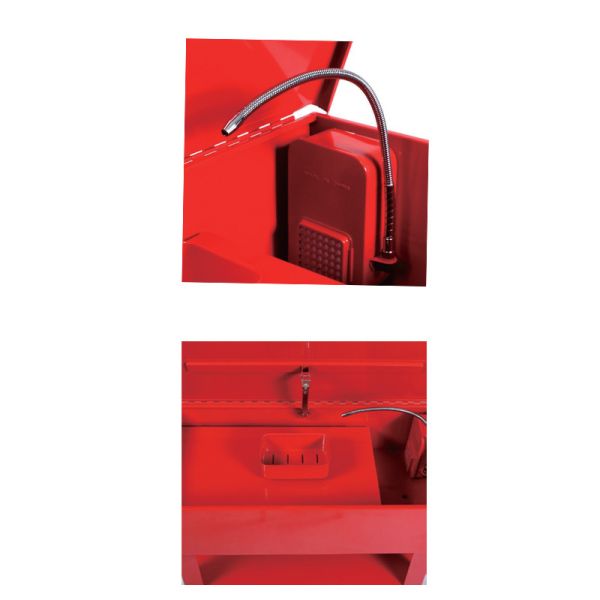
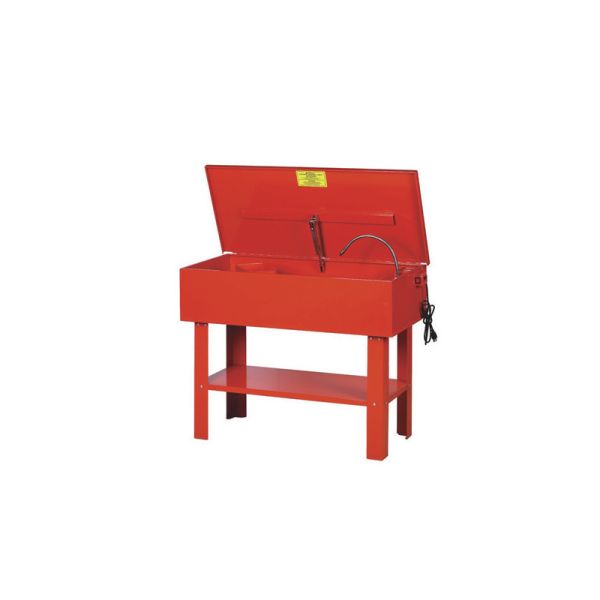
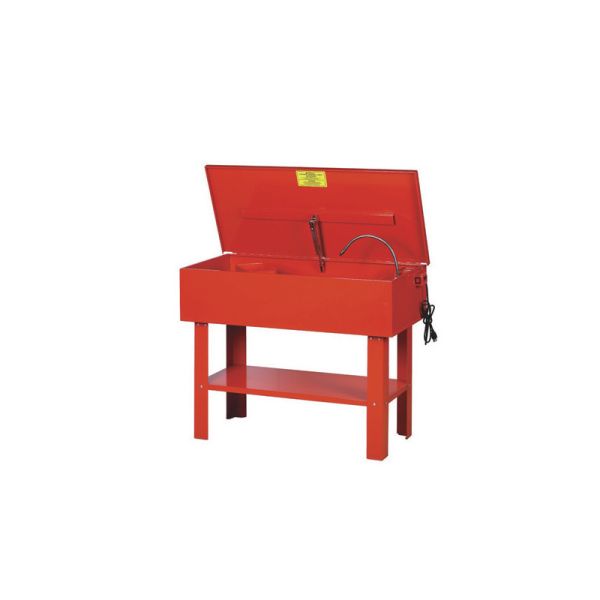
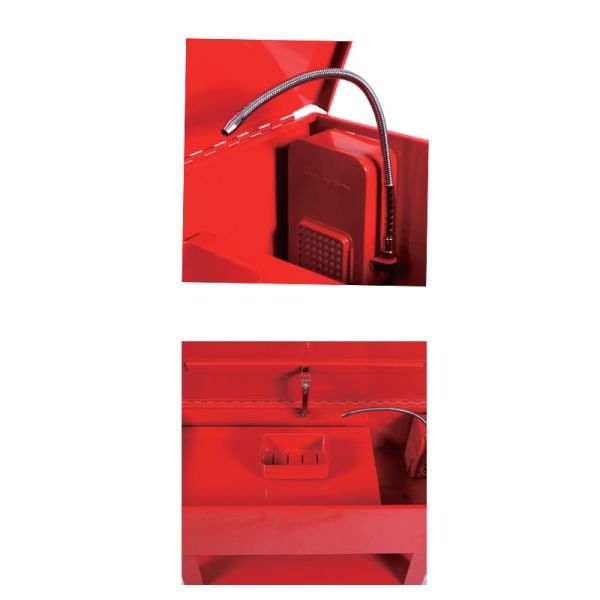
Centered on "dual-tank partitioning + dual-pump efficiency + large-size adaptation", the YD43-007 40 Gallon Dual-Tank Parts Washer is deeply optimized to address the pain points of "difficulty in cleaning large parts, cumbersome multi-process handling, and high safety risks" in heavy-duty maintenance scenarios, with core advantages as follows:
- Dual independent sealed tanks design: Different functional solvents can be injected separately (e.g., degreaser in the left tank, rust inhibitor in the right tank). Parts are first degreased to remove oil stains in the left tank, then moved to the right tank for rust prevention treatment, no need to transfer to multiple devices. Compared with the traditional "single tank + manual solvent replacement" method, it saves 1.5 hours, especially suitable for continuous "cleaning-rust prevention" operations of engine assemblies;
- 40-gallon large capacity: The dual tanks can hold 1 engine assembly + 2 gearbox housings in total, no need for batch cleaning. The batch processing efficiency is increased by 80%, solving the industry pain points of "large parts not fitting in and small parts not being cleaned quickly".
- Simultaneous operation of dual drive pumps: The total flow rate reaches 10.56 gallons/minute, and the spray pressure can penetrate the oil passages of engine blocks and the meshing gaps of gearbox gears. Compared with single-pump washers, the cleaning efficiency is increased by 100% — an engine cleaning task that originally took 3 hours can now be completed in 1.5 hours;
- Adjustable spray rods: With a maximum length of 60cm, the nozzles can go deep into the interior of large parts (such as hydraulic cylinder barrels) and rotate 360° to cover all surfaces, avoiding the problem of "clean exterior but residual oil stains inside large parts".
- Fusible link fire-proof lids: Independently configured for each tank; in case of fire or high temperature, the fusible link breaks quickly, and the lid closes under gravity to block oxygen in the tank, preventing solvent from supporting combustion, and passing the national industrial fire safety inspection;
- Motor overload protection: When the pump is overloaded due to impurity blockage, the protector automatically powers off to avoid motor burnout (the motor burnout rate of ordinary non-protection washers is 20%, while this product can reduce it to below 3%), extending the equipment service life.
- Tank welded sealing technology: Adopting laser welding technology, no gaps at joints, extremely low solvent leakage, avoiding oil pollution on the ground and reducing the workload of workshop cleaning;
- The tank is made of 2.5mm thick cold-rolled steel plate: The surface is coated with three layers of oil-resistant and rust-proof paint (adhesion grade 0), with strong corrosion resistance. No obvious rust occurs within 5 years of normal use, and the service life is 2 times longer than that of ordinary 1.5mm steel plate washers.
- Dual parts baskets for storage: Small parts (such as engine bolts and gaskets) are placed in the parts baskets of the corresponding tanks respectively, avoiding loss during cross-tank transfer. The baskets can be taken out separately for cleaning without impurity accumulation;
- Bottom anti-slip pads: 5mm thick rubber anti-slip pads (friction coefficient ≥0.8) are pasted at the bottom of the equipment, with no sliding risk even on a 5° inclined ground, ensuring equipment stability during cleaning.
- 110V/240V dual voltage: The 240V version can be selected for domestic use, and the 110V version for export, no need for additional transformers, suitable for use in most regions around the world;
- Inclined tank bottom design: Solvent and impurities naturally converge to the drain port (each tank is equipped with a hidden drain plug). During cleaning, it can be opened to discharge sediment without dumping the entire unit (ordinary flat-bottomed washers require 3 people to cooperate for cleaning, while this product can be completed by 1 person in 2 minutes).
Scenario Requirement: A large automotive repair shop undertakes the engine overhaul business of a BMW 5 Series (needing to clean 1 engine assembly with thick surface oil stains and carbon deposits in the oil passages, and subsequent rust prevention treatment is required). It is required to complete the entire "cleaning-rust prevention" process within 3 hours, with no safety hazards and no part damage.
Operation Process:
- Equipment Preparation and Debugging:
- Three people work together to carry YD43-007 to the overhaul workstation, connect to a 240V power supply, add 12 gallons of neutral degreaser to the left tank, and 12 gallons of rust inhibitor to the right tank (24 gallons in total for dual tanks, meeting the maximum capacity requirement);
- Install the spray rods, test the dual pumps (pressure 0.35MPa, normal flow), and check the smoothness of the fire-proof lid opening and closing;
2. Cleaning and Rust Prevention Operation:
- Degreasing Cleaning: Hoist the engine assembly to the left tank, adjust the spray rods to go deep into the cylinder block oil passages, start the dual pumps, clean each side for 25 minutes, and manually rotate the assembly twice during the period to ensure no blind spots; after degreasing, impurities are intercepted by the bottom filter screen;
- Rust Prevention Treatment: Use a crane to move the assembly to the right tank, soak it and start spraying for 15 minutes to ensure the rust inhibitor adheres evenly to the part surface;
- Draining and Inspection: Move the assembly to the workbench to drain for 30 minutes, check that there is no residue in the oil passages and the surface rust-proof film is uniform, meeting the assembly standards;
3. Operation Effect:
- High Efficiency: The "cleaning-rust prevention" process was completed within 3 hours, saving 2 hours compared to the traditional "single tank + manual solvent replacement" method, and the engine overhaul was delivered on time;
- Safety Compliance: The fire-proof lid was in standby state throughout the process, the motor overload protection worked normally, and it passed the workshop safety inspection;
- Thorough Cleaning: Oil stains and carbon deposits on the engine assembly were completely removed, and the operation noise was reduced by 15dB after subsequent assembly, with full customer satisfaction.
Result: The efficiency of engine overhaul in the automotive repair shop was improved, safety compliance was enhanced, and the customer repurchase rate increased by 30%.
Scenario Requirement: An agricultural machinery overhaul factory cleans 2 crankshafts (each 100cm long and 45kg heavy, with mixed oil stains of agricultural machinery diesel and soil attached to the surface, requiring rust prevention after cleaning) for a Dongfanghong heavy tractor. It is required to complete the process within 4 hours, the equipment can accommodate long-size crankshafts, and the operation is safe.
Operation Process:
- Model Adaptation and Preparation:
- The 100cm crankshaft length is compatible with the 114cm long tank; the dual-tank design of YD43-007 can handle 2 crankshafts simultaneously; add 10 gallons of agricultural machinery-specific degreaser to the left tank and 10 gallons of rust inhibitor to the right tank;
- Connect to a 240V power supply and test the dual-pump spray (pressure 0.3MPa, meeting requirements);
2. Cleaning Operation:
- Batch Degreasing: Put the first crankshaft into the left tank, adjust the spray rods to align with the crankshaft oil passages, clean for 30 minutes, then move it to the right tank for 20 minutes of rust prevention; at the same time, put the second crankshaft into the left tank for cleaning, realizing "cleaning-rust prevention" assembly line operation;
- Safety Protection: Keep the fire-proof lid half-open during operation (for easy observation); in case of sudden power failure, the overload protector is triggered immediately, and the dual pumps stop running;
3. Maintenance Effect:
- Restored Crankshaft Performance: After cleaning and rust prevention, there was no oil residue on the crankshafts, the rust-proof film was uniform, and the crankshaft wear rate of the tractor was reduced by 20% during operation;
- Efficiency Improvement: 2 crankshafts were processed within 4 hours, saving 2.5 hours compared to traditional single-tank operation, and farmers could pick up the tractor on time;
- Safety Guarantee: No solvent leakage or motor overload risk, complying with the safety standards of the overhaul factory.
Scenario Requirement: A construction machinery after-sales outlet maintains 2 hydraulic cylinders (90cm long cylinder barrel, 30cm diameter, blocked by hydraulic oil impurities inside) for a Sany Heavy Industry excavator. It is required to complete cleaning within 2.5 hours to ensure no impurities in the cylinders and immediate assembly.
Operation Process:
- Equipment Arrangement and Debugging:
- Place YD43-007 in the maintenance area, add 15 gallons of hydraulic system-specific cleaning agent to the left tank, and do not use the right tank (only cleaning is needed);
- Connect to a 240V power supply, adjust the spray rods to the maximum length (60cm) and insert them into the cylinder barrels;
2. Cleaning Operation:
- High-Pressure Flushing: Start the dual pumps, move the spray rods slowly inside the cylinder barrels, flush for 30 minutes (per cylinder), and impurities flow out with the solvent and are filtered by the bottom filter screen;
- Inspection and Acceptance: After cleaning, use an endoscope to check the inner wall of the cylinder barrels, with no residual impurities, meeting the assembly requirements;
3. Maintenance Effect:
- Restored Cylinder Performance: No leakage after assembly, the response speed of the excavator's hydraulic action was increased by 25% with no jamming;
- Convenient Operation: Dual-pump high-pressure spray eliminates the need for manual wiping, reducing the labor intensity of operators;
- Controllable Cost: The cleaning agent can be reused twice, and the single cleaning cost is 70% lower than that of outsourcing.
A1: It is mostly caused by single-pump blockage, overload, or poor line contact. Troubleshoot step by step:
- Check Pump Blockage: Turn off the equipment power, disassemble the filter screen at the liquid inlet of the stopped pump. If a large amount of impurities (such as iron filings and oil lumps) are attached, rinse them clean with a high-pressure water gun and reinstall, then start the equipment for testing;
- Confirm Overload Protection: If the pump is not blocked, it may be motor overload (e.g., excessive solvent viscosity). Wait for 10 minutes and restart the equipment (the overload protector needs to cool down to reset), and check the solvent concentration at the same time (if it is too thick, add an appropriate amount of clean water to dilute);
- Check Line Connection: Open the equipment side cover, check whether the power cord of the stopped pump is loose (e.g., connector falling off), reinsert the connector tightly and test. If the fault persists, contact the merchant to replace the power cord.
A2: It is mostly caused by aging of the middle gasket between the dual tanks or liquid carrying during part transfer. Handle accordingly:
- Replace the Middle Gasket: If solvent seeps out from the gap between the dual tanks, it indicates that the gasket is aging (e.g., cracks, deformation). Turn off the equipment, drain the solvent, remove the old gasket, replace it with an oil-resistant gasket of the same specification (matching accessories provided by the merchant), and test for no leakage after installation;
- Control Part Liquid Carrying Capacity: When moving parts from the left tank to the right tank, first drain them above the left tank for 1-2 minutes to avoid excessive degreaser being brought into the right tank; a liquid receiving tray can also be placed between the dual tanks to collect dripping solvent;
- Regular Solvent Replacement: If slight mixing has occurred, when the solvent function decreases (e.g., poor degreasing effect, uneven rust-proof film), completely drain the solvents in the dual tanks, rinse twice with clean water, and re-add new solvents with corresponding functions.
A3: Determine in three steps based on "part size + weight + solvent compatibility" to avoid mismatching:
- Confirm Part Size: The part length should be ≤114cm (tank length), width ≤55cm (tank width), and height ≤30cm (tank height); if exceeding these dimensions, the part cannot be placed stably, which may cause solvent overflow or part collision damage;
- Confirm Part Weight: The weight of a single part should be ≤50kg (upper load limit of dual tanks) to avoid tank deformation or equipment shaking during hoisting;
- Confirm Solvent Compatibility: Only use neutral/weakly alkaline solvents (pH 5-9); strong acids (e.g., hydrochloric acid) and strong alkalis (e.g., sodium hydroxide solution with concentration >20%) are prohibited to prevent corrosion of the tank steel plate and gaskets.
A4: Restore the spray effect through two steps: "daily cleaning" and "regular maintenance":
- Clean After Each Use: Turn off the equipment, disassemble the nozzles, rinse them with clean water (if small impurities block the nozzles, use a thin iron wire to unclog the nozzle holes), and reinstall after cleaning to avoid impurity accumulation;
- Regular Maintenance Every Week: Disassemble the entire spray rod, clean it with an ultrasonic cleaner (or soak it in a descaling agent for 30 minutes) to remove stubborn oil stains and scale inside, air-dry and reinstall to ensure smooth water flow;
- Optimize Solvent Filtration: Install a high-precision filter screen (filtration accuracy 0.2mm) at the liquid inlets of the dual tanks to reduce impurities entering the pumps and spray rods, and reduce the blockage probability from the source.