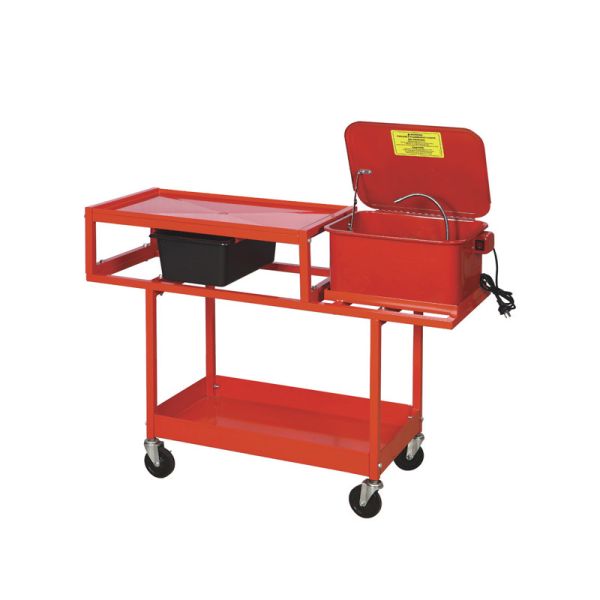
Centered on "lightweight + multi-function + high cost-effectiveness", the YD43-003 Combination Cleaning Table is optimized to address the pain points of "limited space, small parts, and inconvenient handling" in lightweight maintenance scenarios, with core advantages as follows:
- The main body is integrally stamped and formed from 14-gauge thick steel plates, and the connection between the tabletop and the bracket is welded with reinforcing ribs, increasing the tensile strength by 25%. Even if a 50kg parts box is placed for a long time, there is no obvious deformation of the tabletop, solving the shortcoming of ordinary thin steel plate cleaning tables that "bend when the load exceeds 30kg";
- The 3/4" high rim is integrally stamped and formed without splicing gaps, preventing cleaning fluid from leaking through the seams. Compared with cleaning tables with "post-attached rims", the leak-proof reliability is increased by 50%, reducing the workload of workshop floor cleaning.
- Compact size of 123×45×30cm: Can be embedded in the corner of the maintenance workstation or placed against the wall, covering an area of only 0.055㎡, equivalent to one small toolbox, suitable for small repair shops with limited space;
- Low tabletop height of 30cm: Suitable for picking and placing small and medium-sized parts without frequent bending, and easy to match with other maintenance equipment (such as tool cabinets and parts racks) to improve overall operation efficiency.
- Dedicated polyethylene parts washer: Acid and alkali resistant, impact resistant, and can directly use kerosene and part-specific cleaning agents. When cleaning engine carbon deposits and bearing oil stains, the parts have no corrosion or residue, and the cleaning effect is far better than ordinary plastic basins;
- 5L large-capacity waste fluid box: Adapts to the waste fluid volume when cleaning small and medium-sized parts, reducing the frequency of frequent waste fluid dumping. The sealed lid design prevents odor volatilization, meets environmental protection requirements, and avoids soil pollution by waste fluid.
- Net weight of 27kg: Can be easily carried to the maintenance workstation by one person, no need to rely on forklifts or multi-person collaboration, especially suitable for workstation adjustment inside repair shops;
- No power dependence: Full manual operation, no external power supply required, can be used in outdoor temporary maintenance scenarios (such as agricultural machinery field maintenance), adapting to environments lacking stable power supply.
- 10.5L capacity drawer: Stores light tools such as wrenches and screwdrivers in categories, no need to go back and forth to the tool cabinet for access, saving 30% of access time compared to the traditional method of "piling tools on the tabletop";
- Silent roller slide rails: The noise is ≤45dB when pulled, avoiding noise pollution in the maintenance workshop and improving work comfort.
- Durable materials reduce maintenance: The 14-gauge steel is wear-resistant and corrosion-resistant, and there is no need to replace the tabletop or drawer components within 3 years of normal use. The maintenance cost is only 1/3 of that of ordinary plastic cleaning tables;
- High container loading capacity: 154 sets can be loaded in a 20-foot container, reducing logistics costs by 40% compared to bulk transportation, suitable for bulk procurement by small maintenance chain enterprises, significantly reducing procurement costs.
Scenario Requirement: A small automotive repair shop undertakes the engine maintenance business of a Toyota Corolla (needing to clean parts such as pistons, valves, and spark plugs to remove carbon deposits and oil stains). The cleaning table is required to accommodate simultaneous cleaning of multiple parts, store tools in order, prevent cleaning agents from contaminating the ground, and complete cleaning within 2 hours without affecting the maintenance progress.
Operation Process:
- Equipment Preparation and Arrangement:
- One person carries YD43-003 to the maintenance workstation, adjusts it to be level (confirmed by a level meter), and installs the waste fluid collection box under the waste fluid outlet of the tabletop;
- Add 2L of neutral metal cleaning agent to the parts washer, and place tools in categories in the drawer: cleaning brushes on the left and disassembly wrenches on the right;
2. Parts Cleaning Operation:
- Batch Soaking and Cleaning: Put the pistons and valves into the parts washer for 15 minutes of soaking (to soften carbon deposits), and scrub repeatedly with a brush; place the spark plugs directly on the tabletop, wipe the surface oil stains with a cloth dipped in cleaning agent, and the waste fluid flows into the collection box through the tabletop diversion port;
- Convenient Tool Access: When disassembling the piston bolts, take the socket directly from the drawer without going back and forth to the tool cabinet, saving 30 minutes compared to the traditional method;
3. Operation Effect:
- High Efficiency: All parts were cleaned within 2 hours, saving 40 minutes compared to the "ordinary basin + tabletop" separate operation, and the engine maintenance was delivered on time;
- Clean Environment: The tabletop rim completely prevented fluid leakage, no cleaning agent contamination on the ground, reducing 1 hour of floor cleaning time;
- Easy Handling: After the operation, one person can push the workbench to the corner for storage without occupying the main workstation space.
Result: The efficiency of engine maintenance in the small automotive repair shop was improved, customer satisfaction was enhanced, and the workshop space utilization rate was significantly improved.
Scenario Requirement: An agricultural machinery maintenance station performs bearing maintenance on a small tractor (needing to clean more than 20 parts such as deep groove ball bearings and needle roller bearings to remove oil stains and iron filings). The cleaning table is required to clean parts in batches, store tools in order, and be easy to carry to the outdoor maintenance site, with maintenance completed within 3 hours.
Operation Process:
- Model Adaptation and Preparation:
- The bearing size (diameter 2-8cm) is compatible with the 27.5×16-inch tabletop, and the 60kg load capacity of YD43-003 fully meets the needs; one person carries the workbench to the outdoor maintenance area and locks the drawer buckles;
- Add 3L of agricultural machinery-specific cleaning agent to the parts washer, and place bearing disassembly tools and anti-rust paper in the drawer;
2. Maintenance and Cleaning Operation:
- Batch Cleaning: Put the bearings into the parts washer in batches for 20 minutes of soaking, gently scrub the rolling surface with a soft brush to avoid scratching; place the cleaned bearings on the tabletop to dry, and check the operation smoothness using the flatness of the tabletop;
- Outdoor Adaptability: No power dependence, can be used directly in the field without building a temporary power supply; after the operation, one person can carry the workbench back to the indoor storage area;
3. Maintenance Effect:
- Restored Bearing Performance: The cleaned bearings had no impurities, the tractor operation noise was reduced by 15dB, and the operation efficiency was increased by 20%;
- Controllable Cost: No need to purchase additional large-scale cleaning equipment; one YD43-003 meets all bearing maintenance needs, reducing equipment procurement costs by 60%.
Result: The bearing maintenance capability of the agricultural machinery maintenance station was enhanced, the flexibility of outdoor operations was improved, and the customer repurchase rate increased by 30%.
Scenario Requirement: A small hardware processing factory cleans gear parts (diameter 5-10cm) before leaving the factory (to remove iron filings and anti-rust oil remaining from processing). The cleaning table is required to process parts in batches, store tools in order, and be easy to connect with the production line, with 100 gears cleaned within 4 hours.
Operation Process:
- Equipment Arrangement and Preparation:
- Place YD43-003 next to the production line, adjust it to the same height as the production line (facilitating part transfer), and add 4L of neutral cleaning agent to the parts washer;
- Place steel brushes and anti-rust oil rags in the drawer, and lay an anti-slip pad on the tabletop (to prevent gear sliding);
2. Cleaning Operation:
- Batch Processing: Put the gears into the parts washer in batches for 10 minutes of soaking, take them out and clean the iron filings with a steel brush, then wipe the anti-rust oil on the tabletop with a rag;
- Efficient Connection: The cleaned gears are directly transferred to the packaging line through the tabletop, no additional handling required, saving 1.5 hours compared to the traditional "ground cleaning" method;
3. Cleaning Effect:
- Improved Product Qualification Rate: The cleaned gears had no iron filings remaining, and the factory qualification rate increased from 95% to 99%;
- High Efficiency: 100 gears were cleaned within 4 hours, meeting the batch delivery needs of the production line.
Result: The part cleaning efficiency of the hardware processing factory was improved, the stability of product quality was enhanced, and the production efficiency was significantly improved.
A1: It is mostly caused by tabletop inclination or tiny gaps in the rim. Troubleshoot step by step:
- Adjust Tabletop Level: Use a level meter to check the tabletop. If the inclination is >3°, place a 1-2mm thick thin steel plate under the workbench to adjust it to a horizontal state, ensuring the fluid is concentrated in the rim;
- Check Rim Sealing: If there are tiny gaps in the rim caused by stamping, apply industrial oil-resistant sealant (e.g., 3M 5200) to the gaps, air-dry for 24 hours before use, and completely block the leakage path;
- Control Fluid Volume: The fluid height on the tabletop should not exceed 1/2 of the rim (approx. 0.95cm) to avoid overflow due to excessive fluid; operate gently during cleaning to reduce fluid shaking.
A2: It is mostly caused by infrequent filter screen cleaning or insufficient part pretreatment. Handle accordingly:
- Clean the Built-in Filter Screen: Turn off the parts washer, take out the bottom filter screen, rinse the surface iron filings and impurities with a high-pressure water gun, air-dry and reinstall it, which can extend the service life of the cleaning agent (it is recommended to clean the filter screen every time 50 parts are cleaned);
- Replace the Cleaning Agent: If the transparency of the cleaning agent is lower than 50% (severe turbidity), completely pour out the old fluid, rinse the inside of the parts washer with clean water 2-3 times, air-dry and add new cleaning agent (it is recommended to replace the cleaning agent every time 80 parts are cleaned);
- Part Pretreatment: Before cleaning parts with a large amount of iron filings (e.g., gears), blow off the visible impurities on the surface with compressed air, then put them into the parts washer to reduce the contamination speed of the cleaning agent.
A3: Determine in three steps based on "part size + weight + cleaning agent type" to avoid mismatching:
- Confirm Part Size: The part length should be ≤27.5 inches (69.85cm), width ≤16 inches (40.64cm), and height ≤8 inches (20.32cm); if exceeding these dimensions, the part cannot be placed stably, which may cause fluid leakage or part falling;
- Confirm Part Weight: The weight of a single part should be ≤10kg (the tabletop can bear a uniform load of up to 60kg, with a safety margin reserved) to avoid tabletop deformation caused by overloading;
- Confirm Cleaning Agent Type: Use neutral/weakly alkaline cleaning agents with pH 5-9; strong acid (e.g., hydrochloric acid) and strong alkali (e.g., sodium hydroxide solution with concentration >20%) cleaning agents are prohibited to prevent corrosion of the tabletop paint layer and the polyethylene material of the parts washer.
A4: It is mostly caused by dust accumulation on the slide rail or insufficient lubrication, and can be restored with simple treatment:
- Clean Slide Rail Impurities: Fully pull out the drawer, wipe off the oil stains and iron filings on the surface of the slide rail with a dry cloth; if there are stubborn impurities, scrub with a brush dipped in alcohol, air-dry and reinstall the drawer;
- Add Grease: Apply a small amount of lithium-based grease (thickness 1-2mm) on the contact surface of the slide rail, pull the drawer in and out manually 5-10 times to ensure uniform lubrication, and the stuck feeling will be significantly eliminated;
- Check Limit Buckle: If the buckle is misaligned, it will hinder the drawer pulling; gently adjust the buckle angle with a screwdriver to ensure the drawer can be locked normally when closed and has no obstruction when pulled.