Silicon Carbide (SiC) Heating Elements | High-Temp Heating to 1600°C
High-performance silicon carbide heating elements for temperatures up to 1600°C. Superior thermal shock resistance & power density. Explore SW, U-Type, W-Type models for industrial furnaces.
Product Overview
Our Silicon Carbide (SiC) Heating Elements are engineered for extreme industrial heating applications. Capable of operating at temperatures up to 1600°C (2912°F), they deliver unmatched heat output, rapid thermal response, and long service life in both air and controlled atmospheres, making them a superior replacement for traditional metal alloy heaters.
Key Advantages of SiC Heating Elements
- Exceptional Power Density: Generate 5 to 10 times more heat per unit surface area than standard Nichrome wire, enabling faster heat-up and higher operating temperatures.
- Superior Mechanical Strength: Excellent resistance to thermal shock and physical deformation, ensuring reliability under rapid temperature cycling and demanding industrial conditions.
- Clean & Quiet Operation: The heat source is entirely free of noise, emissions, and air pollution, making it ideal for sensitive processes like sintering, brazing, and crystal growth.
Product Types & Applications
1. SW Type (Standard Rod)
- Applications: Universal heating element for a wide range of furnace types.
- Features: Operating range from 600°C to 1400°C (up to 1600°C in suitable conditions). Can be installed both vertically and horizontally.
- Ideal For: General high-temperature furnaces, research labs, and ceramic kilns.
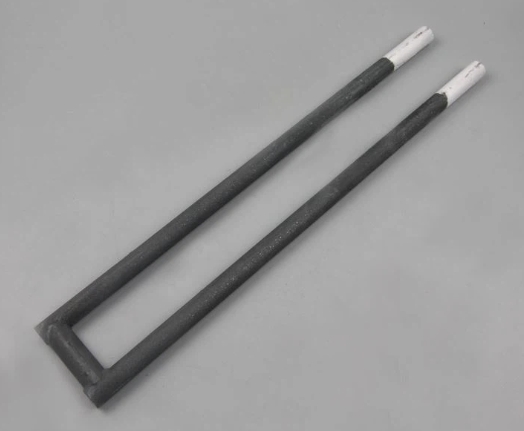
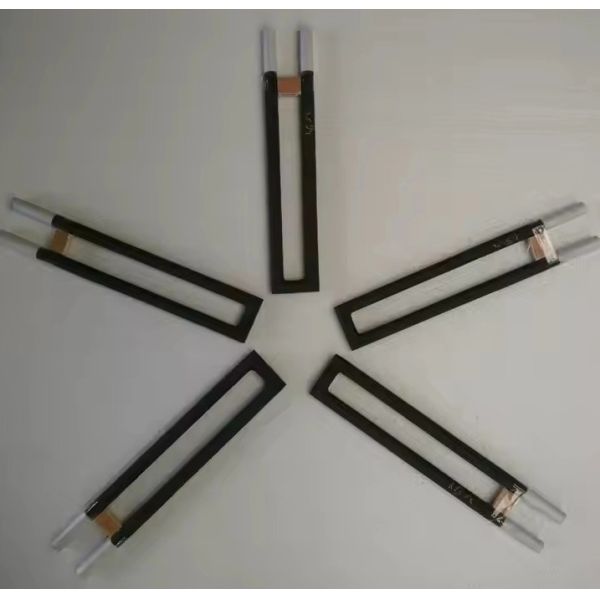
2. U-Type (Hairpin Shape)
- Applications: Compact furnaces where space is constrained.
- Features: Consists of two identical SiC rods connected by a low-resistance SiC bridge, which can also serve as a mounting point. Provides a concentrated heat zone.
- Ideal For: Tube furnaces, and processes requiring a localized high-temperature zone.
3. W-Type (3-Phase Configuration)
- Applications: Large-scale industrial heating requiring high power input.
- Features: A three-rod, one-side terminal design (SGC for vertical, SGD for horizontal installation) that connects directly to a three-phase power supply.
- Ideal For: Float glass production, large batch sintering, and other heavy-duty industrial processes.
Technical Data & Properties
| Property |
Value |
| Specific Gravity |
2.6 - 2.8 g/cm³ |
| Bend Strength |
> 300 MPa |
| Hardness |
> 9 Mohs |
| Tensile Strength |
> 150 kg/cm² |
| Porosity Rate |
< 30% |
| Radiance |
0.85 |
Operating Guidelines & Atmosphere Compatibility
The performance and lifespan of SiC elements are highly dependent on furnace temperature and atmosphere.
| Atmosphere |
Max Recommended Temp (°C) |
Surface Load (W/cm²) |
Potential Risk & Effect |
| Air / Oxygen |
1600 |
15-25 |
Slow oxidation forms protective SiO₂ layer. |
| Hydrogen (H₂) |
1290 |
10-15 |
Can produce methane, destroying the protective SiO₂ layer. |
| Nitrogen (N₂) |
1370 |
10-15 |
Can form an insulating silicon nitride layer, increasing resistance. |
| Water Vapor |
1090-1370 |
10-15 |
Reacts to form silicon hydrate, accelerating element degradation. |
| Chlorine / Halogen |
704 |
15-25 |
Highly corrosive, rapidly destroys the SiO₂ layer and attacks SiC. |
Critical Installation & Usage Notice
- Storage: Keep elements dry and protected from moisture to prevent performance degradation.
- Matching: For multi-element furnaces, sort and group elements so their resistance values are within a 10% tolerance to ensure even load distribution.
- Handling: SiC is hard but brittle. Handle with care during installation and maintenance to avoid breakage.
- Start-Up: Always use a controlled ramp-up voltage when starting a cold furnace. Avoid immediate full power to prevent excessive inrush current from damaging the elements.
- Replacement: Replace damaged elements with new ones of similar resistance. If multiple elements have failed or their resistance has increased significantly, consider a full set replacement for balanced performance.