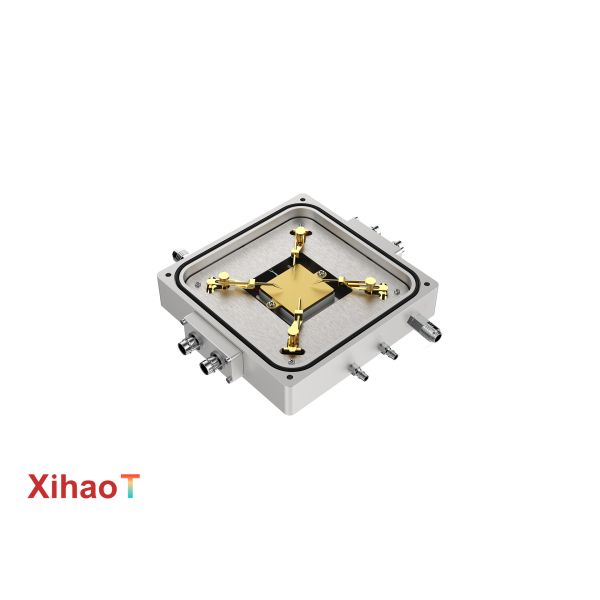
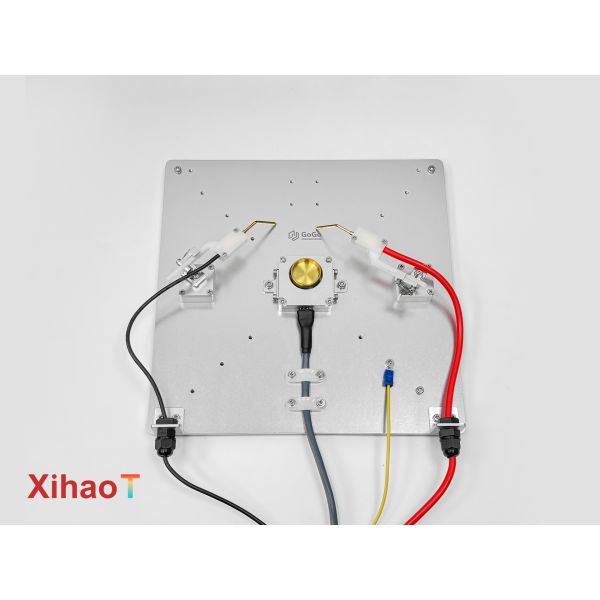
Peltier Probe Stage with Fixed Gold-plated Tungsten Probes and Reflection & Transmission Optical Path for Precise Electrical Analysis
The GoGo EPE120/EPE120V is an innovative Probe Stage that utilizes advanced Thermoelectric (Peltier) cooling technology to deliver precise temperature control without the need for liquid nitrogen. Operating from -25°C to 120°C, this stage provides a clean, efficient, and quiet solution for in-situ electrical characterization and optical observation. It features a set of four fixed, gold-plated tungsten probes for stable and repeatable electrical contact, making this Probe Stage perfectly compatible with a wide array of optical microscopes and electrical measurement devices for integrated material analysis.
Eco-Friendly & Efficient Peltier Technology: This Probe Stage eliminates liquid nitrogen consumption, offering significant operational cost savings and convenience. The solid-state TEC module provides reliable, maintenance-free heating and cooling at rates up to 30°C/min.
Stable & Repeatable Fixed Probe Design: Unlike manual probes, the four pre-aligned, fixed probes ensure consistent, high-quality electrical contact points for every measurement, enhancing data reproducibility and simplifying experimental setup.
Superior Optical Compatibility: Equipped with high-transmission JGS2 windows and both reflection/transmission optical paths, this stage allows for simultaneous electrical testing and high-resolution microscope observation or spectroscopic analysis.
Intelligent Software for Automated Workflows: Controlled by the powerful TNEX software, this Probe Stage enables fully automated experiment sequencing, seamlessly synchronizing temperature profiles with data acquisition from external analyzers.
Versatile & Certified Quality: Manufactured under ISO 9001, 14001, and 45001 certified processes, the chamber supports atmospheric or vacuum conditions and offers customization options for probes and accessories to meet specific needs.
| Parameter | Specification |
|---|---|
| Model | EPE120 / EPE120V (Vacuum Capable) |
| Cooling Technology | Peltier (TEC) - No Liquid Nitrogen |
| Temperature Range | -25°C to 120°C |
| Temperature Stability | ±0.1°C |
| Heating/Cooling Rate | 30°C/min (Max) |
| Probe System | 4 Fixed Gold-plated Tungsten Probes |
| Electrical Interface | 4 x BNC Ports |
| Optical Path | Reflection & Transmission |
| Control Software | TNEX Platform |
This efficient and versatile Probe Stage is ideally suited for research hubs in Southeast Asia, the Middle East, Russia, and Africa. It serves a broad clientele of universities, government research institutes, and high-tech companies specializing in semiconductor research, biomaterials, polymer science, and micro-device testing.
What are the benefits of Peltier cooling in a Probe Stage?
Peltier technology offers a compact, vibration-free, and dry cooling solution. It removes the hassle and ongoing expense of liquid nitrogen, making this Probe Stage more accessible and easier to operate in any lab environment.
What is the advantage of using fixed probes?
Fixed probes guarantee perfect alignment and consistent contact resistance across multiple experiments and users. This eliminates positional errors and saves significant time during setup, leading to more reliable data.
Can this stage be used for temperature-cycling reliability tests?
Absolutely. With a 30°C/min ramp rate and excellent stability, this Probe Stage is an excellent tool for thermal cycling tests on electronic components, sensors, and other devices within its -25°C to 120°C range.
How do I integrate my own electrical measurement instruments?
Simply connect your source meter, parameter analyzer, or LCR meter to the stage's four standard BNC ports. The TNEX software can then coordinate the temperature program with your instrument's measurement commands.
Is the system ready for vacuum experiments?
The EPE120V model is designed with a chamber that can be connected to an optional vacuum system, allowing for electrical testing of sensitive materials in controlled or oxygen-free atmospheres.