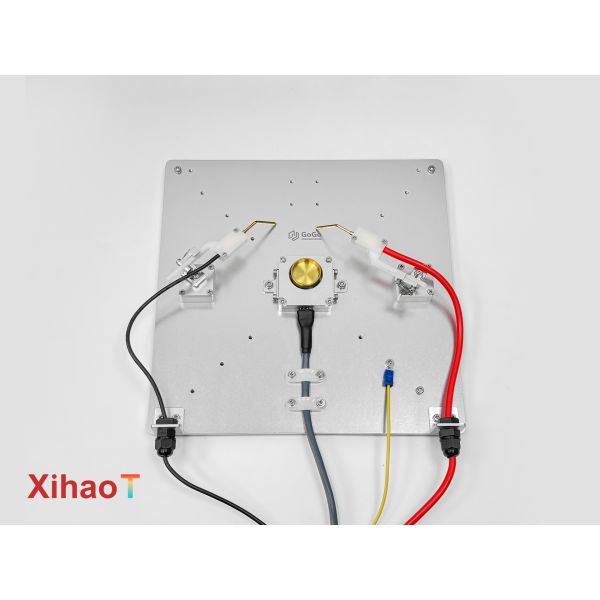
Ultra-High-Temperature 1500°C Probe Stage with Four-Point Probe Method and Ceramic Sample Holder for Resistivity Testing
Product Name: GoGo EH1500V-R Ultra-High-Temperature Vacuum Probe Stage for Resistivity Characterization of Conductive Polymers (1500°C)
Product Introduction
The GoGo EH1500V-R is a specialized ultra-high-temperature Probe Stage designed for precise electrical characterization of advanced materials, including conductive polymers, rubber, and plastics. Utilizing the industry-standard four-point probe method, this system is engineered to accurately investigate the resistivity characteristics of materials across an extreme temperature spectrum from ambient to 1500°C. Its unique optical design incorporates a side-incident light path, enabling simultaneous electrical measurement and observation of samples on a compact ceramic holder within an atmosphere or vacuum-compatible chamber. Governed by the integrated TNEX software, this Probe Stage delivers the stability and control required for groundbreaking research on next-generation conductive composites.
Key Advantages & Why Choose Our System
Unparalleled High-Temperature Electrical Analysis: This Probe Stage provides a reliable platform for four-point probe resistivity measurements at temperatures up to 1500°C with excellent ±0.1°C stability, a critical capability for studying the performance limits of conductive polymers and other temperature-sensitive materials.
Innovative Side-Observation Optical Design: Featuring a 30° side-incident optical path through a Ø15mm aperture, the stage allows for unique sample viewing angles. This design is particularly beneficial for monitoring probe contact and sample morphology during high-temperature testing without top-down optical interference.
Versatile Vacuum & Atmosphere Compatibility: The chamber supports both atmospheric and vacuum conditions, enabling studies on materials sensitive to oxidation or requiring controlled environments. The variable chamber height (0-3mm with probes) accommodates different sample and probe configurations.
Optimized for Soft & Composite Materials: The system is ideally configured for testing softer materials like conductive rubber and plastic, providing a stable platform and precise probe contact essential for obtaining reproducible resistivity data across wide temperature ranges.
Certified Precision & Intelligent Control: Manufactured under ISO 9001, 14001, and 45001 certified processes. The TNEX software enables full automation of complex temperature-resistivity profiles, ensuring data integrity and experimental efficiency.
Technical Specifications
| Parameter | Specification |
|---|---|
| Model / Brand | EH1500V-R / GoGo |
| Primary Application | Resistivity Testing of Conductive Polymers/Rubbers/Plastics |
| Temperature Range | RT ~ 1500°C |
| Temperature Stability | ±0.1°C |
| Max Heating Rate | 150°C/min |
| Measurement Method | Four-Point Probe |
| Sample Holder | Ceramic, φ16mm |
| Optical Path | Reflection (30° side-incident) |
| Chamber Environment | Atmosphere or Vacuum |
| Control Software | TNEX Platform |
Target Markets & Clients
This advanced Probe Stage is tailored to meet the research demands in key global regions, including Southeast Asia, the Middle East, Russia, and Africa. It is an indispensable tool for university materials science departments, industrial R&D centers, and specialized research institutes focused on functional polymers, composite materials, and high-temperature electronics.
Frequently Asked Questions (FAQ)
Why is this Probe Stage specifically suitable for conductive rubber and plastic testing? Its design prioritizes stable, low-stress contact with softer materials using four pure tungsten probes, and it operates in controlled environments (vacuum) to prevent degradation, which is crucial for accurate high-temperature resistivity measurement of polymers.
What is the benefit of the side-incident optical design? The side-viewing port provides a clear line of sight to the sample and probe contact area from an oblique angle. This is invaluable for verifying probe placement, monitoring sample changes, or integrating specialized lighting without the constraints of a top-down view through the main window.
How does the vacuum capability enhance material testing? Many conductive polymers are sensitive to oxidation at high temperatures. The vacuum-compatible chamber allows these materials to be tested in an inert or oxygen-free environment, revealing their true intrinsic electrical properties without oxidation effects.
What does the four-point probe method measure, and why is it used? The four-point probe method is used to measure the sheet or volume resistivity of a material. It eliminates the contact resistance between the probe and the sample, providing a more accurate measurement of the material's intrinsic electrical property than a two-point method.
Is the system ready for complex temperature-resistivity profiling? Absolutely. Controlled by the TNEX software, this Probe Stage can execute sophisticated temperature ramps and holds while you use an external source meter to automate resistivity measurements at each step, creating detailed characterization plots.