| Model | Pall Ring | ||||||
| Material | Carbon Steel; SS 304, 304L, 410, 316, 316L, etc. | ||||||
| Size | mm | 16*16*0.3 | 25*25*0.3 | 38*38*0.4 | 50*50*0.5 | 76*76*0.6 | 89*89*0.7 |
| Bulk density | kg/m3 | 345 | 214 | 193 | 182 | 142 | 145 |
| Number | per m3 | 201000 | 51000 | 15000 | 6500 | 1830 | 1160 |
| Surface | m2/m3 | 346 | 212 | 145 | 106 | 69 | 62 |
| Free Volume | % | 95.5 | 96.2 | 96.7 | 97.5 | 97.4 | 97.1 |
| Typical Application | Absorption, scrubbing and stripping services | ||||||
1. Lower Pressure Drop
Random packing provides a relatively open structure, allowing gases and liquids to pass through with minimal resistance. This significantly reduces pressure drop compared to structured packing or tray systems, making it ideal for vacuum and energy-sensitive operations.
2. High Surface Area for Mass Transfer
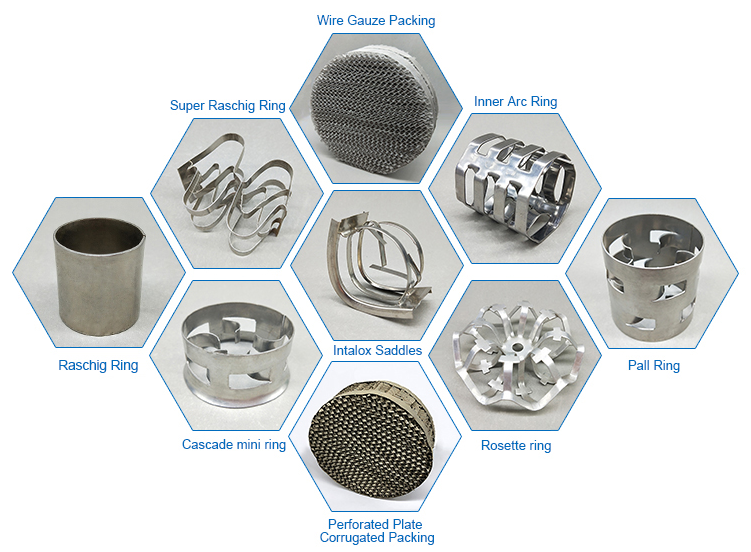
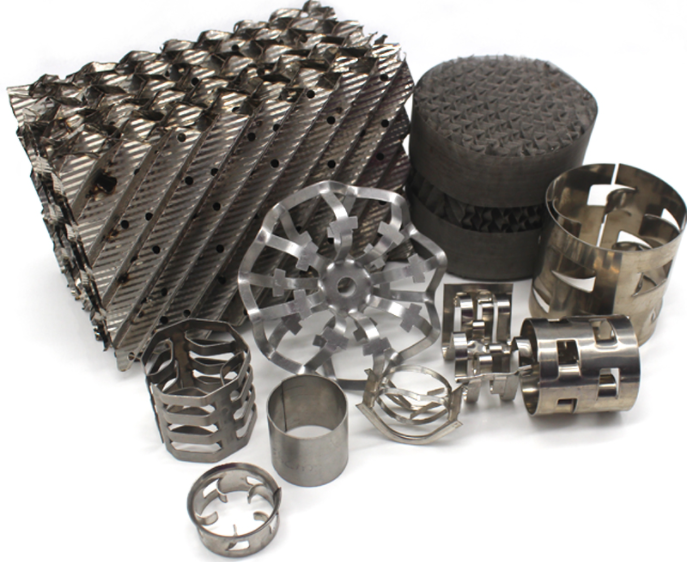
Although randomly arranged, the individual packing elements (such as Raschig rings, Pall rings, or saddles) offer a large specific surface area. This increases contact efficiency between gas and liquid phases, improving mass transfer performance.
3. Cost-Effective and Easy to Install
Random packing is generally less expensive to manufacture and install. It can be quickly dumped into a column without complex assembly, lowering construction and labor costs.
4. Good Liquid Distribution and Wetting
The irregular shape and orientation of the packing elements enhance liquid spreading and wetting. This improves the uniformity of mass transfer and prevents channeling within the column.
5. Versatility in Materials
Random packing is available in metals, plastics, and ceramics. This allows selection according to operating temperature, corrosion resistance, or chemical compatibility, making it suitable for a wide range of industrial environments.
1. Distillation Columns
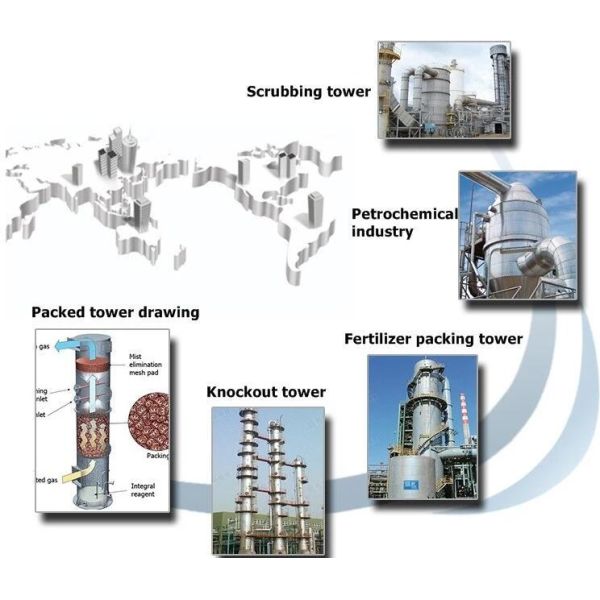
Used in petroleum refining, chemical processing, and solvent recovery systems to enhance vapor–liquid contact and improve separation efficiency.
2. Gas Absorption Towers
Applied in scrubbers to remove contaminants such as SO₂, CO₂, H₂S, ammonia, and VOCs from industrial exhaust streams.
3. Stripping and Desorption Units
Used in wastewater treatment and chemical plants for stripping dissolved gases (e.g., oxygen, nitrogen, CO₂) from liquids.
4. Air Pollution Control Systems
Installed in wet scrubbers and absorption reactors to increase gas–liquid interaction and improve pollutant removal efficiency.
5. Heat Recovery and Cooling Towers
Random packing enhances heat and mass transfer performance in cooling towers, gas cooling sections, and heat recovery units.
6. Water and Wastewater Treatment
Used in biological trickling filters, biofilm reactors, and aeration systems to provide effective support surfaces for microbial growth.
7. Chemical and Petrochemical Processing
Ideal for reactors and contactors where improved liquid distribution and reduced pressure drop are required.