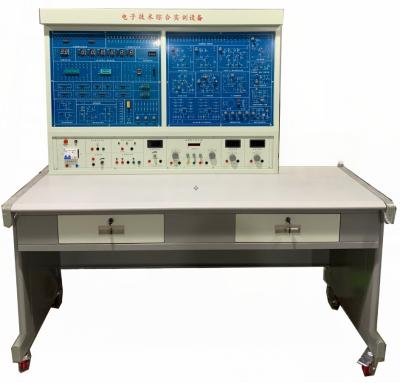
New Motor Variable Frequency Speed Control Metal Lab Equipment Trainer Automation Teaching Vocational Training Device
Variable Frequency Speed Control Metal Lab Equipment Trainer
Advanced automation teaching device for vocational training in electrical engineering and motor control applications.
Product Overview
This comprehensive electrical and electronic training platform integrates advanced teaching instrument technologies with innovative structural design. Featuring a modular hanging-box configuration, the system offers clear layout organization and flexible operation capabilities.
- Fully digital displays with high precision measurement
- Comprehensive protection systems for power supplies and instruments
- Advanced personal safety protection mechanisms
- Ideal for university and college laboratory environments
Technical Specifications
| Dimensions |
1500mm * 700mm * 830mm (Table) |
| Power Supply |
AC three-phase four-wire 380V ±5% 50Hz |
| Input Power |
<1.5 kVA |
| Output AC Power |
Three-phase four-wire 380V, single-phase 0-250V continuously adjustable with voltmeter and ammeter indication |
Educational Applications
Designed for experimental teaching in university courses including Basic Electrical Engineering, Electrical Engineering, Digital Electronics, and Analog Electronics. Expandable to include Programmable Logic Controllers and Motor Frequency Conversion Control experiments.
Electrical Engineering Experiments
- Use of basic electrical instruments and measurement error calculation
- Methods to reduce instrument measurement errors
- Voltmeter and ammeter range extension
- Measurement of volt-ampere characteristics for linear and nonlinear circuits
- Potential and voltage measurement with circuit potential diagrams
- Verification of Kirchhoff's laws and fault diagnosis
- Superposition principle verification and fault diagnosis
- Voltage source and current source equivalent transformation
- Verification of Thevenin's theorem
- Verification of Norton's theorem
- Maximum power transfer conditions determination
- Two-port network analysis
- Reciprocity theorem experiment
- Controlled sources experimental study
- Observation and measurement of typical electrical signals
- First-order RC circuit response testing
- Second-order dynamic circuit response study
- R, L, C component impedance characteristics determination
- RC series and parallel frequency selection network testing
- R, L, C series resonant circuit analysis
- RC double-T frequency selection network
- Circuit state trajectory observation
- R, L, C component characteristics and AC parameters determination
- AC circuit equivalent parameters measurement using three-meter method
- Phasor study in sinusoidal steady-state AC circuits
- Mutual inductance experimentation
- Single-phase iron-core transformer characteristics testing
- Three-phase AC circuit voltage and current measurement
- Three-phase circuit power measurement
- Single-phase electricity meter verification
- Power factor and phase sequence measurement
- Negative impedance converters and applications
- Gyroscope and its applications
Analog Circuit Experiments
- Common electronic instruments usage
- Simple diode testing procedures
- Transistor input/output characteristics
- Single-stage amplifier circuit analysis
- Two-stage amplifier circuit design
- Negative feedback amplifier circuits
- Emitter follower configurations
- Differential amplifier circuits
- Field-effect transistor amplifiers
- RC sine wave oscillator circuits
- LC oscillator and frequency selective amplifiers
- Integrated operational amplifier parameter testing
- Operational amplifier proportional summation circuits
- Operational amplifier integrator and differentiator circuits
- Operational amplifier voltage comparator circuits
- Waveform generator design
- Active filter implementation
- Integrated power amplifier applications
- Complementary symmetry power amplifiers
- Integrated voltage regulator circuits
- Series voltage regulator circuits
- Thyristor controlled rectifier circuits