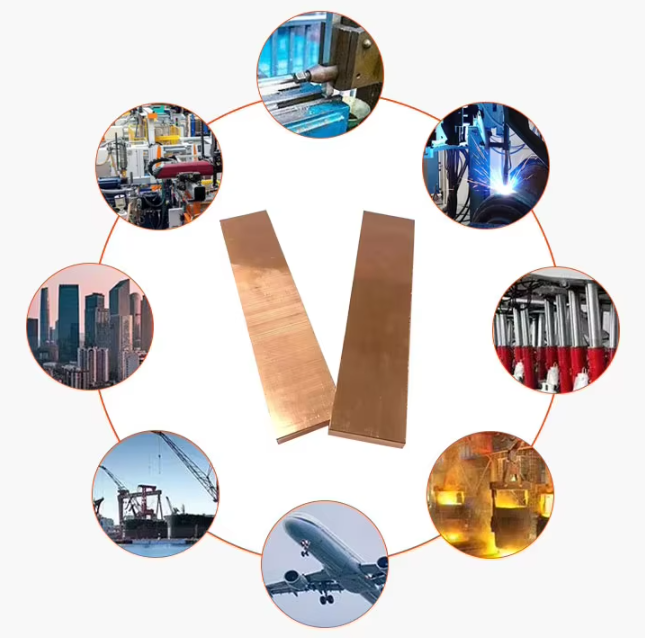
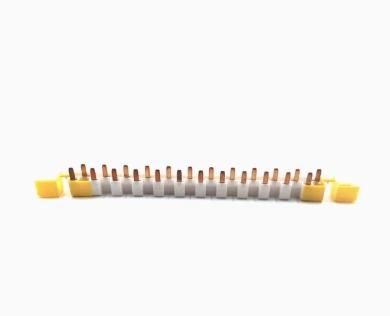
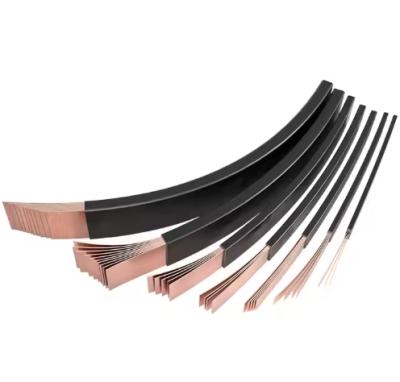
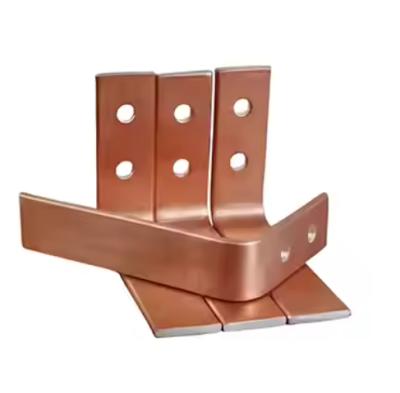
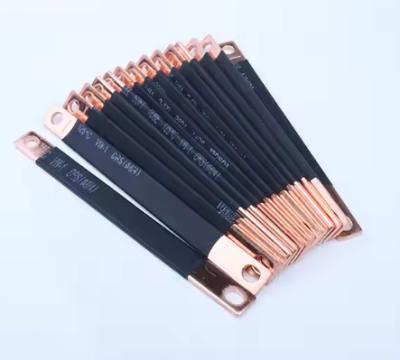
The Electrical Industry ASTM C11000 Bus Bar Copper is a precision-engineered, high-conductivity current carrier manufactured from 99.99% pure electrolytic copper. Available in standard dimensions including 20×2 mm, 30×3 mm, and 50×5 mm, these solid square copper bus bars are specifically designed for switchgear cabinets, panelboards, and industrial power distribution systems.
With an annual production capacity of 1000 tons, Sylaith delivers consistent quality, exceptional conductivity (100.98% IACS), and ultra-low resistivity (0.01707 Ω·mm²/m). Each bar features your choice of round or square edges and is available in custom lengths from 0 to 6 meters. The red copper surface indicates natural, unalloyed material – ideal for long-term, high-current applications where energy efficiency and thermal management are critical.
ASTM C11000 / T2 Grade – Meets U.S. and international standards for ETP copper.
99.99% Pure Copper – Maximizes conductivity and minimizes resistive losses.
Popular Dimensions Ready – 20×2, 30×3, 50×5 mm (other sizes available: 10–200mm width, 5–100mm thickness).
High Conductivity (100.98% IACS) – Superior to standard 101% copper benchmarks.
Low Resistivity (0.01707) – Reduces voltage drop across long busbar runs.
Hardness Rating 86 – Resists bending and vibration during installation and operation.
Round or Square Edges – Safe handling (round) or maximum contact surface (square).
Massive Production Capacity – 50,000 tons/year ensures stable supply for large projects.
Custom Lengths (0–6m) – Cut precisely to your cabinet dimensions.
| Parameter | Details |
|---|---|
| Model No. | ASTM C11000, T2 |
| Material | 99.99% Pure Copper |
| Copper Content | 99.99% |
| Grade | ASTM C11000 / T2 (also C10200, JIS C1100, C1020) |
| Alloy or Not | Non-alloy (Pure Copper) |
| Shape | Square / Rectangular |
| Common Sizes | 20×2 mm, 30×3 mm, 50×5 mm Also: 10×25 mm, 6×25 mm, 1/2″, 2″, 3″ |
| Width Range | 10 – 200 mm / 1/4″ – 10″ |
| Thickness Range | 5 – 100 mm / 1/4″ – 5″ |
| Length | 0 – 6 meters (custom available) |
| Edge Type | Round or Square |
| Conductivity (IACS) | 100.98% |
| Resistivity | 0.01707 Ω·mm²/m |
| Hardness | 86 |
| Color | Red (natural copper) |
| MOQ | 300 kg |
| Production Capacity | 1000 tons/year |
| Packaging | Wooden Box |
| Payment Term | T/T: 30% deposit, balance before delivery |
| Trademark | Sylaith |
| Origin | China |
Switchgear & Power Cabinets – Main and distribution busbars for LV/MV panels.
Industrial Control Panels – Power supply to motor starters, VFDs, and PLCs.
Renewable Energy – Solar combiner boxes, wind turbine converters.
EV Charging Infrastructure – Internal high-current bus links.
Substations & Transformers – Grounding and phase busbars.
Data Center Busways – Overhead power distribution.
Marine Electrical Systems – Corrosion-resistant power distribution.
Battery Energy Storage Systems (BESS) – Cell-to-busbar connections.
A copper bus bar acts as a rigid, low-inductance conductor distributing high currents from a single power source to multiple branch circuits. When installed inside a switchgear cabinet, the main bus bar connects to the incoming breaker, while smaller bus bars (like 20×2 mm or 30×3 mm) feed outgoing breakers or disconnects.
With copper’s resistivity at 0.01707 Ω·mm²/m, a 50×5 mm bar (250 mm² cross-section) has extremely low resistance per meter. For example, a 1-meter length carrying 500A loses only about 17 watts – far less than an equivalent cable. The large surface area and high thermal conductivity (≈400 W/m·K) rapidly dissipate heat into the surrounding air or cabinet structure.
The 99.99% purity eliminates grain boundary impurities that cause localized heating. This ensures stable performance under continuous full-load conditions, with minimal thermal expansion or mechanical stress on connection points.
Q1: What is the difference between 20×2 mm, 30×3 mm, and 50×5 mm bus bars?
A: They differ in current-carrying capacity. 20×2 mm (40 mm²) suits up to ~200A, 30×3 mm (90 mm²) up to ~400A, and 50×5 mm (250 mm²) up to ~800A. Exact ratings depend on ambient temperature and mounting.
Q2: Can I order lengths shorter than 6 meters?
A: Yes. We cut to exact lengths based on your cabinet drawings – no minimum length restriction beyond the 300kg MOQ for bulk orders.
Q3: Why choose round edges over square edges?
A: Round edges reduce corona discharge (important for medium voltage) and are safer to handle. Square edges provide slightly more surface contact for bolted connections.
Q4: How does 100.98% conductivity compare to standard copper?
A: Standard pure copper is 100% IACS (International Annealed Copper Standard). Our 100.98% exceeds this benchmark due to ultra-high 99.99% purity, meaning lower energy loss than standard copper.
Q5: Is the 1000 ton/year capacity real?
A: Yes. Sylaith operates large-scale production lines, ensuring stable supply for OEMs, contractors, and distributors worldwide – even for large infrastructure projects.
Q6: Do you provide third-party test reports?
A: Yes. We provide mill test certificates (MTC) including chemical composition (99.99% Cu), conductivity, and resistivity for each production batch. Third-party inspection (e.g., SGS, BV) is available upon request.
Q7: What is the lead time for a 300 kg order of mixed sizes (20×2, 30×3, 50×5)?
A: Typically 15–20 working days after 30% deposit confirmation, depending on current production schedule.
Q8: Can these bus bars be bent or punched after delivery?
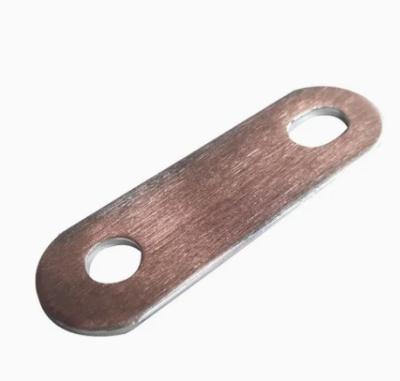
A: Yes. Copper’s ductility allows bending, punching, and drilling. For precise applications, we can pre-machine holes or bends per your drawing.