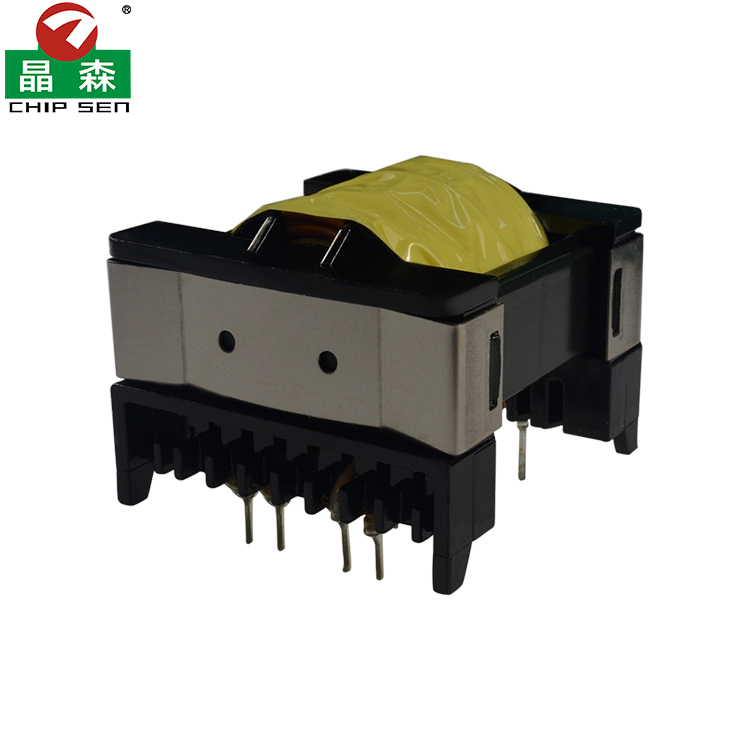
Compact Efficient PQ50 High Frequency Transformer Low Loss Stable for UPS
The PQ50 is a high frequency ferrite transformer platform developed for compact isolated power conversion. Its PQ core geometry provides a relatively large magnetic cross section and winding area within a compact installation envelope, making it suitable for applications requiring power density, efficiency, controlled leakage inductance, and stable thermal performance.
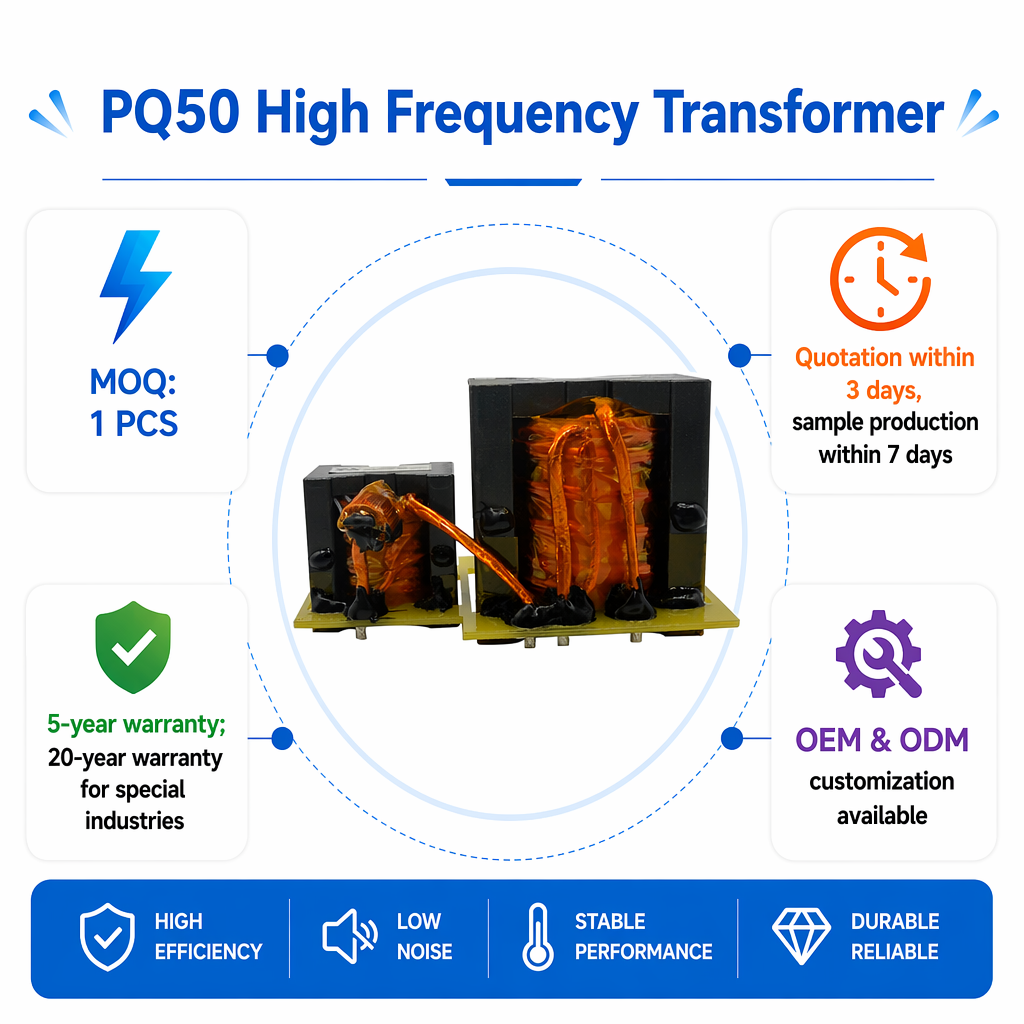
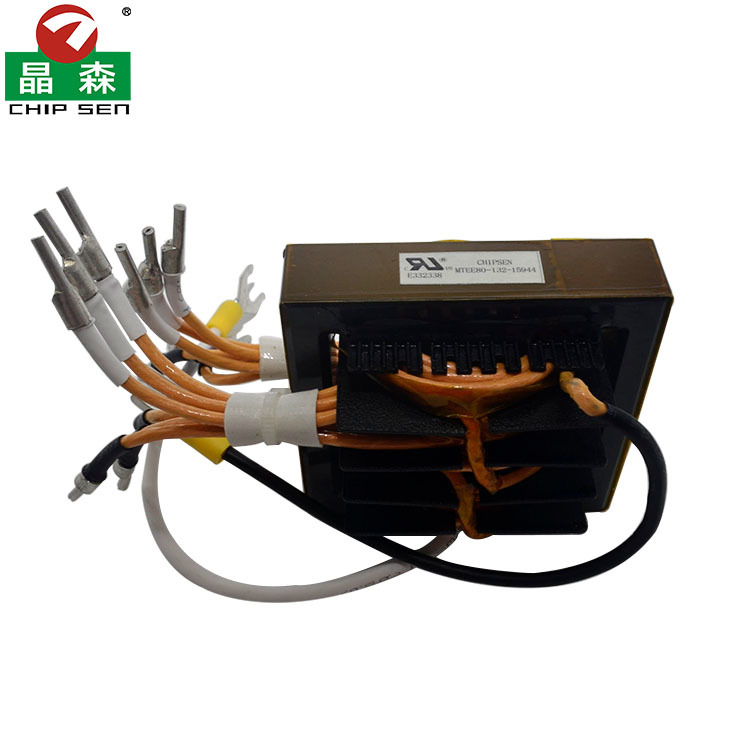
The image shows two magnetic assemblies installed on a shared base. This may represent a customer-specific transformer assembly rather than one standard PQ50 configuration. The quantity of magnetic components, wiring arrangement, mounting base, and electrical relationship must be confirmed through the approved drawing.
All numerical values below are typical engineering inquiry references rather than guaranteed ratings. Final performance depends on converter topology, input voltage, output requirements, switching frequency, duty cycle, waveform, cooling method, insulation system, and allowable temperature rise.
Product Description
The PQ50 high frequency transformer is designed for compact, medium to high power conversion in UPS systems, industrial power supplies, inverters, battery chargers, telecommunications equipment, and renewable energy applications.
Its PQ ferrite core geometry provides efficient utilization of the magnetic cross section and winding window. The structure can accommodate multiple primary and secondary windings, insulation barriers, electrostatic shields, and higher current conductors while maintaining a relatively compact footprint.
Depending on the application, the transformer can use round wire, parallel wire, litz wire, copper foil, or a combined winding structure. Winding sequence can be optimized for leakage inductance, interwinding capacitance, copper loss, insulation, and temperature rise.
The pictured product contains two magnetic assemblies on a common mounting base. Chipsen can provide a single transformer or a customized integrated magnetic assembly according to the customer circuit, mechanical drawing, and wiring requirements.
Quality Control
Chipsen establishes the manufacturing and inspection plan according to the approved electrical specification, mechanical drawing, converter conditions, and customer quality requirements.
Incoming ferrite cores, copper conductors, bobbins, insulation materials, pins, lead wires, adhesives, and protection devices are inspected before production. Winding, insulation, assembly, impregnation, termination, testing, marking, and packaging are controlled through documented procedures.
| Inspection Item |
Inspection Purpose |
| Turns Ratio Test |
Confirms the required primary and secondary voltage relationship |
| Primary Inductance Test |
Verifies magnetizing inductance at the specified test condition |
| Leakage Inductance Test |
Confirms coupling and converter compatibility |
| Winding Resistance Test |
Evaluates conductor consistency and copper loss |
| Polarity and Phase Test |
Confirms winding orientation and multiple output relationships |
| Insulation Resistance Test |
Evaluates insulation between windings, core, pins and leads |
| Dielectric Strength Test |
Verifies the specified isolation withstand capability |
| Interwinding Capacitance Test |
Available for EMI sensitive applications |
| Temperature Rise Test |
Confirms thermal performance under agreed operating conditions |
| Load Performance Test |
Evaluates voltage, current, loss and efficiency |
| Core Loss Evaluation |
Confirms magnetic performance under the defined waveform |
| Pin Strength Test |
Evaluates the mechanical reliability of PCB terminals |
| Solderability Test |
Confirms compatibility with the agreed soldering process |
| Lead Pull Test |
Evaluates the mechanical strength of lead connections |
| Dimension Inspection |
Verifies footprint, height and mounting dimensions |
| Impregnation Inspection |
Checks material coverage, cleanliness and assembly |
| Thermal Device Test |
Confirms sensor or protector operation where installed |
| Appearance Inspection |
Checks polarity marks, insulation, pins, leads and workmanship |
| Packaging Inspection |
Confirms protection, quantity, orientation and labels |
Special medical, automotive, railway, charging and energy storage applications require separate validation plans. Test conditions, limits and sampling requirements must be defined in the approved specification or quality agreement.
Company Profile
Chipsen specializes in the development and manufacturing of custom magnetic components for industrial equipment, power electronics, automation systems, and electrical control applications.
The product range includes high-frequency transformers, low-frequency transformers, planar transformers, power inductors, high-current inductors, toroidal inductors, common-mode chokes, EMI filter magnetics, wireless charging coils, custom coils, and non-standard magnetic components.
Chipsen supports drawing-based development, sample-based replacement development, and application-requirement design. Engineering discussions can cover low DCR, leakage inductance, EMI, insulation, temperature rise, winding structure, footprint, pinout, terminals, protection devices, and production-testing requirements.
The objective is to provide evaluation-ready samples and a clearly defined specification before production approval.
Frequently Asked Questions
What information is required to customize a PQ50 transformer?
Please provide the converter topology, input voltage range, output voltage and current, continuous and peak power, switching frequency, duty cycle, current waveform, target inductance, leakage limit, insulation requirement, dimensions, cooling conditions, pinout, and annual demand.
What power can a PQ50 transformer handle?
Approximately 300 W to 3 kW is a broad inquiry reference rather than a guaranteed rating. Actual capacity depends on topology, switching frequency, flux density, winding design, cooling, ambient temperature, efficiency target, and allowable temperature rise.
What is the advantage of a PQ core?
A PQ core provides a relatively large magnetic cross section and winding window within a compact geometry. This can support high power density, efficient winding arrangements, and reduced overall converter size.
Can the PQ50 be used in an LLC converter?
Yes. A PQ50 transformer can be developed for LLC resonant conversion. The resonant frequency range, turns ratio, magnetizing inductance, leakage inductance, gain requirement, and load range must be provided.
Can leakage inductance be customized?
Yes. Leakage inductance can be minimized for efficient coupling or intentionally controlled for resonant operation. The required value, tolerance, frequency, and test connection must be specified.
Can the transformer use litz wire or copper foil?
Yes. Round wire, parallel wire, litz wire, copper foil, and combined winding structures can be evaluated according to frequency, current, loss, winding space, and termination requirements.
Can multiple secondary outputs be provided?
Yes. Multiple isolated or connected secondary windings can be developed when winding space, power distribution, insulation, and thermal requirements permit.
Can Chipsen produce the two transformer assembly shown in the image?
Yes. A customized assembly using multiple magnetic components on a shared mounting base can be evaluated. The electrical relationship, wiring diagram, dimensions, mounting points, and mechanical requirements must be provided.
Can interwinding capacitance be reduced?
Yes. Winding sequence, insulation spacing, sectional construction, and electrostatic shielding can be optimized. Reducing capacitance may affect leakage inductance, dimensions, and thermal performance.
Can the PCB pin arrangement be customized?
Yes. Pin quantity, spacing, diameter, position, polarity, and electrical assignment can be developed according to the customer PCB drawing.
Can high voltage isolation be provided?
Yes. Reinforced insulation, suitable barriers, creepage, clearance, and dielectric testing can be incorporated according to working voltage and the applicable safety standard.
Can Chipsen develop a replacement from a physical sample?
Yes. The sample can be evaluated for dimensions, turns ratio, inductance, DCR, winding arrangement, pinout, and assembly. Actual converter operating conditions are still required.
Can samples be produced within seven days?
Seven day sample production is a target for eligible designs after the drawing, electrical requirements, materials, and test conditions are confirmed. Special tooling or materials may require additional time.
Are the specifications on this page guaranteed?
No. They are typical engineering and purchasing references. Only values confirmed in the approved drawing, product specification, and validation documentation are guaranteed for the final product.