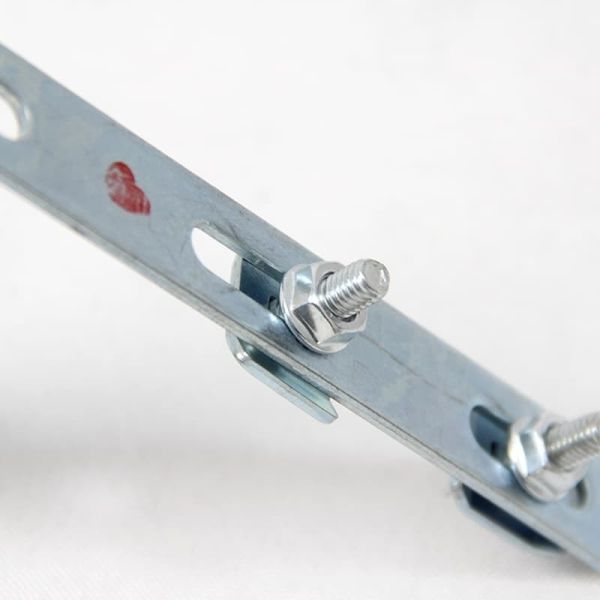
Cable tray fixings are the mechanical components used to secure cable trays to supports, structures, or building surfaces, ensuring stability, load safety, and long-term reliability.
Main Types of Cable Tray Fixings
1. Suspension Fixings (Overhead Support)
Used to hang trays from ceilings or roof structures.
Threaded Rod (All-Thread) & Strut Channels: The most common system.
Components: Threaded rod (M8, M10, M12 are common), nuts, washers, and beam clamps or channel nuts within a strut channel (Unistrut-type). Allows for easy height adjustment and is very versatile.
Cable Tie Hangers & Steel Strapping: Used for lighter trays or in telecom/data applications. Must be rated for the load and be non-corrosive.
Drop Rod Hooks: For hanging ladder tray directly from ceiling wires or steel purlins.
2. Wall Mount Fixings
Used to attach trays to vertical walls or structural columns.
Cantilever Arms (Wall Brackets): Brackets fixed to the wall with a horizontal arm supporting the tray. Can be single or double-sided.
Flange Brackets (End/Corner Brackets): Used to terminate a tray run at a wall or change direction from horizontal to vertical.
J-Bolts or Through-Bolts: For securing the tray side rail directly to a concrete or steel column.
3. Fixings to Structure
The method of attaching the support component (like a rod or bracket) to the building is critical.
Concrete:
Anchor Bolts: Chemical anchors (resin) or mechanical anchors (wedge, sleeve, drop-in) are the strongest and most common for heavy loads.
Concrete Screws: For lighter loads, faster installation.
Steelwork:
Beam Clamps: Wrap around the flange of an I-beam or H-beam. Choose a model that doesn't require drilling.
C-Clamps / Girder Clamps: Similar to beam clamps.
Drilled and Tapped: Drilling through the steel and using a bolt and nut. Provides the strongest connection but is invasive.
Masonry/Brick:
Heavy-Duty Wall Plugs & Bolts: Requires careful selection based on the brick type and potential for cracking.
Secure cable trays to support systems
Maintain correct tray alignment and spacing
Transfer cable load safely to the structure
Prevent vibration, movement, and deformation
Bolts & Nuts – tray-to-support and tray-to-tray connection
Spring Nuts / Channel Nuts – used with strut channels
U-Bolts – fixing trays to round pipes or beams
Beam Clamps – drilling-free fixing to steel structures
Wall Plugs / Anchor Bolts – concrete wall or ceiling installation
Tray Couplers / Splice Plates – join tray sections
Hold-Down Clamps / Clips – prevent uplift or lateral movement
Materials: Carbon steel, stainless steel (SS304 / SS316)
Surface treatment:
Electro-galvanized (indoor use)
Hot-dip galvanized (industrial / outdoor)
Stainless steel (high corrosion environments)
| Do's | Don'ts |
| ✅ Follow the approved design and layout drawings. | ❌ Guess the load or span. Always calculate it. |
| ✅ Use a compatible drill bit and setting tool for anchors. | ❌ Overspan the tray. This is the #1 cause of sagging. |
| ✅ Torque bolts to the manufacturer's specification. | ❌ Use inappropriate or cheap fasteners (e.g., drywall screws for overhead support). |
| ✅ Ensure all threaded rod is cut cleanly and secured with double nuts if needed. | ❌ Ignore expansion joints on long runs (>30m). |
| ✅ Use spring or cut washers to prevent loosening from vibration. | ❌ Mount trays directly to walls without an air gap (unless designed for it) – impedes ventilation and cable heat dissipation. |
| ✅ Earth/Bond the tray system continuously as per regulations. | ❌ Forget to consider cable pulling tension forces on end fixings. |
Reputation and project experience of Bending Cable Tray Fixings:
Bending Cable Tray Fixings has a good industry recognition: Bending has been operating in the field of Cable Tray for 10 years and has received good reviews from domestic and international customers.
Bending Cable Tray Fixings has strong capabilities to ensure the smooth delivery of your project orders and provide reliable support for your orders.
Bending Cable Tray Fixings service and support:
Pre-sales support: During the quotation and design stages, Bending will respond sensitively and quickly provide you with the most suitable Cable Tray bridge frame project service plan and support under the guidance of professional technical engineers.
The professional production line, production, and inspection of Cable Tray Fixings ensure that your orders are consistently delivered on time, which has always been a good sign of the Bending Cable Tray Fixings
After-sales service for Cable Tray Fixings: We will promptly handle any related issues in the field of Cable Tray Fixings bridge, provide spare parts, or offer timely installation technology.