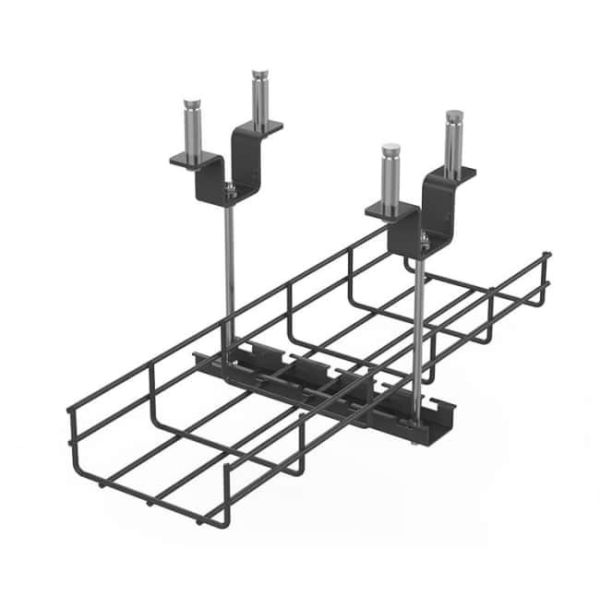
Bending Wire Mesh Cable Tray Support is an essential component in cable management systems designed to provide sturdy and flexible support for wire mesh cable trays. Made from high-quality steel or other durable materials, this support ensures that the cable tray remains securely in place, preventing sagging or instability under the weight of cables.
Wire mesh cable tray support refers to the structural system used to fix, suspend, or carry wire mesh (basket) cable trays.
Because wire mesh trays are lightweight and open-structured, they rely on external supports to:
Maintain correct load capacity
Control deflection and vibration
Ensure compliance with electrical and fire standards
Supports the transfer of the cable load from the tray to the building structure (ceiling, wall, floor, or steel frame).

Common Types of Wire Mesh Cable Tray Supports
1. Trapeze Support (Most Common)
Summary:
Horizontal support suspended from the ceiling using threaded rods.
Details:
Components: threaded rods + strut channel/angle steel
The tray sits directly on the strut
Load shared by two rods
Ideal for long straight runs
Typical use:
Industrial plants, data centers, and commercial buildings
2. Wall-Mounted Bracket
Summary:
Tray fixed directly to the wall via cantilever brackets.
Details:
Single-side support
Easy installation and inspection
Load capacity depends on wall strength
Typical use:
Corridors, risers, plant rooms
3. Floor-Mounted / Raised Support
Summary:
Tray supported from below using posts or frames.
Details:
Used when ceiling fixing is not allowed
High stability
Often custom-fabricated
Typical use:
Substations, tunnels, outdoor installations
4. Single Rod Center Support
Summary:
Tray supported from center using one threaded rod.
Details:
Material-saving solution
Limited load capacity
Strict spacing control required
Typical use:
Light cable loads, telecom or data cabling
5. Direct Fixing (Clip / Clamp Support)
Summary:
Tray fixed directly to beam or steel structure.
Details:
No drilling (beam clamps)
Fast installation
Load capacity depends on clamp rating
Bending Wire Mesh Cable Tray Support Typical Support Spacing Requirements
| Tray Width | Normal Load Spacing | Heavy Load Spacing |
| ≤150 mm | 1.5–2.0 m | 1.2 m |
| 200–300 mm | 1.2–1.5 m | 1.0 m |
| ≥400 mm | 1.0–1.2 m | ≤1.0 m |
Bending Wire Mesh Cable Tray Support Standards
IEC 61537 – Cable tray systems
NEMA VE 1 / VE 2
UL / FM (when fire-rated systems are required)
Local building load codes (seismic, wind, fire)
Reputation and project experience of Bending Wire Mesh Cable Tray Support:
Bending Wire Mesh Cable Tray Support has a good industry recognition: Bending has been operating in the field of Cable Tray for 10 years and has received good reviews from domestic and international customers.
Bending Wire Mesh Cable Tray Support has strong capabilities to ensure the smooth delivery of your project orders and provide reliable support for your orders.
Bending Wire Mesh Cable Tray Support service and support:
Pre-sales support: During the quotation and design stages, Bending will respond sensitively and quickly provide you with the most suitable Cable Tray bridge frame project service plan and support under the guidance of professional technical engineers.
The professional production line, production, and inspection of Wire Mesh Cable Tray Support ensure that your orders are consistently delivered on time, which has always been a good sign of the Bending Wire Mesh Cable Tray Support
After-sales service for Wire Mesh Cable Tray Support: We will promptly handle any related issues in the field of Wire Mesh Cable Tray Support bridge, provide spare parts, or offer timely installation technology.