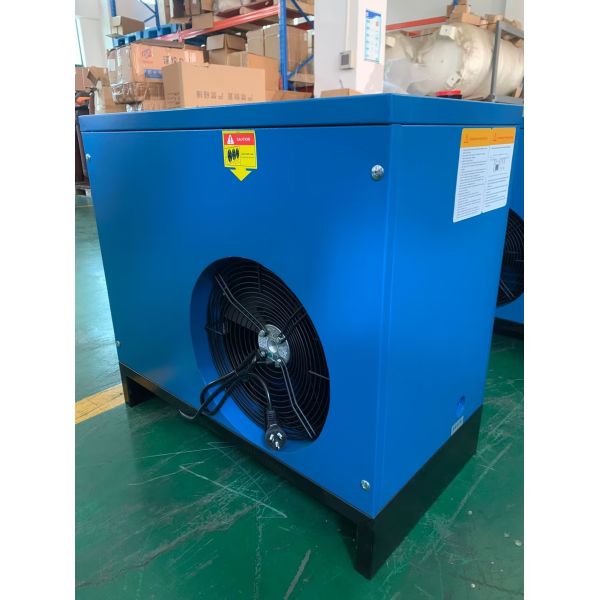
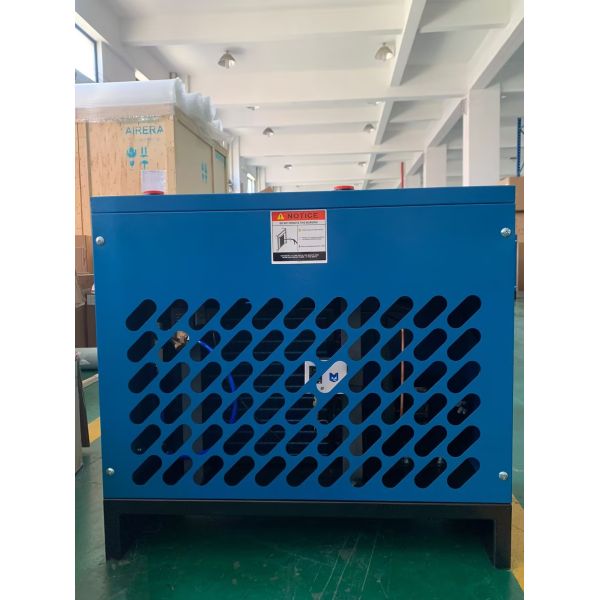
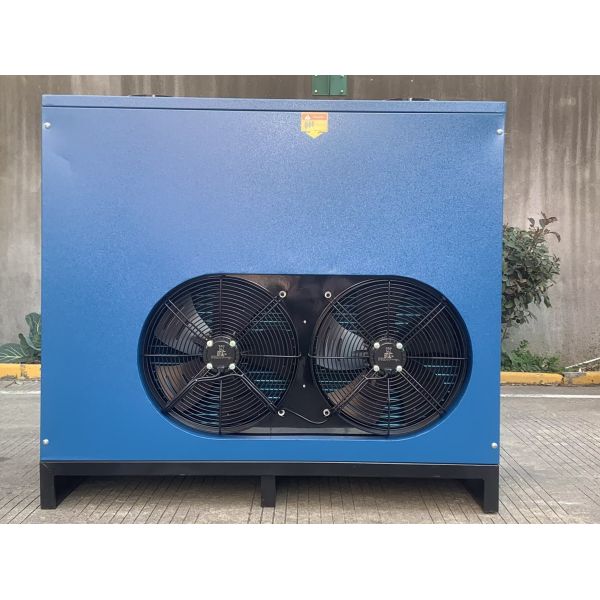
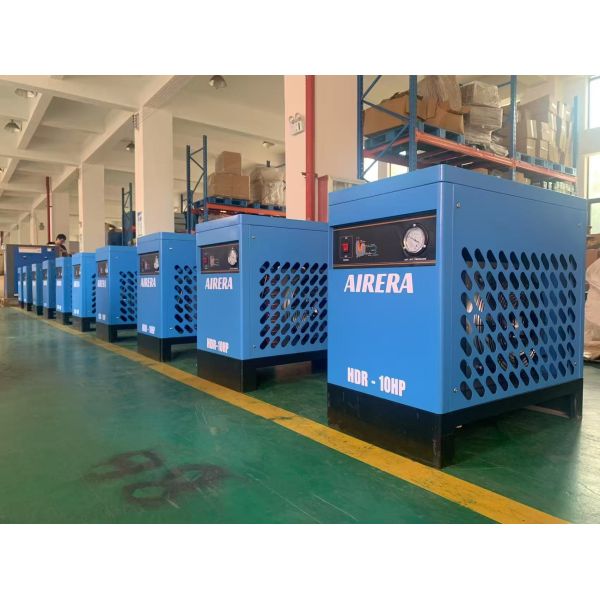
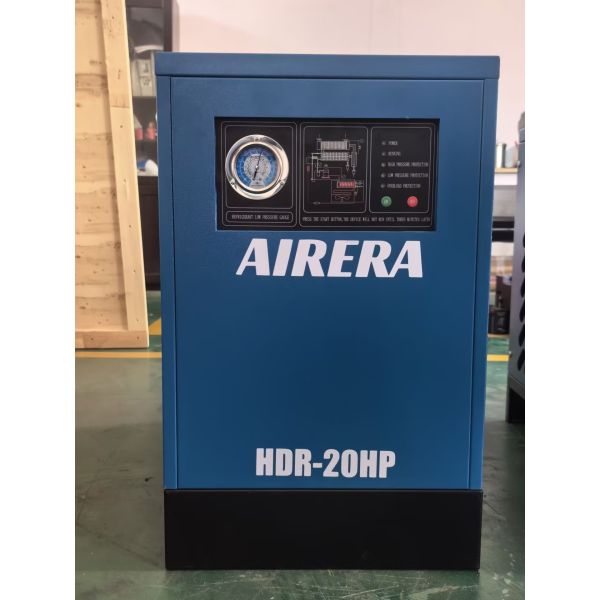
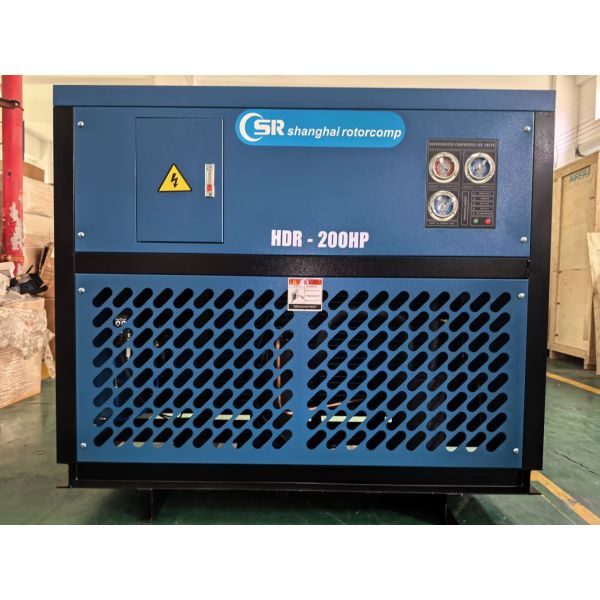
Engineered for small-to-medium precision pneumatic workstations and severe thermal environments, this AIRERA 1.2Nm³/min air-cooled refrigerated dryer serves as a compact, wide-body purification benchmark. Innovatively configured with a widened chassis architecture and heavy-duty, high-efficiency condensation flow fields, the unit comprehensively optimizes air-cooled thermal dissipation space. Even when the inlet air temperature reaches a soaring 55°C, the system maintains ultra-low refrigerant pressures and robust heat-exchange efficiency, guaranteeing zero high-temperature overload trips or frequent shutdown incidents under hostile operating conditions. Utilizing AIRERA's cutting-edge refrigeration control process and high-efficiency evaporator, it delivers a smooth, steady, and continuous supply of moisture-free compressed air, completely eradicating pipeline condensation and offering a smart selection for safeguarding premium air dryness and operational longevity in extreme industrial conditions.
Stable performance under high-temperature conditions
This HDR series air dryer can withstand inlet air temperatures of up to 80 degrees Celsius. Even in high-temperature workshops during the summer or in scenarios where waste heat from air compressors is directly fed into the system, it can reliably maintain a dew point between 2 and 10 degrees Celsius, ensuring that dehumidification remains effective even when the inlet air is overheated.

Comprehensive Coverage Across All Flow Rates with Strong Adaptability
With models available for flow rates ranging from 1.2 Nm³/min to 65 Nm³/min, these units can be precisely matched to any application—from low-power air compressors in small repair shops to high-flow units in large factories. Pipe connections ranging from Rc1/4 to DN125 are all provided, eliminating the need for additional adapters or modifications.

Maintains a stable, low dew point to prevent corrosion caused by moisture in the air supply.
A high-quality heat exchange evaporator, paired with an automatic drain valve, thoroughly filters moisture from the compressed air, ensuring that the air used in laser cutting, metal spraying, and electronics manufacturing is free of water droplets—thereby preventing workpiece oxidation and paint bubbling.

| ITEM | UNIT | MODEL HDR-10HP |
|---|---|---|
| Capacity | Nm³/min | 1.2 |
| Motor | Power(kw) | 0.85 |
| Power Supply | V | 220/1/50 |
| Air Connection |
Rc1 |
|
| Dimension | L×W×H in mm | 630×450×640 |
| Weight | kg | 50 |
| Working pressure | Mpa | <=1.3 |
| Max. inlet temperature | ℃ | 80 |
| Max. ambient temperature | 40 | |
| Min.ambient temperature | 5 | |
| Cooling type | Air-cooling or Water-cooling | |
| Refrigerant | R22 | |
| PDP | 2~10°C |

Why can this wide-body air-cooled freeze dryer run stably when the inlet air temperature reaches as high as 55°C without triggering high-pressure or over-temperature shutdown?
The core lies in our oversized high-efficiency condenser and wide-body flow channel design. Conventional freeze dryers easily trip due to soaring refrigerant pressure when the inlet temperature exceeds 45°C under high thermal loads. This model increases the heat exchange area and optimizes airflow volume, maintaining excellent heat dissipation efficiency even under 55°C high-temperature conditions to ensure continuous operation.
For a small flow rate model of 1.2 $text{Nm}^3/text{min}$, why bother designing it with a "wide-body" structure?
This is to cope with harsh summer conditions or poorly ventilated compressor rooms. Although the flow rate is 1.2 $text{Nm}^3/text{min}$, an inlet temperature of 55°C brings in far more latent heat and moisture than usual. The "wide-body" structure accommodates a larger internal space, allowing for longer and wider evaporators and condensers. This significantly boosts tolerance and adaptability to harsh environments without expanding the footprint.
Absolutely. Thanks to the powerful refrigeration system that prevents over-temperature shutdowns, even with 55°C inlet air, the internal pre-cooler and evaporator can still powerfully cool and condense the high-heat airflow. This keeps the pressure dew point stably controlled within standard ranges, ensuring the downstream equipment always receives dry, moisture-free, and clean compressed air.