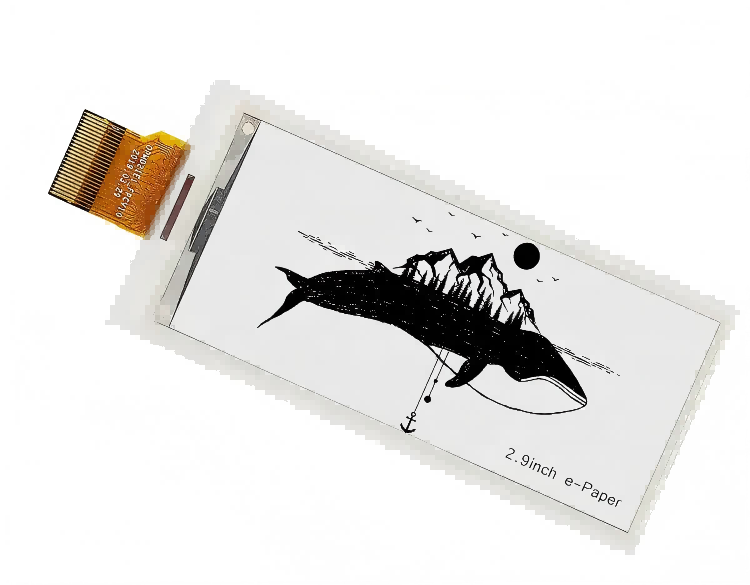
2.9 Inch E-paper Display 128×296 Resolution 24pin Ultra-Low Power 2-Color E-Ink Screen(Model: YE029A262)
Product Features
◊128×296 pixels display (112 DPI, pixel pitch 0.226×0.227mm)
◊Black/White (B/W) 2-color full display capabilities ◊High contrast & high white reflectance (white L*≥66, black L*≤20)
◊Pure reflective mode & ultra wide viewing angle
◊Ultra-low power consumption (≤3μA deep sleep, 80mAs max update power)
◊Bi-stable display & wide temperature range (-15~65℃, normal 0~50℃)
◊Hard-coat antiglare surface & on-chip display RAM
◊3-wire/4-wire SPI + I2C temperature sensor interface (internal/external)
◊On-chip booster/regulator & ROHS2.0+HF+REACH compliant
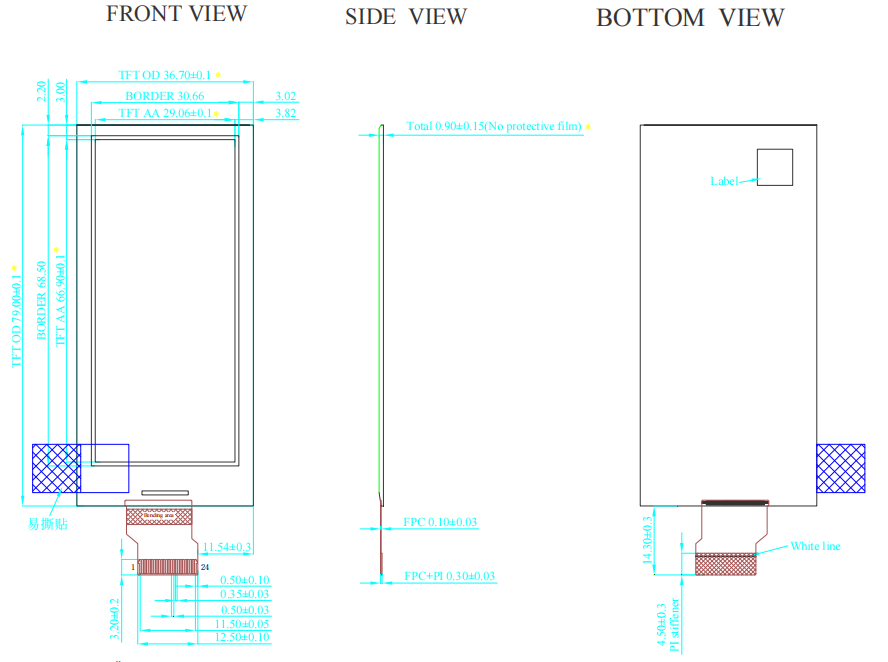
The YE029A262 is an Active Matrix Electrophoretic Display (AMEPD) optimized for medium-size wide-temperature scenarios. It features a 2.9-inch active area (29.06×66.90mm) with 128×296 pixels (0.226×0.227mm pitch, 112 DPI), supporting Black/White 2-color display—ideal for clear information presentation in electronic shelf labels and harsh environments. The module integrates a SSD1680 driver IC, including gate buffer, source buffer, timing control, oscillator, DC-DC converter, SRAM, and LUT, ensuring stable performance. With an ultra-thin outline (36.7×79.0×0.9mm without masking film) and lightweight design (5.0±0.2g), it fits seamlessly into devices like electronic shelf labels, portable terminals, and industrial monitors. The hard-coat antiglare surface and pure reflective mode eliminate glare under strong light, while bi-stable technology ensures ultra-low power consumption—only drawing current during screen updates.
| Type | E-Paper | Screen Refresh Method | Full Refresh |
| Resolution | 128×296 (112 DPI) | Place of Origin | Shenzhen, China |
| Brand Name | Yingzhanying Technology | Outline Dimensions | 36.7(H)×79.0(V)×0.9(D) mm |
| Supplier Type | All (IPS) | Active Area | 29.06(H)×66.90(V) mm |
| Interface | 3-wire/4-wire SPI (BS1 pin selectable), I2C (temp sensor) | Driver IC | SSD1680 |
| MOQ | 5PCS | Operating Temperature | -15~65℃ (Normal: 0~50℃) |
| Connector Type | 24-pin 0.5mm ZIF Socket | Storage Temperature | -25~60℃ |
| Colors | Black/White |
| Power Consumption | Update: ≤80mAs (25℃); Deep Sleep: ≤3μA |
Product Picture
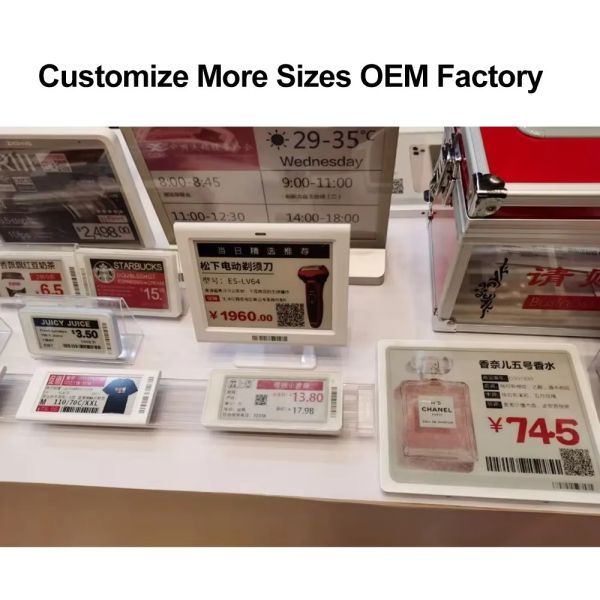
The YE029A262 excels in medium-size wide-temperature scenarios with its 112 DPI display and 2-color high contrast. It clearly presents black-and-white information, making it perfect for electronic shelf labels, industrial monitors, and portable terminals. Its pixel pitch (0.226×0.227mm) ensures sharp text and barcodes, even small fonts remain legible. The hard-coat antiglare surface eliminates glare under direct sunlight, maintaining readability in retail stores or outdoor environments. With an ultra-thin (0.9mm) and lightweight (5.0g) design, it fits into space-constrained devices like smart labels, while ultra-low power consumption (≤3μA deep sleep) enables over 12 months of battery life for daily-updated applications. Its wide temperature range (-15~65℃) adapts to harsh industrial and outdoor conditions.
The YE029A262 has diverse industry applications. In retail, it serves as standard electronic shelf labels for groceries, electronics, and more, using 2-color high contrast to display product names, prices, and stock status—enhancing customer information access. Its low power consumption reduces retail maintenance costs. In logistics, it functions as cargo tags, displaying waybills and transportation statuses, withstanding -25~60℃ transportation for 10 days. In industrial control, it acts as status monitors, indicating normal (white background with black text) and fault (black background with white text) states, adapting to -15~65℃ workshop environments. In portable terminals, its compact size fits into handheld devices for data display. With ROHS2.0+HF+REACH compliance and rigorous reliability testing, it meets global environmental and reliability demands.
Core Advantages

The YE029A262 features 128×296 resolution (112 DPI) with 0.226×0.227mm pixels, delivering sharp text, barcodes, and 2-color graphics—ideal for clear information presentation. Its color performance is outstanding: white state L*≥66, black state L*≤20, with high reflectance and contrast ratio (white reflectance divided by dark reflectance) ensuring clear visibility in low light. The pure reflective mode saves power by eliminating backlighting, while the hard-coat antiglare surface reduces glare under direct sunlight. With an ultra-wide viewing angle, there’s no brightness deviation from any direction, supporting multi-person viewing for shared devices.
With an operating temperature range of -15~65℃ (normal 0~50℃), the module adapts to harsh environments like cold warehouses, hot workshops, and outdoor kiosks. It passed 240-hour high/low-temperature operation tests (40℃/0℃) and 50 temperature cycles (-25℃~60℃), ensuring stable performance in extreme conditions. The internal temperature sensor (I2C) enables real-time waveform adjustment, optimizing display effect across different temperatures. Its storage temperature range (-25~60℃) supports long-term transportation and storage without performance degradation.
Powered by bi-stable technology, the module only consumes power during updates (max 80mAs at 25℃) and draws ≤3μA in deep sleep. A standard lithium battery can power daily-updated devices for over 12 months, reducing replacement frequency. It passed rigorous reliability tests: 168-hour high-humidity operation (40℃, 90%RH), ESD testing (contact ±2KV/air ±8KV), and UV exposure resistance (765 W/㎡ for 168hrs). The hard-coat screen resists scratches and fingerprints, while ROHS2.0+HF+REACH compliance meets global standards. Its 5-year design life (25℃/60%RH, daily updates) ensures long-term use.
The module supports 3-wire/4-wire SPI (selectable via BS1 pin) and I2C for temperature sensors, compatible with most MCUs and embedded systems—no complex drivers needed. Pins 6 and 7 are pre-grounded on FPC, simplifying circuit design. The 24-pin 0.5mm ZIF Socket and easy-to-tear sticker enable quick, secure installation. Customizations include FPC length/bending area (for non-flat devices), cover glass processing (anti-glare/anti-fingerprint), and OTP programming (10-byte user ID, waveform parameters), adapting to diverse application needs like electronic shelf labels and industrial monitors.
Technical Drawing
PIN Definition
| PIN | Symbol | Description | Remark |
| 1 | NC | No connection and do not connect with other NC pins | Keep Open |
| 2 | GDR | N-Channel MOSFET Gate Drive Control | |
| 3 | RESE | Current Sense Input for the Control Loop | |
| 4 | NC | No connection and do not connect with other NC pins | Keep Open |
| 5 | VSH2 | Positive Source driving voltage | |
| 6 | GND | Ground | Pre-grounded on FPC |
| 7 | GND | Ground | Pre-grounded on FPC |
| 8 | BS1 | Bus selection pin | Low=4-wire SPI, High=3-wire SPI |
| 9 | BUSY | Busy state output pin | High=IC working, no command allowed |
| 10 | RES# | Reset signal input | Active low |
| 11 | D/C# | Data/Command control pin | High=Data, Low=Command |
| 12 | CS# | Chip Select input pin | Low=IC enabled for MCU communication |
| 13 | SCL | Serial communication clock input | |
| 14 | SDA | Serial communication data input | |
| 15 | VDDIO | Power input pin for the Interface | |
| 16 | VCI | Power Supply pin for the chip | 2.4~3.6V |
| 17 | VSS | Digital ground | |
| 18 | VDD | Core logic power pin | |
| 19 | VPP | Power Supply for OTP Programming | 10V |
| 20 | VSH1 | Positive Source driving voltage | |
| 21 | VGH | Positive Gate driving voltage | |
| 22 | VSL | Negative Source driving voltage | |
| 23 | VGL | Negative Gate driving voltage | |
| 24 | VCOM | VCOM driving voltage | OTP programmed in factory |
The YE029A262 offers multiple customization options to meet diverse application needs:
FPC Design: Flexible layout and connector type can be adjusted to fit system requirements.
Cover Glass: Size, thickness, shape, and surface printing (logo, pattern) can be customized.
Display Colors: Various color combinations available for customization, including black-white-red-yellow, black-white, black-white-red, etc.
Refresh Modes: Multiple refresh methods customizable, such as fast refresh, slow refresh, full refresh, partial refresh, and more.