Description
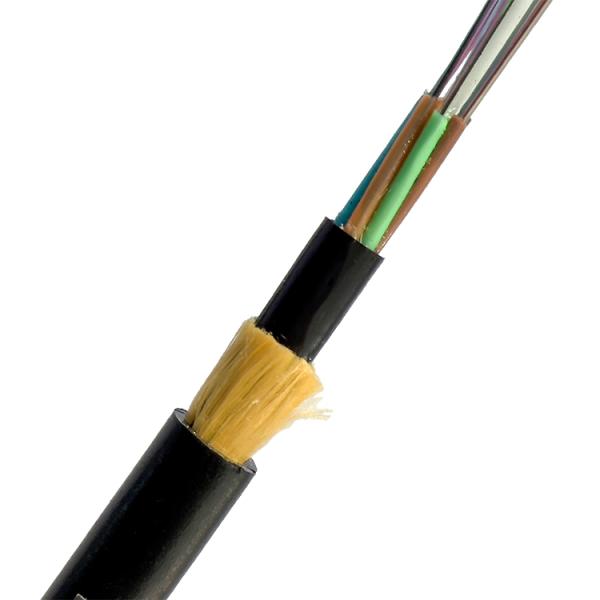
ADSS (All-Dielectric Self-Supporting) cable is a specialized type of fiber optic cable engineered for aerial installation without requiring any metallic components or separate support structures. Its unique composition allows it to be mounted directly onto existing utility poles and high-voltage transmission towers. Because it is completely non-metallic, the cable provides excellent immunity to electromagnetic interference (EMI) and electrical hazards. This makes it a preferred solution for data transmission alongside power distribution grid
Physical Parameters
| Span(m) |
Ice+Wind:0mm+35m/sec |
Ice+Wind:12mm+30m/sec |
| Cable O.D.(mm/in) |
Cable Weight (kg/km)/(lb/kft) |
Max.Working Tension(N/lb) |
Max .Sag(%) |
Cable O.D.(mm/in) |
Cable Weight (kg/km)/(lb/kft) |
Max.Working Tension(N/lb) |
Max .Sag(%) |
| 100 |
13.9/5.472 |
152/102.01 |
7578/1704 |
2 |
13.8/0.543 |
150.0/100.67 |
6621/1489 |
2 |
| 200 |
14.3/0.562 |
161/108.05 |
10430/2346 |
3 |
14.1/0.555 |
157.0/105.37 |
9000/2024 |
3 |
| 400 |
15.9/0.625 |
199/133.56 |
23221/5223 |
3 |
15.4/0.606 |
187.0/125.50 |
19225/4331 |
3 |
| 500 |
16.7/0.657 |
220/147.65 |
30590/6881 |
3 |
16.1/0.633 |
204.0/136.91 |
24885/5598 |
3 |
| 600 |
16.3/0.641 |
209/140.27 |
26952/6063 |
4 |
15.7/0.618 |
196.0/131.54 |
22154/4983 |
4 |
| 800 |
16.5/0.649 |
216/144.97 |
29452/6625 |
5 |
15.9/0.625 |
201.0/134.90 |
24042/5408 |
6 |
| 1000 |
16.7/0.657 |
221/148.32 |
31271/7034 |
6 |
16.1/0.633 |
204.0/136.91 |
24407/5490 |
6 |
* Above table do not cover all of available types. Other ADSS cables can be manufactured upon customer's request according to different span and sag environment.
| Minimum Bending Radius: |
|
Maximum Compressive Load: |
4000N |
| Under installation: |
20×OD |
Repeated Impact: |
4.4 N.m (J) |
| During operation |
10×OD for unarmoured cables |
Twist (Torsion): |
180×10 times, 125×OD |
| |
20×OD for armoured cables |
Cyclic Flexing: |
100 cycles |
| Temperature Range: |
|
|
|
| Operating Temperature Range: |
-40℃(-40℉) to +70℃(+158℉) |
Crush Resistance: |
263N/cm (1250lb/in) |
| Storage Temperature Range: |
-50℃(-58℉) to +70℃(+158℉) |
|
|
Key Characteristics & Construction
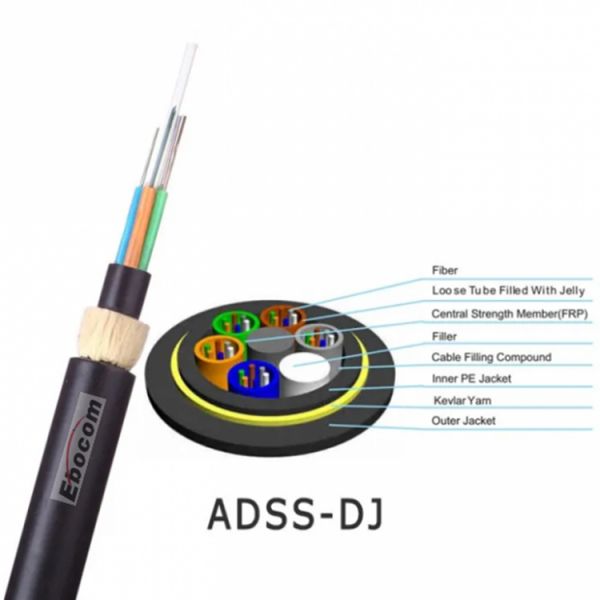
ADSS cables are built to withstand harsh environmental conditions while protecting the fragile internal glass fibers. Their structural design typically incorporates several core layers
Optical Fiber Core: Contains up to 144 single-mode or multi-mode fibers for data transmission
Central Strength Member: Typically made from Fiberglass Reinforced Plastic (FRP) to provide internal structural support without conductivity
Strength Layers: Wrapped in premium aramid yarns (Kevlar) that supply high tensile strength. This helps the cable tolerate high wind, ice loads, and tension
Outer Sheath: Composed of tracking-resistant (AT) or polyethylene (PE) materials. It blocks UV rays and guards against moisture
Major Technical Advantages
- Self-Supporting Structure: Replaces old strand-and-lash methods, requiring no support or messenger wires.
- Live-Line Installation: Workers can deploy ADSS safely on energized grids, eliminating grid downtime.
- Long Span Capabilities: Strong strength-to-weight ratios support clear spans from 50 meters up to 800+ meters.
- Zero Electrical Risk: Eliminates bonding, grounding, and lightning attraction hazards.
- Cost-Efficient Deployment: Reuses existing poles, significantly reducing civil engineering and digging expenses
Primary Applications
ADSS cables serve as the communication backbone across multiple industries
Power Utility Networks: Installed directly on high-voltage transmission towers below power lines to monitor grids and manage control data
Telecommunication Backhauls: Leveraged by telecom operators for long-distance rural networks where digging trenches is too costly
5G Small Cell Deployment: Connects urban 5G neighborhood antennas mounted on public utility poles back to city hubs
Complex Terrestrial Crossings: Strung safely across natural barriers like rivers, deep valleys, and highways without intermediate poles.
Railway Infrastructure: Deployed along transport corridors to secure signaling, camera monitoring, and control system pathway