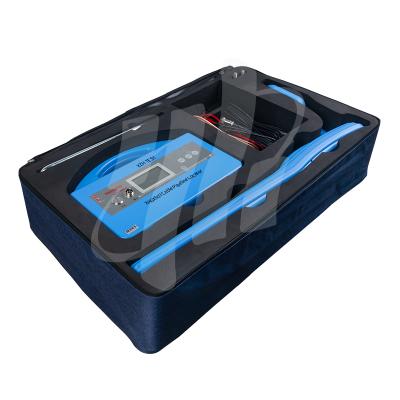
XHGX507C1 Cable Pipe Locator | Cable Fault Locator
XHGX507C1 is a comprehensive underground cable and pipeline path detection instrument (cable pipe locator) with strong performance. It provides pipeline path detection, cable identification and fault finding functions, and consists of a transmitter, a transmitting current clamp, a receiver, a receiving flexible current clamp, a connecting test line and an optional A-frame. It accurately locates pipelines and cables, measures depth and is suitable for trenchless detection and patrol of underground metal pipelines and cables.
Designed For: Power cable operation and maintenance crews, cable identification and cut-over teams that must positively identify a target live or de-energized cable among many to prevent mistaken sawing, distribution network and utility cable patrol departments, municipal pipeline management units, and trenchless pipeline construction and survey teams.
Key Specifications
| Parameter |
Specification |
| Model |
XHGX507C1 |
| Product Type |
Underground cable and pipeline path detection instrument (cable pipe locator) |
| Functions |
Pipeline path detection, depth measurement, cable identification and A-frame fault finding |
| Receiver Frequencies |
11 active frequencies from 640Hz to 197kHz; passive 50Hz, 60Hz, 250Hz; RF 32.7kHz, 65.6kHz, 81.9kHz, 197kHz |
| Detection Modes |
Classic positioning mode, wire cruise mode, signal distortion measurement mode |
| Transmitter Output Modes |
Direct connection, caliper coupling and induction method |
| Transmitter Output |
Maximum 15W with 9 adjustable output gears and automatic impedance matching |
| Pipeline Detection Range |
Direct connection 0–20km; coupling 0–10km; induction suitable for cables buried less than 2m deep |
| Depth Measurement |
0 – 20 m |
| Depth Accuracy |
±5% (burial depth 0–3m); -10% (burial depth 3–20m) |
| Cable Identification |
Flexible caliper intelligent identification; 1 to 20 cables pre-calibrated at the transmitter end |
| Receiver Display |
4.3 inch capacitive touch LCD with 360° path indication, depth, current and relative position |
| Receiver Power |
8.4V 5200mAh high-capacity rechargeable lithium battery |
| Transmitter Display |
5 inch capacitive touch LCD with integrated tool-box chassis |
| Transmitter Clamp |
Caliper coupling, jaw size Φ125mm |
| Flexible Current Clamp |
Rogowski coil, jaw inner diameter about 200mm for cables below Φ200mm |
Core Features
Multiple detection modes: classic positioning mode, wire cruise mode and signal distortion measurement mode.
Classic positioning mode shows compass, direction and signal amplitude to indicate the left and right direction of the pipeline.
Wire cruise mode gives 360° all-round path indication with continuous depth, current and relative position display.
Current direction determination can eliminate adjacent line interference and prevent tracking errors.
Fully digital high-precision sampling with an extremely narrow receiving passband and strong anti-interference ability.
11 active detection frequencies and 3 passive detection frequencies are available.
The transmitter offers direct output, caliper coupling and induction signal output modes.
Cable identification can positively identify live and power-off cables, with 1 to 20 cables pre-calibrated at the transmitter end.
Built-in high-power rechargeable lithium battery with automatic impedance matching and fully automatic protection.
Three Signal Output Methods & Cable Identification
Direct Connection Method
A direct test clip is connected to the output interface and the instrument automatically identifies the accessory. Signals can be traced over long distances (generally 0–20km) and this method gives the strongest, most reliable signal for path detection and depth measurement.
Caliper Coupling Method
The transmitter clamp couples the signal to the target cable without disconnecting it, and the arrow on the clamp shows the signal direction. This method is used for live cable detection and for cable identification, and generally traces 0–10km.
Induction Method
The transmitter induces a signal into the pipeline through its internal antenna. It requires no direct connection and suits cables buried less than 2m deep; interference must be considered, so a receiver is normally kept 20m away when using induction.
Cable Identification Workflow
Up to 20 cables are pre-calibrated at the transmitter end and then received and identified at the remote end with the flexible Rogowski current clamp, which clamps cables below Φ200mm without disconnecting them. A successful identification is marked with a tick and non-target cables with a cross, quickly and automatically identifying the target cable and preventing accidental sawing of live cables.
FAQ
Q1: Who is the XHGX507C1 cable pipe locator designed for?
It is designed for power cable operation and maintenance crews, cable identification and cut-over teams that must positively identify a target live or de-energized cable among many to prevent mistaken sawing, distribution network and utility cable patrol departments, municipal pipeline management units, and trenchless pipeline construction and survey teams.
Q2: What can the instrument detect?
It performs pipeline path detection, pipeline census and depth measurement of metal pipelines and underground cables, and it also supports cable identification and optional A-frame fault finding, so it is a comprehensive path detection instrument for trenchless environments.
Q3: How does cable identification work?
Using the flexible caliper intelligent identification, up to 20 cables can be pre-calibrated at the transmitter end and then received and identified at the remote end. A successful identification is marked with a tick and a non-target cable with a cross, which quickly and automatically identifies the target cable and avoids the serious risk of mistakenly sawing a live cable.
Q4: What signal output methods and frequencies are available?
The transmitter adds signals through the direct connection method, the caliper coupling method or the induction method, with 11 active frequencies from 640Hz to 197kHz and a maximum output power of 15W with 9 adjustable gears.
Q5: How deep and how long can it trace?
The depth measurement range is 0 to 20m with a depth accuracy of ±5% for burial depths of 0–3m. With the direct connection method the traceable cable length generally reaches 0–20km and with the coupling method 0–10km, while the induction method suits cables buried less than 2m deep.
All English version available, please contact us for more photos.