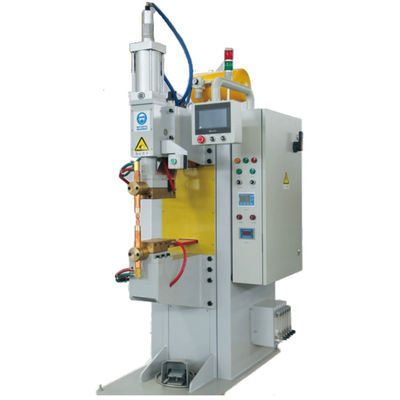
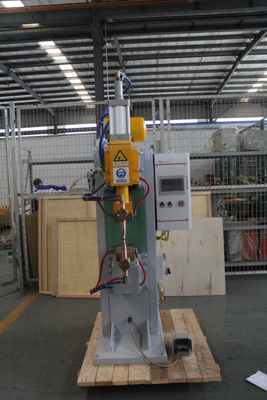
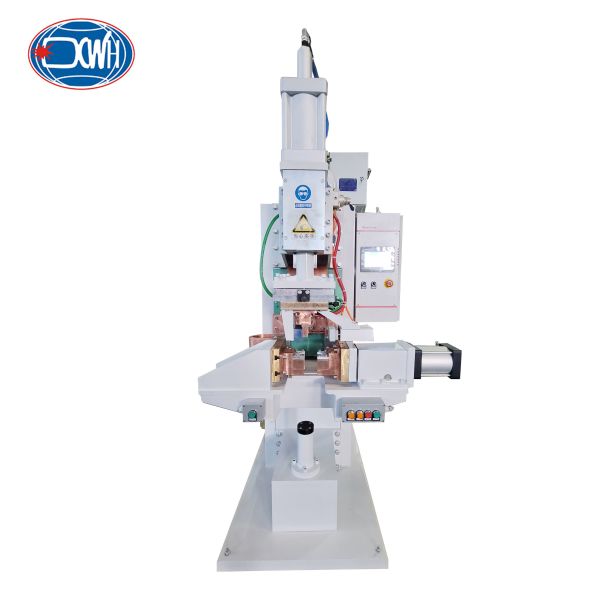
The Xinwei DN(B) Series MFDC Stationary Welding Machine is a dual-mode resistance welding platform — capable of both precision spot welding and high-force projection welding in a single workstation. Powered by advanced Medium Frequency Direct Current (MFDC) inverter technology with closed-loop digital control, it delivers exceptional weld quality, deep penetration, and minimal spatter across a wide range of materials and joint configurations.
Unlike single-purpose machines, the DN(B) Series allows manufacturers to switch between spot and projection welding modes without changing equipment — reducing capital investment, floor space, and operator training requirements. This dual capability is particularly valuable for tier suppliers and contract manufacturers who handle diverse workpiece portfolios.
The three-phase rectifier and high-performance IGBT inverter module convert standard 380V/50Hz line power into stable, ripple-free medium-frequency DC welding current. Independent digital management of weld heat, pre-press time, hold time, and off time — all under closed-loop feedback — ensures every weld meets exacting specifications. The near-unity power factor delivers 30-40% energy savings compared to equivalent AC welders.
Unlike pneumatic systems that fluctuate with air supply variations, the servo-driven electrode force system provides programmable, digitally controlled pressure with sub-Newton repeatability. This is critical for projection welding applications — such as nut and bolt welding — where precise force control directly determines weld consistency and prevents projection collapse before current flows.
Switch between standard spot welding (sheet-to-sheet lap joints) and projection welding (sheet-to-fastener, embossed projection joints) without changing equipment. This dual capability consolidates two processes into one workstation — eliminating the need for separate machines and reducing production line complexity. Ideal for manufacturers producing assemblies that require both structural spot welds and fastener projection welds.
The integrated microcomputer controller features a user-friendly interface with programmable welding schedules, real-time process monitoring, and adaptive feedback. Operators can store multiple weld recipes for different workpieces and switch between them instantly. The adaptive control continuously monitors weld parameters and compensates for electrode wear, material variations, and line voltage fluctuations — ensuring the 1000th weld is identical to the first.
The DN(B) Series is constructed with a heavy-duty rigid frame and premium components designed to withstand rigorous industrial duty cycles. With power ratings from 100 to 250 KVA and 50% duty cycle, it handles continuous multi-shift operation in demanding environments — from automotive tier-1 production lines to high-volume appliance manufacturing.
| Industry | Typical Workpiece | Welding Mode |
|---|---|---|
| Automotive Manufacturing | Body panels, seat frames, bracket assemblies, nut/bolt projection welds | Spot + Projection |
| Home Appliances | Washer drums, oven cavities, microwave enclosures, mounting studs | Spot + Projection |
| Electronic Instrumentation | Precision enclosures, connector brackets, shielding components | Spot (fine control) |
| Aerospace Components | Light-alloy structural panels, sensor mounts, fastener welding | Spot + Projection |
| General Metal Fabrication | Structural frames, cabinets, multi-point assemblies | Spot + Projection |
The DN(B) Series employs MFDC (Medium Frequency Direct Current) inverter resistance welding technology in a three-stage power conversion chain. Stage 1: Three-phase 380V/50Hz AC input is rectified to stable DC via a three-phase bridge rectifier. Stage 2: The DC bus feeds a high-frequency IGBT inverter module that converts to 1000Hz medium-frequency AC. Stage 3: This MF AC passes through a compact, high-efficiency welding transformer which steps it down to high-current, low-voltage output, then a secondary rectifier converts it to ultra-stable DC welding current delivered through water-cooled copper electrodes. The closed-loop digital controller independently manages four critical parameters — weld heat (current × time), pre-press time, hold time, and off time — using real-time sensor feedback to maintain ±1% accuracy across the entire production run.
| Parameter | Unit | DN(B)-100 | DN(B)-160 | DN(B)-200 | DN(B)-250 |
|---|---|---|---|---|---|
| Rated Power | KVA | 100 | 160 | 200 | 250 |
| Power Input | V | 3φ AC 380V | |||
| Max. Short Circuit Current | KA | 30 | 35 | 40 | 45 |
| Duty Cycle | % | 50 | |||
| Max. Electrode Force | N | 6000 | 6000 | 10000 | 15000 |
| Electrode Length | mm | 450 | 450 | 450 | 500 |
| Working Stroke | mm | 80 | |||
| Cooling Consumption | L/min | 20 | |||
| Max. Welding Capacity | mm | 3.0+3.0 | 4.0+4.0 | 5.0+5.0 | 6.0+6.0 |
Spot welding joins two or more overlapping sheets by passing current through flat electrodes, creating a weld nugget at the sheet interface. Projection welding uses a workpiece with a raised embossment (or a weld nut/bolt) that concentrates current and force at a specific point. The DN(B) supports both modes — simply switch the electrode configuration and weld schedule. Projection mode is commonly used for welding nuts, bolts, and studs to sheet metal.
MFDC offers three decisive advantages: closed-loop current control (±1% accuracy vs ±10% for AC), 30-40% energy savings through near-unity power factor, and significantly smaller transformer size for faster magnetic response. For applications requiring consistent weld quality — such as automotive safety components or aerospace structures — MFDC is the standard, not an option.
Low-carbon steel, stainless steel, galvanized steel, coated steels, and aluminum alloys. The precise current control and servo pressure system make it particularly effective for coated and high-strength steels where process windows are narrow. Contact our engineering team with your specific material specifications for a welding feasibility assessment.
Switching takes under 5 minutes. Change the electrode configuration, select the stored weld recipe from the controller memory, and you are ready. No mechanical recalibration is required. The microcomputer controller stores up to 99 programmable weld schedules for instant recall.
Send us your workpiece drawings and production requirements. Our engineering team will evaluate your application, configure the optimal DN(B) Series solution, and provide a detailed proposal — including electrode design, power rating, and automation integration options.
Send Drawing | Request Welding Test | Get Custom Solution
The following images are from the original product page. Review and reposition as needed.