ATI Sputtered Building Insulation Film: Premium Glass Thermal Armor
Product Description
Are modern expansive glass facades converting your premium workspace or living area into an energy-draining greenhouse? Unshielded architectural glass allows massive amounts of shortwave infrared radiation to penetrate deep indoors, spiking ambient temperatures, overloading HVAC chillers, and causing blinding screen glare that destroys daytime productivity.
Overcome severe environmental heat loading with our professional-grade Building Insulation Film powered by ATI multi-alloy plasma sputtering. This elite performance membrane utilizes a synchronized matrix of Aluminum, Titanium, and Indium atoms deposited in a high-vacuum chamber. The Aluminum layer physically redirects solar heat energy outward before it can penetrate the glass, the Titanium shield prevents any atmospheric oxidation or edge-rusting, and the Indium infusion ensures exceptional optical definition with ultra-low haze. Secure an ecofriendly, thermally balanced indoor environment with no color distortion and immense utility savings.

Advanced Technology & Technical Parameters
| Advanced ATI Sputtered Process | Technical Parameter | Real-World Performance Benefit |
| Tri-Alloy Ballistic Plasma | Infrared Rejection (IRR): 96% | Provides pure physical reflection of solar heat waves, keeping glass surfaces cool |
| Titanium Passivation Layer | Salt Spray Resistance: > 2500 Hrs | Prevents edge oxidation and blackening, perfect for high-humidity coastal zones |
| Indium Oxide Clarifier | Interior Reflection Rate: < 8% | Eliminates annoying interior glare and "night mirror reflection" from the inside |
| Thermosetting Cross-Linked PSA | Shear Strength Bond: > 5.2 N/25mm | Remains firmly anchored under severe long-term thermal expansion cycles |
Advanced Architectural Window Film Engineering & Performance Matrix
| Core Engineering Process | Process Mechanism & Technical Definition | Performance Parameters | Property Enhancement Benefits |
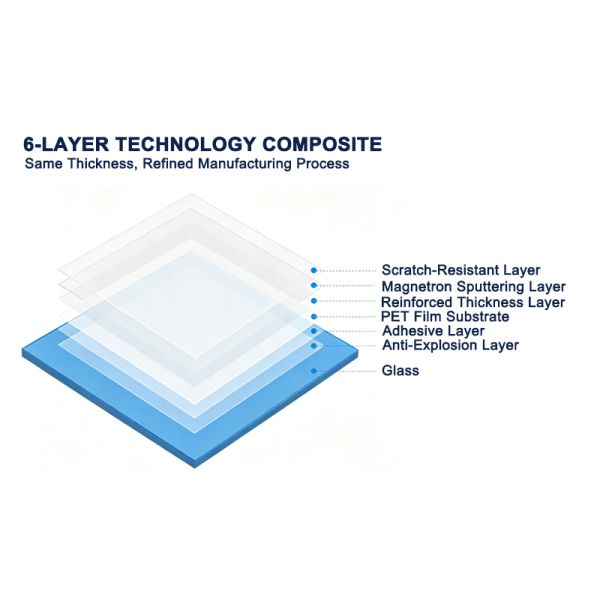
| Magnetron Sputtering Technology | A high-vacuum ballistic deposition method where metallic target atoms are uniformly layered onto a high-clarity optical web to deflect thermal waves. | • Shading Coefficient (SC): 0.32 - 0.38 • Solar Absorption Rate: < 15% | Bounces solar heat away via external physics reflection, ensuring the glass stays cool and completely avoiding thermal stress cracks. |
| Nano-Ceramic Technology | A molecular-level dispersion technique that embeds non-conductive, heat-absorbing crystal particles deep inside the window film layers. | • Near-Infrared Rejection (NIRR): 90% - 98% • Electronic Signal Attenuation: 0% | Shields the building from intense solar rays while allowing unobstructed 5G communication, Bluetooth connectivity, and Wi-Fi networks. |
| Spectrally Selective Technology | An optical filtration system engineered to separate different bands of solar energy, maximizing natural glare-free light while dropping radiant heat. | • Total Solar Energy Rejected (TSER): 70% - 78% • UV Barrier Efficiency: 99.9% | Perfect for modern homes and commercial buildings; delivers maximum interior cooling without sacrificing architectural transparency. |
| Dual-Action Low-E Coating | A specialized multi-layer micro-emissivity coating that updates the structural thermal resistance profiles of standard glass panels. | • Winter U-Value Enhancement: 25% - 30% • Material Emissivity Index: 0.55 - 0.62 | Functions as a smart year-round climate barrier: repels intense external heat waves during the summer and traps indoor heat during the winter. |
| Cross-Linked Pressure Adhesive | An industrial-grade, water-activated acrylic pressure polymer that triggers strong internal molecular bonding during installation. | • Heavy Shear Strength Bond: > 5.0 N/25mm • Commercial Warranty Rating: 15 Years | Guarantees long-term visual clarity; completely eliminates bubbling, peeling, haze formation, or yellowing under brutal direct sun. |
*Technical parameters vary. Reach out to our experts.
Contact us today to request your Free Sample Kit!
FAQ:
Q1: Why should I choose an ATI Sputtered Building Insulation Film over a ceramic film?
A1: Ceramic films work by absorbing heat, meaning the glass window itself gets very hot and eventually radiates that heat into your rooms during late afternoons. This ATI film utilizes true tri-alloy sputtering to reflect the sun's energy away completely. It delivers significantly higher thermal defense for areas facing extreme, direct sun exposure.
Q2: Will the metal components in this ATI film cause it to rust or corrode at the edges over time?
A2: No, this is where the real alloy engineering shines. Traditional silver tints use pure aluminum which rusts quickly when exposed to window moisture. Our film introduces Titanium atoms into the matrix. The Titanium creates a permanent anti-oxidation shield that completely locks out moisture and salt air, preventing black edges for life.
Q3: Does this high-performance window film distort natural indoor lighting or colors?
A3: Not at all. Thanks to the integration of Indium—a rare element renowned for its high electrical conductivity and incredible optical transparency—our film maintains an ultra-low haze rating (<0.8%). It filters out harsh brightness while preserving crisp, true-to-life color profiles looking outside.
Q4: Is this architectural film safe for installation on high-end low-E double-pane windows?
A4: Yes, it is 100% safe. Because the ATI matrix relies on physical reflection rather than heat accumulation, it features an exceptionally low solar absorption rate. It does not create high thermal stress between the glass panes, eliminating the risk of thermal glass cracking or breaking.