Specifications
Brand Name :
Elacera
Model Number :
Alumina Ceramics
Certification :
ISO9001-2015
Place of Origin :
Changsha, Hunan, China
MOQ :
Negotiable
Price :
Negotiable
Payment Terms :
T/T
Supply Ability :
100,000 ㎡/ year
Delivery Time :
25-45 workdas
Packaging Details :
Packed in wooden cases or iron racks
Density :
3.65 g/cm3
Corrosion Resistance :
High
Material :
Alumina
Volume Resistivity :
10^14 Ω·cm
Hardness :
9 Mohs
Color :
White
Rockwell Hardness :
85 HRA
Tensile Strength :
300 MPa
Thermal Conductivity :
25 W/mK
Surface Finish :
Polished
Description

Product description

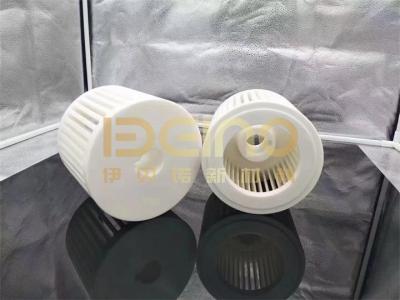
In the ultrafine powder processing industry, the stability of the classification system directly affects the particle size and purity of the final product. This is especially true in applications such as lithium battery materials and electronic ceramic powders, where control of metal contamination is extremely stringent. Traditional metal classifying wheels are prone to wear after prolonged operation and may introduce metallic impurities. Therefore, an increasing number of airflow milling machines are adopting ceramic classifying wheels as an alternative.

Ceramic classifying wheels are typically manufactured from a single piece of high-purity alumina or zirconium oxide. Ceramic itself has high hardness and good wear resistance, maintaining a low wear rate even under high-speed airflow impact and powder friction. This is particularly important when processing lithium battery cathode materials, as the material itself requires high purity, and any metallic impurities can affect the final performance.

In actual use, the material enters the classification zone with the airflow, and the high-speed rotation of the classifying wheel creates a centrifugal force field. Finer particles pass through the classifying wheel and enter the collection system, while coarser particles return to the grinding zone for further grinding. This process requires the classifying wheel to maintain dimensional stability over a long period; otherwise, the classification accuracy will gradually decrease. Ceramic materials, due to their low wear, more easily maintain stable classification results.

Compared to metal classifiers, ceramic classifiers offer another advantage: a smoother surface. Powder is less likely to adhere to the wheel surface, reducing material blockage and improving equipment efficiency. For powder processing plants requiring continuous production, this significantly reduces downtime for cleaning.

From a maintenance perspective, while ceramic classifiers have a slightly higher initial cost, their longer lifespan results in lower overall operating costs. Many users have found that replacement cycles are significantly extended and equipment operation is more stable after switching to ceramic classifiers.
Currently, these ceramic classifiers are widely used in classification systems for lithium-ion battery cathode materials, lithium iron phosphate, ternary materials, electronic ceramic powders, and fine chemical powders. The size and structure of the classifier can be customized to match various air jet mills, depending on the equipment model.

Wear Resistant Alumina Ceramic Classifier Wheel for Air Jet MillWear Resistant Alumina Ceramic Classifier Wheel for Air Jet Mill

Product parameters

Parameter Specification Unit Notes
Material High-purity Alumina Ceramic ≥ 99% Al₂O₃
Hardness ≥ 15 Mohs Excellent abrasion resistance
Density 3.8–3.9 g/cm³
Fracture Toughness 4–5 MPa·m^0.5
Operating Temperature ≤ 1200 °C Suitable for continuous operation
Maximum Rotational Speed ≤ 3600 RPM Depends on the air jet mill model
Wheel Diameter 150–400 mm Customizable
Wheel Thickness 10–30 mm Customizable
Particle Size Range 1–100 μm Depends on classifier settings
Service Life 3–5 times metal wheels Under normal operating conditions
Comparison: Alumina Ceramic Classifier Wheel vs Traditional Materials
Feature Alumina Ceramic Classifier Wheel Traditional Metal/Other Materials Advantage
Material Hardness ≥ 15 Mohs 5–8 Mohs Ceramic is significantly harder, resists wear and abrasion
Wear Resistance Very high Moderate Reduces frequent replacements and downtime
Operating Temperature ≤ 1200°C ≤ 500°C Ceramic withstands high temperatures, suitable for heat-generating powders
Service Life 3–5 times longer Standard An extended lifespan reduces operational costs
Particle Size Accuracy Stable and precise May degrade over time Ensures consistent milling quality
Maintenance Frequency Low High Less downtime and labor cost
Corrosion Resistance Excellent Poor Ceramic is resistant to chemical corrosion
Cost Efficiency Higher initial, lower long-term cost Lower initial, higher long-term cost Ceramic reduces overall maintenance and replacement costs
Contamination Risk Low Higher Ceramic is inert, avoiding material contamination
Key Feature
High Wear Resistance: Alumina ceramic material resists abrasion, ensuring a long service life.
Precision Classification: Optimized design ensures accurate particle separation, improving product quality.
Corrosion & Heat Resistance: Ideal for materials that generate heat or contain reactive compounds.
Low Maintenance: Durable structure reduces replacement frequency and maintenance downtime.
Stable Performance: Maintains efficiency and accuracy even under continuous operation.

Advantages
Extended Lifespan: Compared to metal wheels, alumina ceramic wheels last 3–5 times longer.
Improved Milling Efficiency: Ensures consistent particle size, reduces material contamination, and improves output.
Cost-effective: Fewer replacements and reduced downtime save overall operational costs.

FAQ
Q1:What materials are compatible with this wheel?
A1:Suitable for powders like chemicals, minerals, and food additives. Avoid highly reactive chemicals that may corrode alumina.
Q2:How long is its lifespan?
A2: Typically, 3–5 times longer than traditional metal wheels under normal operating conditions.
Q3:Can it be customized for different air jet mills?
A3:Yes, we provide customized sizes and specifications to fit various air jet mill models.
Q4:Is it suitable for high-speed milling?
A4:Yes, the wheel is designed to handle high rotational speeds without performance loss.
Q5:How should I maintain the wheel?
A5:Minimal maintenance is required. Regular cleaning of powder residues is recommended to maintain accuracy.


Send your message to this supplier
Send Now

Wear Resistant Alumina Ceramic Classifier Wheel for Air Jet Mill

Ask Latest Price
Brand Name :
Elacera
Model Number :
Alumina Ceramics
Certification :
ISO9001-2015
Place of Origin :
Changsha, Hunan, China
MOQ :
Negotiable
Price :
Negotiable
Contact Supplier
Wear Resistant Alumina Ceramic Classifier Wheel for Air Jet Mill

Hunan Yibeinuo New Material Co., Ltd.

Verified Supplier
3 Years
hunan, changsha
Since 2015
Business Type :
Manufacturer
Total Annual :
400-600
Employee Number :
120~150
Certification Level :
Verified Supplier
Contact Supplier
Submit Requirement