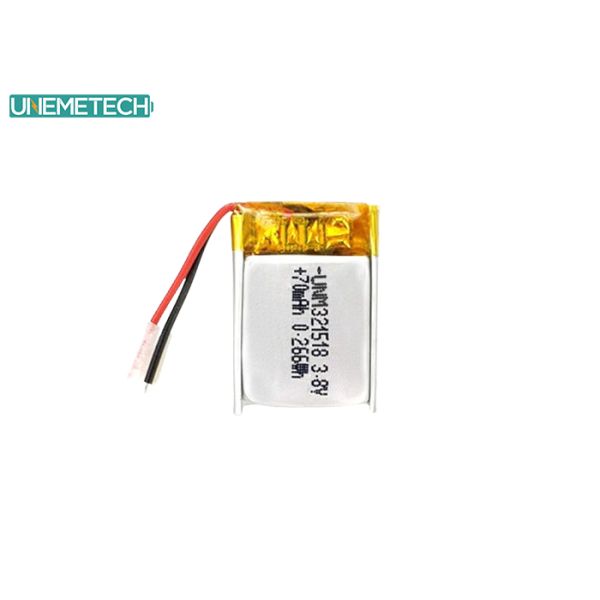
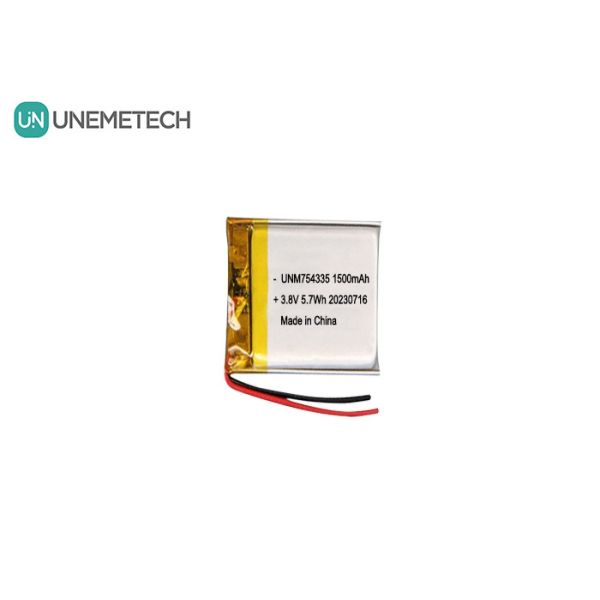
The 441718 battery is an ultra-compact rechargeable lithium polymer battery features a nominal voltage of 3.8V and a capacity of 110mAh. With compact dimensions of 4.5 × 17.2 × 20.0 mm, it is specifically designed for medical bracelets, wearable health monitoring devices, and other space-constrained portable electronics.
As a high-voltage 3.8V lithium polymer battery, the 441718 battery provides stable power output, low self-discharge, high energy density, and reliable cycle life. It is widely used in smart medical bracelets, patient monitoring wearables, healthcare trackers, and compact medical electronic devices.
Custom 441718 battery packs with PCM/BMS protection circuits, connectors, cables, and customized specifications are available to meet specific application and product design requirements.
| Battery Type | Polymer Lithium Ion Battery |
| Model Number | UNM 441718 |
| Nominal Voltage | 3.8V |
| Capacity | 110mAh (Nominal) | 120mAh (Typical) |
| Cell Energy | 0.407Wh |
| Cell Chemistry | LiCoO₂ / NCM (Customizable) |
| Cell Dimensions (Max) | 4.4 × 17.2 × 18.0 mm |
| Pack Dimensions (Max) | 4.5 × 17.2 × 20.0 mm |
| Weight | Approx. 3.0g |
| Battery Pack Internal Impedance | ≤ 450 mΩ |
| Shipment Voltage | 3.85–4.0V (Adjustable upon request) |
| Max Charge Voltage | 4.35V |
| Standard Charge Current | 0.2C (22mA) to 4.2V, CCCV Mode |
| Max Charge Current | 1.0C (110mA) | Customizable |
| Discharge Cut-off Voltage | 3.0V |
| Standard Discharge Current | 0.2C (22mA) |
| Max Continuous Discharge Current | 1.0C (110mA) | Customizable |
| Operating Temperature | Charge: 0–45 °C | Discharge: -20–60 °C |
| Max. Cell Dimensions: 4.4 × 17.2 × 18.0 mm | Plug wire: UL3302 AWG32 / 20 ± 3 mm (adjustable upon request) |
| Max. Pack Dimension: 4.5 × 17.2 × 20.0 mm | PCM Protection: FH9261-DGB / FH3016FDY / DW01A with 8205 MOSFET |

The 441718 high-voltage polymer lithium ion battery is specifically designed for compact, lightweight, and rechargeable medical wearable devices. Its compact dimensions, stable voltage platform, and reliable cycle performance make it an ideal power solution for medical bracelets, health monitoring products, and other portable electronic devices.
Typical applications include:

Custom configurations, including PCM/BMS protection circuits, connectors, and cable options, are available to ensure safe integration into your specific product requirements.
All UNEMETECH polymer lithium ion batteries undergo strict quality control and comply with international safety & transportation standards, ensuring safe and reliable performance worldwide.
Depending on project requirements and target market regulations, we can provide certification documents such as CB, IEC 62133, UN38.3, MSDS, KC, PSE, BSMI, UL, RCM, CE, REACH, and RoHs 2.0 test reports, and other compliance documentation as required.

“We’ve partnered with UNEMETECH for our smart medical bracelet project. The 441718 high-voltage lithium polymer battery delivers stable voltage, reliable capacity, and excellent consistency across production batches. As a compact lithium polymer battery for medical wearable devices, it fits perfectly within our product design, while the long cycle life helps ensure dependable daily operation. UNEMETECH’s engineering team provided prompt technical support and customized battery solutions that greatly simplified our product development process. We look forward to continuing our cooperation on future healthcare wearable battery projects.”
— Project Manager, Medical Wearable Device Manufacturer
UNEMETECH specializes in customized lithium polymer battery solutions for medical bracelets, wearable health monitoring devices, healthcare electronics, smart wristbands, and other compact portable products. We offer customized PCM/BMS protection circuits, connectors, cable lengths, labels, and battery pack assemblies to ensure seamless integration into your device.
From prototype development to mass production, our experienced engineering team provides professional technical support, reliable manufacturing, and flexible customization services to meet the requirements of medical and wearable electronic applications.