Hard Metal Tools Tungsten Carbide Insert Pins for Dynamic Molds
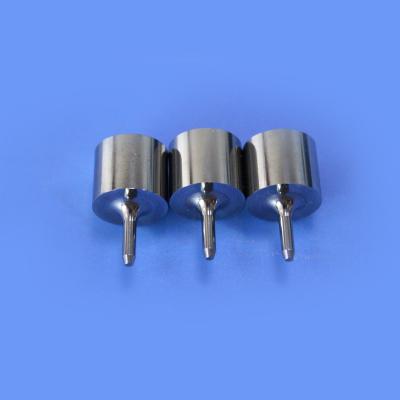
Dynamic molds, also known as sliding molds or moving molds, are essential components in various manufacturing processes, particularly in plastics and metalworking industries. Tungsten carbide insert pins for dynamic molds are specialized components used in molding applications where precise movement and wear resistance are crucial.
Detailed Production Specifications
- Ultra-precision Design: The φ0.129 precision of the tungsten carbide inlaid needle head is maintained at ±0.001, ensuring high precision during mold operation
- Concentricity Requirement: Overall concentricity requirement of the inlaid needle is 0.002, ensuring stable performance during use
- R-corner Design: The R-corner between φ0.260 and φ0.129 is precisely set to 0.122, ensuring a tight fit in the mold
- Consistency: This series of tungsten carbide inlaid needles maintains excellent overall consistency for perfect matching and improved efficiency
Sanxin Carbide Product Features
| 100% virgin wolfram carbide materials |
| Fine-grain, even ultra fine grain tungsten carbide available |
| Excellent wear, abrasion, and corrosion resistance |
| High fracture strength and high hardness |
| Longer service life |
| Varied cemented carbide material grades |
| Competitive EXW factory pricing |
| Customization services available |
Carbide Pins Technical Specifications
| Feature |
Description |
| Material Properties |
Tungsten carbide insert pins are chosen for their exceptional hardness, wear resistance, and strength, making them ideal for withstanding high pressures and repetitive motion cycles in moving mold applications |
| Precision Machining |
Manufactured with high precision to tight tolerances, ensuring accurate fit within mold assemblies and reliable movement during molding processes |
| Interchangeability |
Designed to be interchangeable within the mold, allowing for easy replacement and maintenance without significant downtime |
| Low Friction |
Low coefficient of friction reduces wear on pins and ensures smooth movement within the mold, contributing to longevity and quality |
| Custom Designs |
Customizable in size, shape, and configuration to meet specific moving mold application requirements |
| Wear Resistance |
Exceptional wear resistance ensures extended service life and minimizes frequent replacements, leading to cost savings and improved efficiency |
| Corrosion Resistance |
Highly resistant to corrosion, ensuring longevity and performance even in harsh molding environments with moisture or chemical exposure |
Material Composition
Tungsten carbide is a major component of cemented carbide materials. As a hard phase of refractory metal, tungsten steel is used with transition metal (Co, etc.) as the binder phase. The super-hard material prepared by powder metallurgy technology is cemented carbide. Cemented carbide offers high strength, high hardness, wear resistance, corrosion resistance, high temperature resistance, and minimal linear expansion. It serves as an excellent tool material widely used in industrial production and processing operations, particularly for precision mold equipment such as tungsten steel pins used in AR8 anti-vibration rotor core stamping molds. Material performance meets basic use requirements, while long-lasting life provides efficiency guarantees for industrial mass production.
Dynamic Molds Tungsten Carbide Insert Pin Benefits
Precision Movement
Facilitates accurate and consistent movement of mold components, ensuring production of high-quality, uniform molded parts
Durability
Offers long-lasting performance and durability, reducing maintenance requirements and manufacturing downtime
Improved Efficiency
Provides smooth and reliable movement within the mold, contributing to increased productivity in molding processes
Quality Assurance
Helps maintain tight tolerances and ensures molded part integrity, enhancing overall quality control
Tungsten carbide insert pins specifically designed for moving molds are critical components that play a key role in ensuring smooth operation and precision of molding processes, ultimately leading to production of high-quality, consistent molded parts.