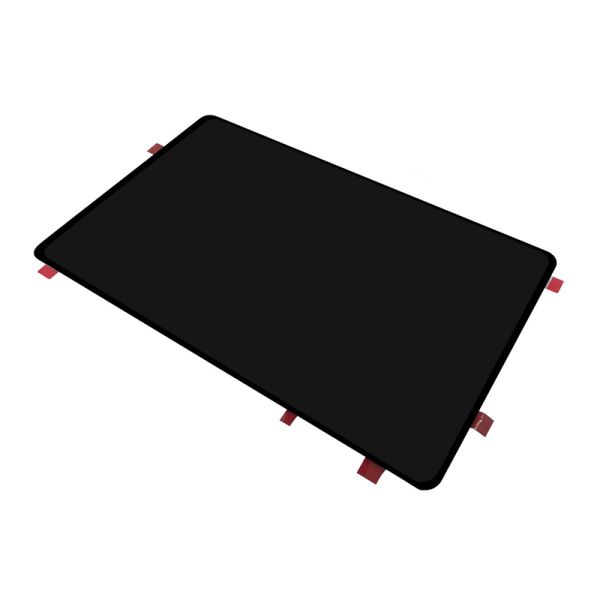
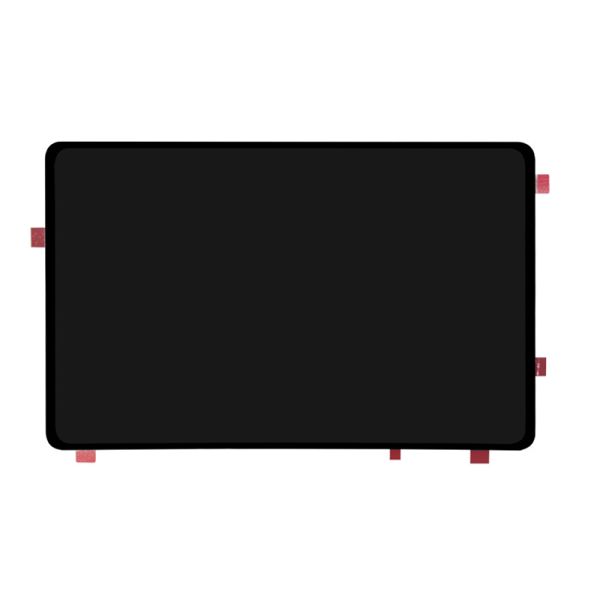
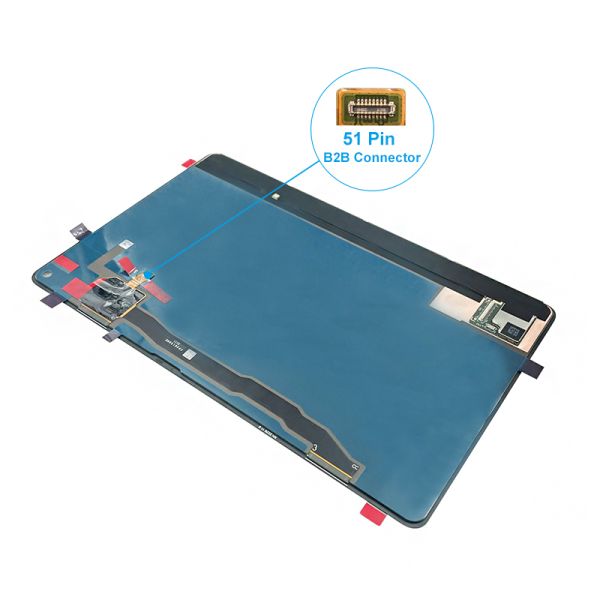
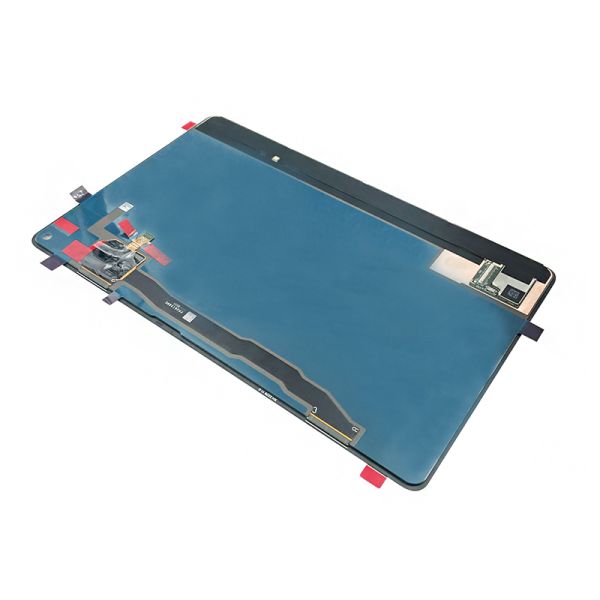
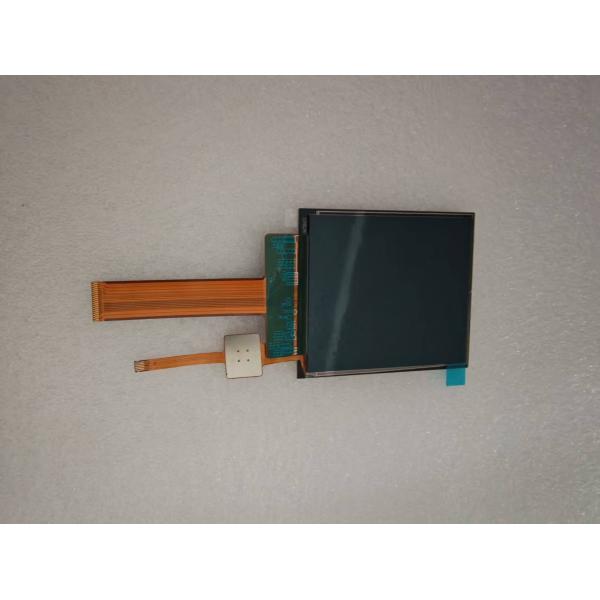
HX20QBC73.A is 11.2 inch amoled display module with oncell touch Display color: 1.07B (RGB x 10 bits) and Display format: 11.2” (2560RGBx1536) and Pixel arrangement: Real RGB
Display Interface: MIPI 2-port D-PHY TP Interface: SPI Driver IC : RM692H0 , Touch screen: On-cell; Touch IC: GT6975P
Product Parameter
| Part No. |
HX20QBC73.A |
| Display Size |
11.2 inch AMOLED display |
| Outline Size (mm) |
249.22*154.08 |
| AA Size (mm) |
244.22*146.53 |
| Resolution |
2560RGB*1536 |
| Interface |
MIPI 2-port |
| Brightness |
450c/d |
| View Angle |
all |
| Driving IC |
RM692H0 |
| Touch screen |
On-cell |
Product Picture
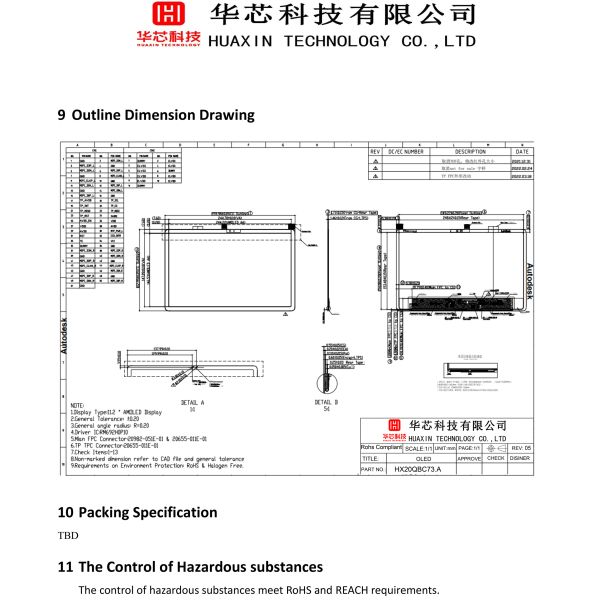
Drawing & Pin Definition
OLED Product Knowledge
OLED Advantages:
- Lighter and thinner than LCDs
- High contrast ratio
- High color saturation
- Lower power consumption
OLED Disadvantages:
- AMOLED is more expensive than LCD and TFT
- Lifetime is shorter than LCD and TFT
Company Information
Huaxin Advantage:
- Factory base located at inland city which has cost effective
- Most advanced new equipment which can keep quality stable
- Most processes using fully automatic equipment which has efficiency and stable quality
- Professional engineers and production leaders with 20+ years experience in LCD field
- Self design for customized product
Our Certificates:
- ISO14001
- ISO9001/IATF16949
- SGS of LCD module
Production Capacity
| Annual Production Capacity |
2021 (Current) |
2022 (Goal) |
2023 (Challenge) |
2024 (Challenge) |
2025 (Challenge) |
Remark |
| LCD Production Capacity |
4.5 |
9 |
9 |
9 |
9 |
Unit: thousands of logarithms/Day |
| LCM Production Capacity |
70 |
150 |
300 |
450 |
450 |
Unit: Thousand piece/Day |
| Backlight Production Capacity |
100 |
200 |
300 |
500 |
500 |
Unit: Thousand piece/Day |
| OLED Production Capacity |
10 |
20 |
30 |
40 |
50 |
Unit: Thousand piece/Day |
Product Application
- Safety box & instrument
- Lock & smart home
- Transmitter & watch
- Watch & radio
- Collimator & navigator
AMOLED Display Characteristics
- Self-Emissive Pixels
- High Contrast Ratio
- Color Accuracy and Vibrancy
- Wide Viewing Angles
- Power Efficiency
- Thinness and Flexibility
- Fast Response Time
Power Efficiency Comparison
1. Power Consumption:
AMOLED displays consume power on a per-pixel basis, meaning that pixels displaying black or dark content consume very little power, while pixels displaying bright or white content consume more power. LCD and LED displays require a constant backlight that consumes power regardless of the displayed content.
2. Content Dependency:
AMOLED displays are more power-efficient for content with dark or black areas, as individual pixels can be turned off to save power. LCD and LED displays consume a relatively constant amount of power as the backlight remains active.
3. Brightness Control:
AMOLED displays can dynamically adjust pixel brightness for better efficiency in low-brightness scenarios. LCD and LED displays typically have fixed backlight brightness, resulting in higher power consumption.
4. Display Size:
AMOLED displays tend to be more power-efficient for smaller sizes as consumption scales with pixel count. Larger LCD/LED displays may require more power-hungry backlights, reducing efficiency compared to same-size AMOLED displays.