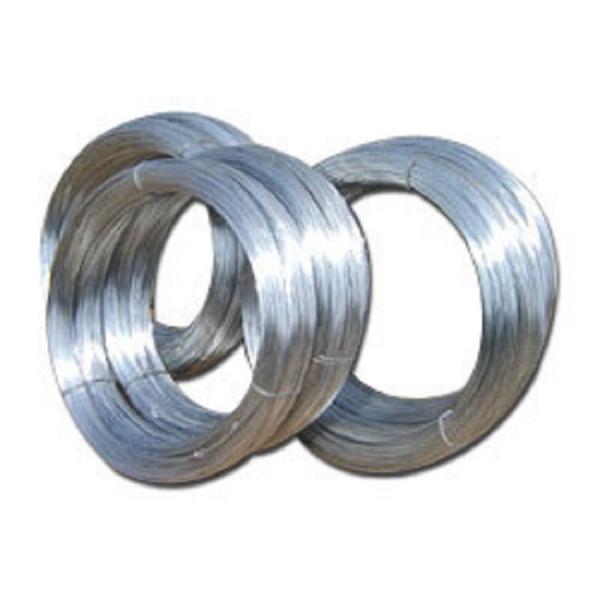
Wire is bought by weight and consumed by length. The conversion between the two looks like arithmetic, and it is, but three things make the answer differ from the catalogue: diameter enters the formula squared, the density differs between austenitic and ferritic grades, and a coil never yields exactly the nominal length once the ends are cut off.
This wire is supplied from 0.15 mm to 12 mm in 304 and 316L, annealed at 550-750 N/mm2, in coils of 5-250 kg. The table below gives weight per 1000 m at 7.9 g/cm3, the density used for austenitic grades.
For 430 the figure is about 2.5% lower, because ferritic density is roughly 7.7 g/cm3. That is small but real on a full container, and it also means a quoted length from a weight figure will be slightly optimistic on ferritic wire.
| Item | Specification |
|---|---|
| Product | Annealed stainless steel wire, weight and length basis |
| Material grade | 304 / 316L (201 and 430 on request) |
| Wire diameter | 0.15-12 mm |
| Density (austenitic) | 7.9 g/cm3 |
| Density (ferritic 430) | 7.7 g/cm3 |
| Weight, 0.5 mm | 1.55 kg per 1000 m |
| Weight, 1.0 mm | 6.20 kg per 1000 m |
| Weight, 2.0 mm | 24.8 kg per 1000 m |
| Weight, 3.0 mm | 55.8 kg per 1000 m |
| Weight, 5.0 mm | 155 kg per 1000 m |
| Weight, 8.0 mm | 397 kg per 1000 m |
| Coil weight | 5-250 kg; actual weight stated per coil |
| Reference standard | ASTM A580 / GB/T 4240 |
| MOQ | 500 kg per size |
| Certification | ISO 9001; mill test report 3.1 |
Cross-section area is pi times diameter squared divided by four. Multiplying that area in square millimetres by 7.9 gives grams per metre directly, because one square millimetre times one metre is one cubic centimetre.
A 1% error in diameter becomes about a 2% error in weight per metre. On a length-sensitive application that is 2 metres short in every 100 metres, which is why a diameter band is worth agreeing even when the weight is what gets invoiced.
301, 304 and 316L all sit close to 7.9 g/cm3. Ferritic 430 at about 7.7 g/cm3 gives a lighter coil for the same length, so a length calculated from weight will read slightly high.
Every coil has a start and an end that are not usable on an automated line. On a 250 kg coil that allowance is small; on a 5 kg spool of fine wire it is a visible share of the total, and it should be discussed rather than discovered.
Long lengths are sometimes made by joining coils. Each joint is a stop for the line, so the number of joints per coil is a legitimate question when lengths are long and diameters are fine.
Pallet, spool and packing weight are excluded from net weight but often included in a rough estimate. On spool supply the spool itself can be a noticeable fraction of the shipped figure.
Give the metres your line must produce, and the coil weight that follows from it, rather than only a tonnage. It makes the diameter band and the coil-end allowance part of the same conversation.
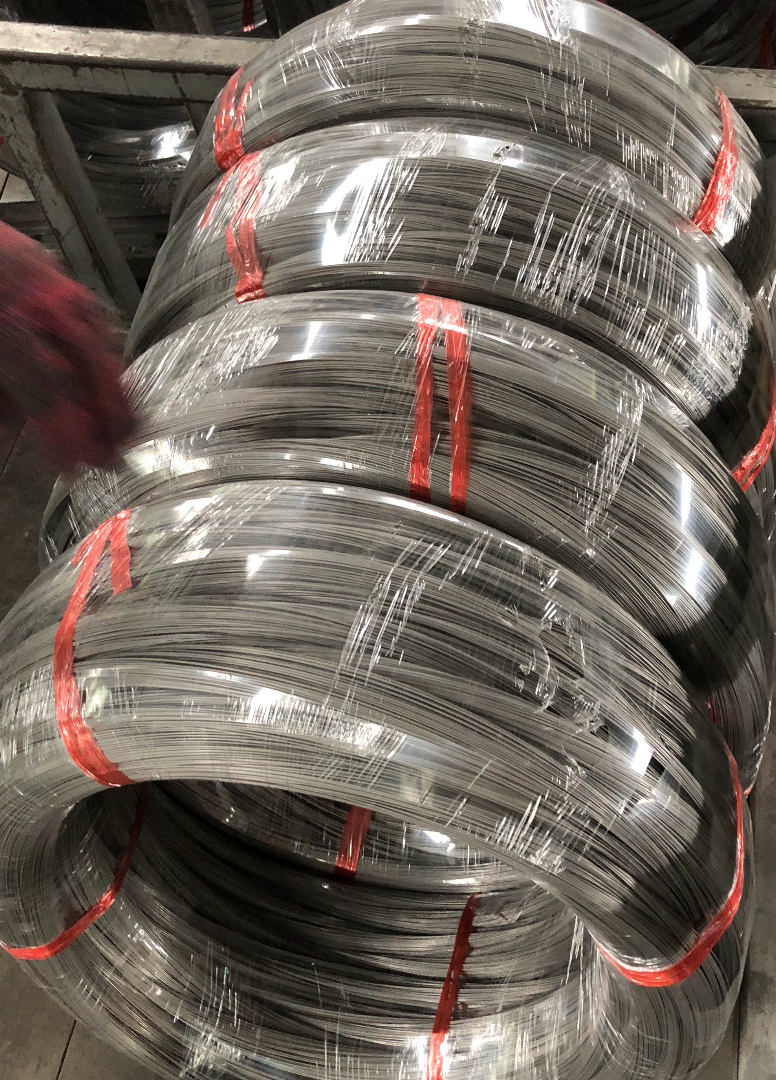
Coils are weighed individually and the actual figure is recorded. A packing list with per-coil weights lets the customer reconcile length without unwinding the coil.
Where a length is calculated from weight, state the density used. The difference between 7.9 and 7.7 is small per coil and not small across a year of shipments.
Warp and weft consumption is planned in metres, while purchase is in kilograms, so the conversion is part of production planning rather than accounting.
Heading stock is consumed by piece count; the weight per piece follows from the wire diameter and the cut length.
Cut lengths for fixtures and frames are ordered by length and reconciled against coil weight at goods-in.
Diameter is measured inline and at coil ends, tensile and elongation are tested per heat per ISO 6892-1, and each coil is weighed before packing with the figure recorded. Coil labels carry heat number, size and net weight.
Send the diameter, grade, required length and coil weight for technical confirmation and quotation.