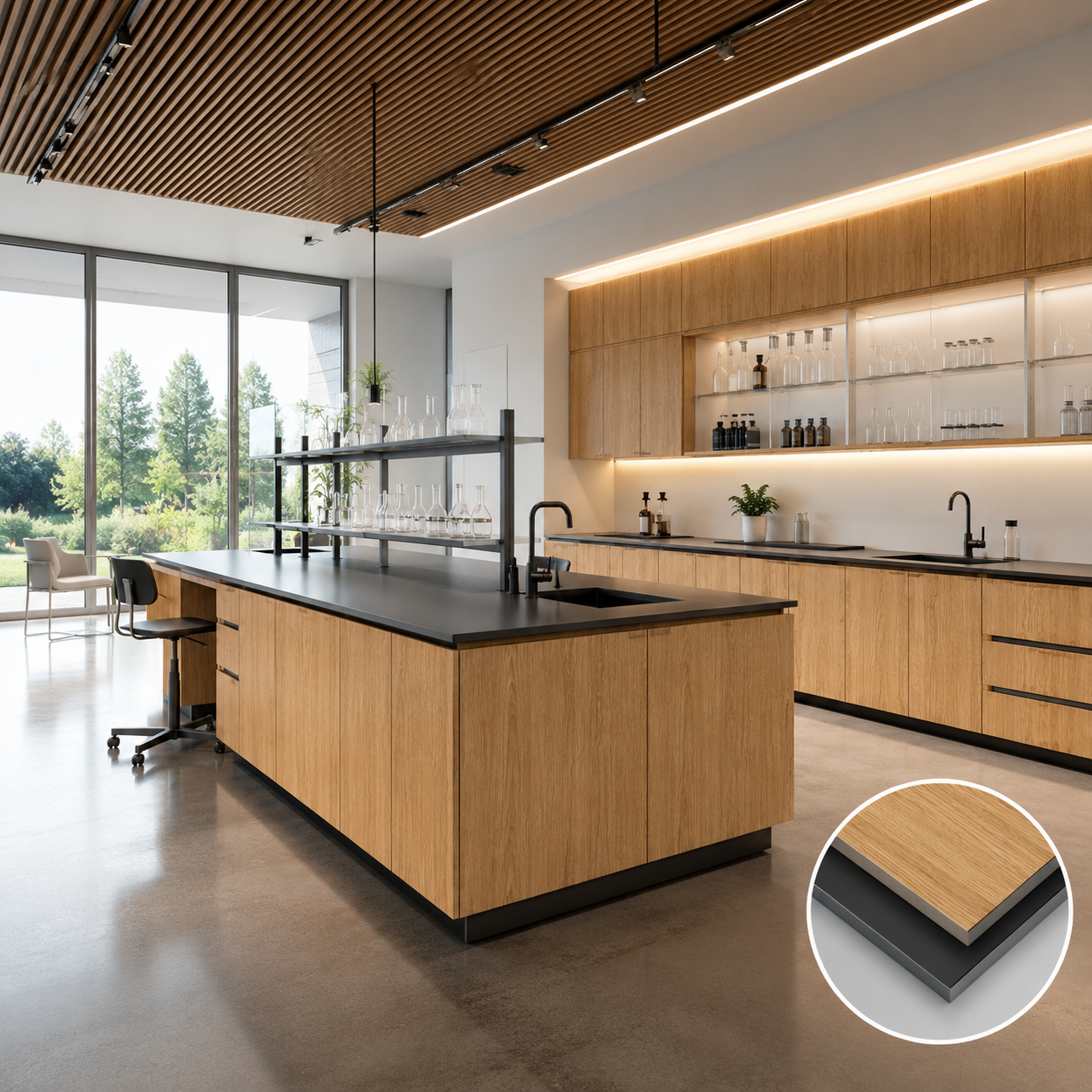
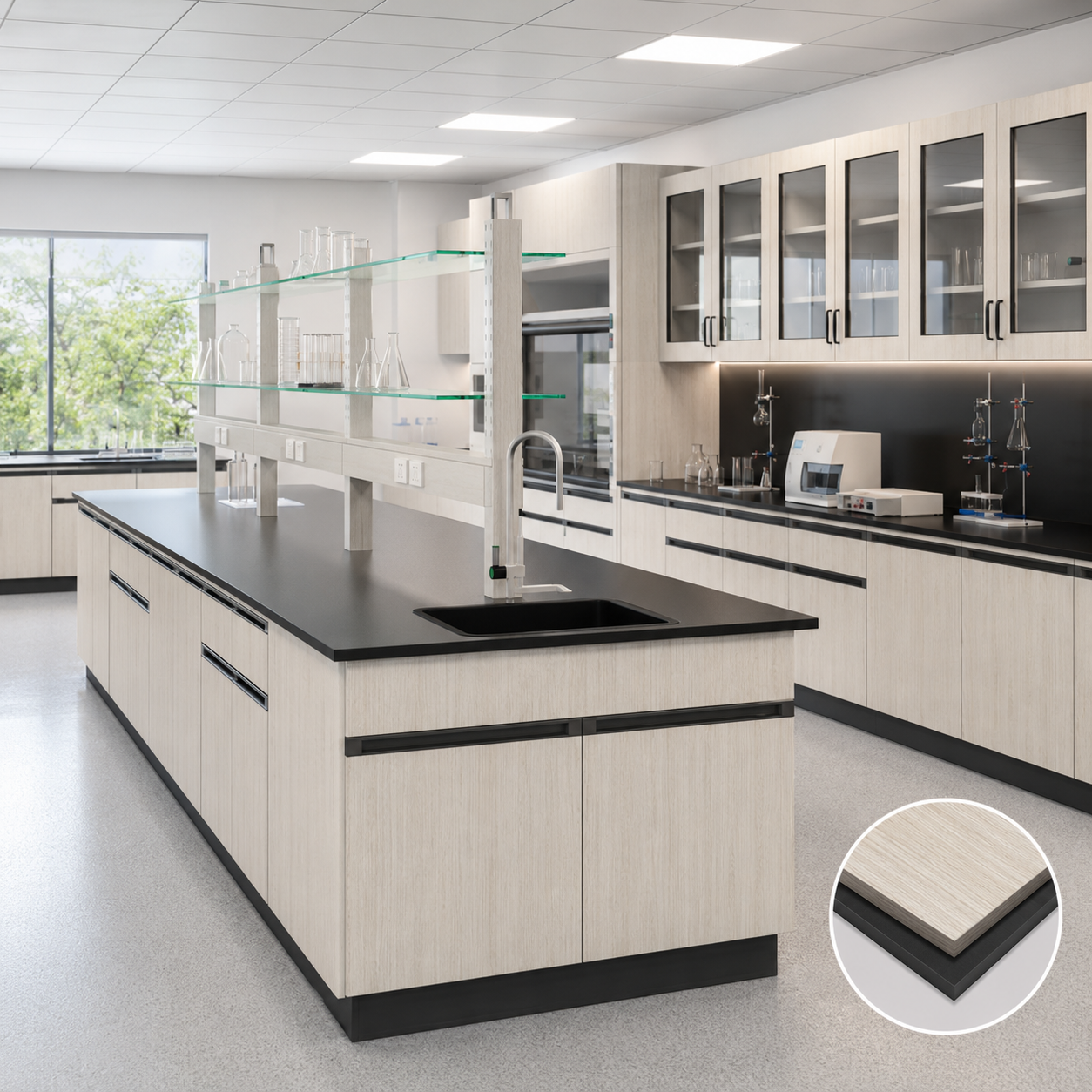
Our phenolic resin lab countertop is a high-pressure compact laminate (HPL) work surface engineered specifically for scientific and educational environments. Manufactured from multiple layers of kraft paper impregnated with thermosetting phenolic resin and finished with a melamine-resin decorative surface, the board is pressed under high temperature and pressure to form a dense, homogeneous, non-porous panel.
Designed for school science labs, university teaching rooms, research institutes, industrial testing laboratories and QA/QC centers, the countertop withstands daily exposure to acids, alkalis, solvents, reagents, moisture and abrasion while remaining easy to clean and maintain.
Available in a range of solid colors and customizable thicknesses, sizes and edge finishes, it is supplied as cut-to-size panels ready for bench top installation.
-
2. Key Features & Benefits
-
2.1 Chemical Resistance
-
Withstands a wide range of laboratory chemicals, including dilute acids, alkalis, organic solvents, detergents and reagent solutions.
-
Resists staining and surface degradation from routine chemical spills in teaching and research settings.
-
Non-porous surface prevents liquid penetration, limiting contamination build-up and simplifying decontamination.
-
2.2 Moisture & Water Resistance
-
Solid-through compact laminate construction does not delaminate or swell in high-humidity environments.
-
Suitable for wash-down areas, sink surrounds and constant humidity labs.
-
Sealed edges further protect against edge-face water uptake.
-
2.3 Mechanical Durability
-
Hard, scratch- and abrasion-resistant surface withstands daily use of glassware, instruments and lab equipment.
-
Good impact resistance against dropped objects compared with普通人造石 or wood-based alternatives.
-
Dimensionally stable under normal temperature and humidity variations.
-
2.4 Heat & Thermal Performance
-
Resists brief contact with moderately hot items (e.g. drying racks, warm glassware) within typical lab working ranges.
-
Not rated for direct placement of open flames or extremely hot plate surfaces; heat mats or stands are recommended.
-
2.5 Hygiene & Cleanability
-
Smooth, non-porous, easy-to-wipe surface — compatible with standard disinfectants and laboratory cleaners.
-
Does not support bacterial or fungal growth under normal lab conditions.
-
Low-maintenance: no sealing, waxing or periodic re-finishing required.
-
2.6 Aesthetic & Customization
-
Available in multiple solid colors (commonly black, light gray, dark gray, white/beige, green-blue) to match lab interior design.
-
Cut-to-size panels, rounded corners, drilled cut-outs for sinks / gas taps / power outlets available on request.
-
Edge options: square edge, sealed edge, post-formed / bullnose edge.
-
3. Typical Technical Specifications
The values below are typical industry parameters for standard-grade phenolic compact laminate worktops. Exact figures depend on the selected grade and certification; final data is confirmed on the quotation / datasheet.
|
Parameter
|
Typical Value
|
Note
|
|
Material
|
Phenolic resin impregnated kraft paper core + melamine resin decorative surface
|
Compact laminate / HPL
|
|
Standard panel size
|
1220 × 2440 mm (4' × 8')
|
Other large formats available by request
|
|
Common thickness
|
12 mm / 16 mm / 19 mm / 25 mm
|
12.7 mm / 19 mm most common for lab tops
|
|
Density
|
approx. 1.35–1.45 g/cm³
|
Solid, through-color core
|
|
Water absorption (24h)
|
≤ 2%
|
Per standard laminate test methods
|
|
Chemical resistance
|
Resistant to dilute acids, alkalis, common solvents, detergents
|
List of resistant chemicals available on request
|
|
Surface finish
|
Matte / semi-matte, scratch-resistant
|
Reduces glare under lab lighting
|
|
Light stability
|
Good color retention under normal indoor lighting
|
Avoid prolonged direct UV exposure
|
|
Edge treatment
|
Square / sealed / post-formed
|
Sealing recommended in wet areas
|
|
Custom processing
|
Cut-to-size, CNC routing, corner rounding, sink cut-out, drilling
|
Fabrication drawings required
|
Note for buyers: Specific test reports (e.g. BS EN 438, ISO 4586, chemical resistance lists, fire rating) can be provided upon request along with the quotation. Fire-retardant / A-grade variants are available for projects requiring higher fire performance.
-
4. Applications