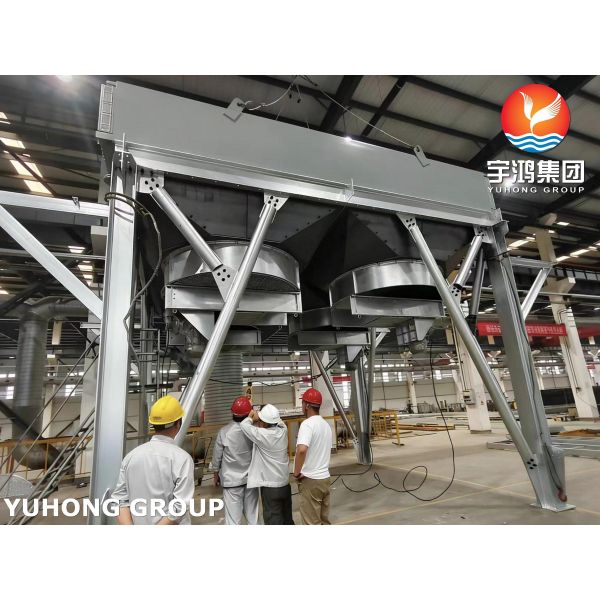
API 661 Forced Draft Air Cooled Exchanger for Petroleum
Forced Draught Air Cooled Heat Exchanger with API 661, Petroleum Industry
Need a custom quote for Air Cooled Exchangers? Contact our engineering team directly: jimmy@steelseamlesspipe.com
Selection of Induced Draught or Forced Draught
The air-cooled heat exchanger shall be either a forced-draught exchanger or an induced-draught exchanger and shall include the components shown in Figure 1 and any auxiliaries such as ladders, walkways and platforms. Forced-draught fans should be used, except that induced-draught fans should be considered for the following situations:
- If temperature control of the process is critical and sudden downpour of rain (i.e. excessive cooling) can cause operating problems
- To minimize the risk of hot-air recirculation
- On sites where air-side fouling is a significant problem, however forced draft can be used if screens are specified
- To improve thermal performance in the event of a fan failure (due to the stack effect)
- In hot climates, where the fan plenum chamber shields the bundle from the sun
- For services that have a temperature approach of 11 °C (20 °F) or less
Figure 1: Forced Draught vs Induced Draught Configurations
| A) Forced Draught |
B) Induced Draught |
| 1 - Tube Bundle |
6 - Fan |
| 2 - Header |
7 - Fan Ring |
| 3 - Nozzle |
8 - Fan Deck |
| 4 - Supporting Column |
9 - Drive Assembly |
| 5 - Plenum |
10 - Fan Guard |
Construction of Tube Bundle
Tube bundles shall be rigid, self-contained, and designed for handling as a complete assembly.
A) Removable cover-plate header
B) Removable bonnet header
| Typical Construction of Tube Bundles |
| 1 |
Tubesheet |
| 2 |
Removable cover plate |
| 3 |
Removable bonnet |
| 4 |
Top and bottom plates |
| 5 |
Tube |
| 6 |
Pass partition |
| 7 |
Gasket |
| 8 |
Nozzle |
| 9 |
Side frame |
| 10 |
Tube spacer |
| 11 |
Tube support cross-member |
| 12 |
Tube keeper |
| 13 |
Vent |
| 14 |
Drain |
| 15 |
Instrument connection |
Tubes and Finning
Maximum Fin Selection Temperature for Fin Bonding Types:
| Fin Bonding Type |
Maximum Process Temperature °C (°F) |
| Embedded fins |
400 (750) |
| Externally bonded (hot-dip galvanized steel fins) |
360 (680) |
| Extruded fins |
300 (570) |
| Footed fins (single L) & overlap footed fins (double L) |
130 (270) |
| Knurled footed fin, either single L or double L |
200 (390) |
| Externally Bonded (welded or brazed fins) |
> 400 (750) (maximum should be negotiated) |
Tubes and Finning Construction