Specifications
Model Number :
Tubesheet, Naval brass, Copper alloy
Price :
Negotiable
Nominal Composition :
Cu 60%, Zn 39.2%, Sn 0.8%
Certification :
ASME, U STAMP, EN, ISO
MOQ :
1 PC
Delivery Time :
10 - 30 Days
Thermal Conductivity :
~116 W/m·K
Payment Terms :
T/T
UNS Designation :
C46400 (Naval Brass)
Yield Strength :
≥ 200 MPa
Tensile Strength :
≥ 450 MPa
Supply Ability :
1000 PCS per month
Material Standard :
ASME SB171
Brand Name :
YUHONG
Packaging Details :
Pallet, PLY-Wooden case
Place of Origin :
China
Description

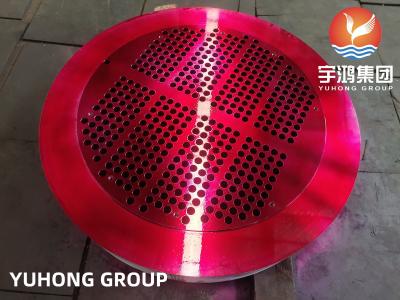
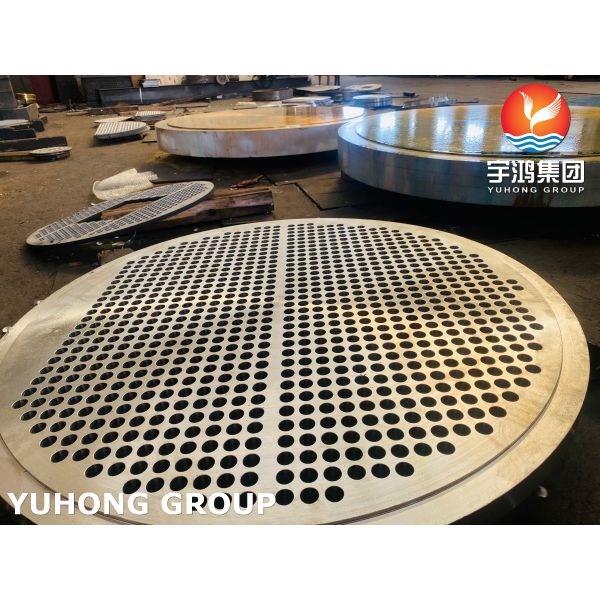
ASME SB171 C46400 Naval Brass Tubesheet for Shell & Tube Heat Exchangers – Seawater Corrosion Resistant Copper Alloy Tube Sheet

Yuhong Group Co., Ltd. supplies ASME SB171 C46400 naval brass tubesheets alongside a complete range of shell & tube heat exchangers, pressure vessels, air coolers, U-tubes, finned tubes, baffle plates, and channel heads. This page focuses on C46400 tubesheets for seawater-cooled and marine-grade heat transfer equipment.

Product Overview

ASME SB171 C46400 tubesheets are pressure-retaining components used to fix, seal, and support tube bundles in shell & tube heat exchangers, condensers, and marine coolers. The material is a wrought copper-zinc-tin alloy (UNS C46400), with a nominal composition of 60% Cu, 39.2% Zn, and 0.8% Sn. This tin addition is not decorative: it directly suppresses dezincification and improves resistance to impingement attack in chlorinated or brackish cooling water. The tubesheet is available in forged or rolled form, custom-drilled to triangular, square, or staggered patterns, and machined with grooves for tube expansion joints.

Key Parameters

Parameter Specification
Material Standard ASME SB171
UNS Designation C46400 (Naval Brass)
Nominal Composition Cu 59.0-62.0%, Sn 0.50-1.0%, Zn remainder
Tensile Strength (annealed) ≥ 345 MPa
Yield Strength (annealed) ≥ 140 MPa
Elongation ≥ 35%
Thermal Conductivity ~116 W/m·K
Operating Temperature Range ≤ 204°C (medium-low pressure service)
Tube Hole Tolerance Machined to customer drawing
Form Forged disc or rolled plate

Material & Corrosion Performance

The duplex alpha-beta structure of C46400 provides a balance of strength and machinability suitable for multi-hole drilling. Its corrosion resistance in seawater is primarily attributed to tin substitution for zinc, which alters the electrochemical behavior of the beta phase and retards selective zinc leaching. C46400 also exhibits resistance to stress-corrosion cracking in ammonia-free cooling water. However, ammonia-bearing media should be avoided — a documented failure case involved C46400 tubesheets cracking after retubing when ammonia entered the system through process make-up water. This is a material selection boundary, not a manufacturing defect.

Manufacturing & Quality Control

Tubesheets are forged or rolled according to ASME SB171, then CNC-drilled, grooved, and reamed. As an inspection baseline, ultrasonic testing (UT) is performed to detect internal laminations and inclusions, while liquid penetrant testing (PT) checks machined surfaces and tube-hole edges for surface-breaking defects. Dimensional inspection covers hole diameter, pitch, bolt circle, and thickness. Material test certificates traceable to the original mill heat number are issued with each delivery.

Typical Applications

  • Marine heat exchangers and seawater condensers using C70600 (90/10 Cu-Ni) or C71500 (70/30 Cu-Ni) tubes

  • Ship engine cooling systems, ballast water coolers, and offshore platform cooling circuits

  • Power plant surface condensers with seawater or brackish cooling water

  • Desalination preheaters and multi-stage flash condenser tube sheets

  • HVAC chiller tubesheets and industrial low-pressure heat exchangers

FAQ

Can C46400 tubesheets be used with titanium tubes?
Galvanic coupling between naval brass and titanium is significant. When titanium tubes are specified, an insulating sleeve or coated tubesheet face is typically required.

Why does tin matter in C46400?
Tin inhibits dezincification by modifying the corrosion product layer. Without tin, high-zinc brasses in seawater tend to suffer selective zinc loss and wall thinning.

What tube-to-tubesheet joint methods are compatible?
Roller expansion, hydraulic expansion, and seal welding are commonly used. Grooved holes improve pull-out strength for expanded joints.

Contact

For project-specific dimensions, material certificates, or technical consultation, contact Yuhong Group Co., Ltd. at vladimir@steelseamlesspipe.com

ASME SB171 C46400 Naval Brass Tubesheet for Shell & Tube Heat Exchangers

Send your message to this supplier
Send Now

ASME SB171 C46400 Naval Brass Tubesheet for Shell & Tube Heat Exchangers

Ask Latest Price
Model Number :
Tubesheet, Naval brass, Copper alloy
Price :
Negotiable
Nominal Composition :
Cu 60%, Zn 39.2%, Sn 0.8%
Certification :
ASME, U STAMP, EN, ISO
MOQ :
1 PC
Delivery Time :
10 - 30 Days
Contact Supplier
ASME SB171 C46400 Naval Brass Tubesheet for Shell & Tube Heat Exchangers

YUHONG HOLDING GROUP CO., LTD

Verified Supplier
2 Years
ningbo
Since 1990
Business Type :
Manufacturer, Exporter, Trading Company, Seller
Total Annual :
50M-75M
Employee Number :
50~850
Certification Level :
Verified Supplier
Contact Supplier
Submit Requirement