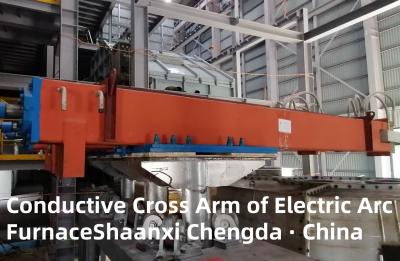
The copper contact jaw for the electrode conductive arm of an electric arc furnace (EAF) and ladle refining furnace (LRF) is a crucial component for conducting electricity and clamping electrodes. Here is a detailed introduction:
Function and Application
The copper contact jaw is installed on the electrode conductive arm and is mainly used to clamp the electrode to achieve a reliable electrical connection, transmitting electrical energy to the electrode to heat it up and enable the normal operation of the EAF and LRF. It is widely used in steelmaking EAF, ladle refining furnace, ferrosilicon refining furnace, and other equipment.
Structural Features
- Basic Structure: It usually includes a base body with a rear surface close to the electrode arm, a front surface facing the electrode, a first end face, a second end face, and at least one first side face and second side face. There are two contact surfaces on the front surface, which are mirror - symmetric and extend axially along the base body.
- Cooling Channel System: In order to ensure its normal operation in a high - temperature environment, the copper contact jaw is provided with a cooling channel system, which has a coolant inlet, a coolant outlet, and a number of cooling channels extending axially and radially through the base body. The diameter of the cooling channels is generally in the range of 4.0 to 16.0 mm, and the cooling channels are formed by single - side - open deep holes, which can effectively dissipate heat and improve the cooling effect.
Material Selection
- Copper Alloy: Usually, copper alloys such as chrome - copper alloy are selected. These materials have excellent electrical conductivity, thermal conductivity, and wear - resistance, which can meet the requirements of high - current transmission and long - term use in high - temperature environments.
- Copper - Steel Composite Plate: Some copper contact jaws are made of copper - steel composite plates. The copper layer is used for conduction, and the steel layer is used to bear various mechanical forces, which combines the advantages of high electrical conductivity of copper and high mechanical strength of steel.
Performance Requirements
- Electrical Conductivity: It needs to have low contact resistance to ensure efficient transmission of electrical energy and reduce power loss. For example, the contact resistance between the copper - aluminum composite transition plate and the copper chuck is required to be ≤ 0.5 μω·m².
- Mechanical Strength: It should have sufficient mechanical strength to withstand the clamping force and the vibration and impact during the operation of the electrode. The clamping force can reach 50 - 200 kN.
- Cooling Performance: The cooling channel system should have good cooling performance to ensure that the temperature of the contact jaw is within a reasonable range during operation and prevent overheating. The water inlet temperature is generally ≤ 35 ℃, and the pressure is 0.3 - 0.5 MPa.
Manufacturing Process
- Forging or Rolling: First, a forged or rolled copper contact jaw blank is provided, and the blank has the basic shape and size of the contact jaw.
- Machining: Then, through mechanical processing, especially deep - hole drilling, a coolant inlet, a coolant outlet, and cooling channels are introduced. This process requires high - precision processing equipment and technology to ensure the accuracy and smoothness of the cooling channels.
Key attributes
video outgoing-inspection