Product Description
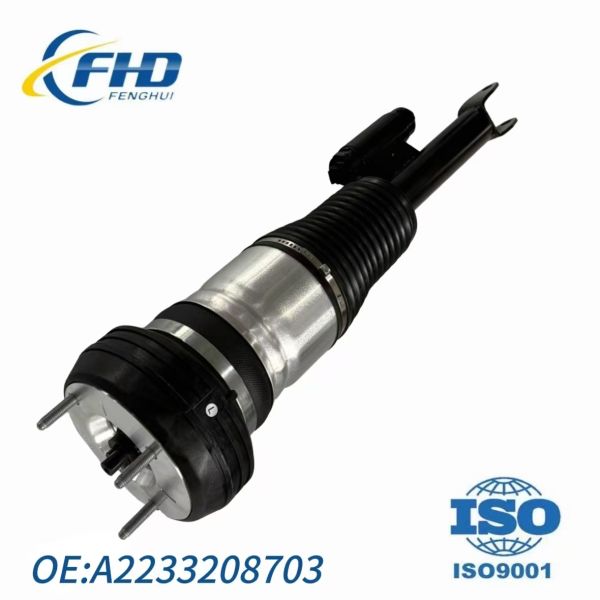
This air suspension strut assembly is developed specifically for Mercedes-Benz S-Class W223 2WD models (from 2021 onwards), precisely fitting the front left (driver's side) position and manufactured to original OE standards.
This component integrates the load-carrying function of an air spring with the damping adjustment function of a shock absorber, making it one of the core actuating components of the Mercedes-Benz AIRMATIC air suspension system. It absorbs road impacts from the front left wheel, maintains lateral body stability, and works in coordination with the front right strut, lower control arm, anti-roll bar and subframe to form a complete front axle suspension system, delivering precise handling response and a smooth riding experience for 2WD models.
Compared to the 4WD version, this product features specific optimization for the front axle load distribution of 2WD chassis, with slight differences in damping tuning and air spring stiffness to better match the drive configuration and weight distribution of 2WD models. The product adopts an original equipment structure design, requiring no modifications for direct replacement of old original parts, fully inheriting all performance parameters of the OE component and ensuring seamless integration with the vehicle's electrical system, air line system and chassis control unit.
Frequently Asked Questions
Q1: After installation, one side of the vehicle is noticeably lower, but there is no fault code on the dashboard. What is the reason?
This is usually not an electronic issue, but rather an air pressure imbalance between the left and right air springs. After replacing the new strut, the air suspension system requires a number of inflation and deflation cycles to automatically achieve pressure adaptation. It is recommended to start the vehicle and let it idle for 3-5 minutes to allow the air pump to naturally inflate the new strut. If the vehicle remains uneven, try raising the body and lowering it back to normal height, repeating 2-3 times. If the problem persists, check whether the air line fittings have a minor leak.
Q2: Can this strut directly replace the original old part, and is it necessary to replace both left and right sides as a pair?
The front left strut can be replaced individually; it is not mandatory to replace them in pairs. This product is manufactured to original factory dimensions and structure, with mounting holes, air line interfaces and fixing methods completely identical to the original part, requiring no modifications. However, from a practical standpoint, if the right front strut has been in service for a long time (e.g., over 80,000 km), the rubber air spring may have hidden aging. It is recommended to replace both sides simultaneously for more balanced body support and consistent road feel.
Q3: After replacement, the steering wheel feels heavier or the front wheels bounce noticeably over bumps. Is this normal?
This is a normal break-in phenomenon after installation. The damping oil inside the new strut requires a certain driving distance (approximately 200-300 km) to fully circulate and reach stable damping characteristics. During this period, you may feel slightly heavier steering or firmer road feedback. It is recommended to drive normally on regular city roads for a while, and the damping characteristics will gradually return to normal. If there is no significant improvement after 500 km, an internal sticking condition of the strut should be checked.
Q4: Does this product support low-stance body lowering modifications?
No. This product is designed to Mercedes-Benz original standard height parameters, with air spring travel and mechanical limits corresponding to the original ride height range. Forcibly lowering the body by modifying air lines or sensor links may cause the air spring to remain compressed for extended periods, accelerating rubber fatigue and cracking, and also affect the suspension's bump stop function. For lowering purposes, it is recommended to use air suspension products specifically developed for modification applications with shorter air springs.
Q5: Will the air spring become hard or crack in low winter temperatures?
No. This product uses a low-temperature resistant rubber compound that maintains normal elasticity and airtightness in environments as low as -30°C. However, rubber elasticity may slightly decrease at low temperatures. It is recommended to drive at low speed for 1-2 km after starting the vehicle in extremely cold weather, allowing the air spring to naturally warm up and soften through road vibrations. Do not force rapid inflation with the air pump while the air spring is frozen, as this may cause localized stress cracking.
Q6: There is slight oil residue on the outside of the strut. Is this a sign of oil leakage?
Not necessarily. During factory assembly, a thin layer of anti-rust lubricating oil is applied to the piston rod surface. During initial driving after installation, some of this oil may be carried out and form a light oil film on the upper part of the strut body, which is normal. To determine whether it is true leakage, wipe it off with a clean paper towel and observe: if no new oil residue appears after wiping, it is assembly oil; if obvious flowing oil continues to appear after several days of driving, the oil seal may be damaged and replacement is required.