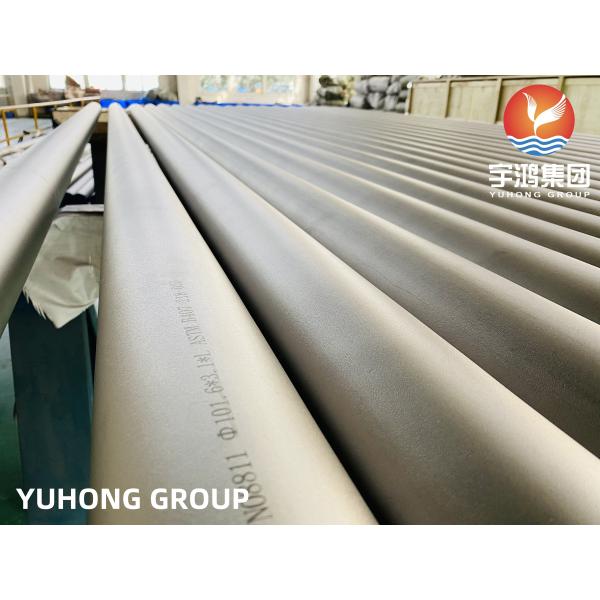
ASTM B619 UNS N10276 / 2.4819 Hastelloy C-276 Welded Pipe
Equivalent Grades for Hastelloy C276 Pipe
| STANDARD | UNS | WNR. | AFNOR | EN | JIS | OR | GOST |
| Hastelloy C276 | N10276 | 2.4819 | - | NiMo16Cr15W | NW 0276 | ЭП760 | ХН65МВУ |
Hastelloy C276 Pipe Chemical Composition
| Hastelloy C276 | Ni | C | Mo | Mn | Si | Fe | P | S | Co | Cr |
| Balance | 0.010 max | 15.00 – 17.00 | 1.00 max | 0.08 max | 4.00 – 7.00 | 0.04 max | 0.03 max | 2.5 max | 14.50 – 16.50 |
Hastelloy C276 Pipe Mechanical Properties
| Density | Melting Point | Yield Strength (0.2%Offset) | Tensile Strength | Elongation |
| 8.89 g/cm3 | 1370 °C (2500 °F) | Psi – 52,000 , MPa – 355 | Psi – 1,15,000 , MPa – 790 | 40 % |
Key Characteristics of B619 C276 Welded Pipe
Manufacturing: Typically made from rolled and welded sheet or plate. The weld seam is usually heat-treated (solution annealed) to restore corrosion resistance.
Low-Carbon Welded Version: The B619 standard, combined with the C276 chemistry, ensures a low-carbon product. This is crucial to prevent carbide precipitation in the heat-affected zone of the weld, which could become a site for corrosion attack.
Superior Corrosion Resistance: Resists a vast array of corrosive media, including:
Wet chlorine gas, hypochlorite, and chlorine dioxide
Sulfuric, hydrochloric, and phosphoric acids
Mixed acids (e.g., HNO3/HF used in pickling)
Seawater and brine solutions
Contaminated phosphoric acid (containing fluorides and chlorides)
Cost-Effectiveness (vs. Seamless): For larger diameters and thinner walls, welded pipe (ASTM B619) is often more economical than seamless pipe (ASTM B622), while meeting the same performance criteria for many applications.
Hastelloy is a renowned group of high-performance, corrosion-resistant superalloys, predominantly nickel-based. They are alloyed with substantial amounts of molybdenum, chromium, and other elements to achieve exceptional strength and durability in aggressive, high-temperature environments. These specialized materials are engineered for critical applications in industries like chemical processing and aerospace, where conventional materials are inadequate.
Applications
Chemical Processing Industry (CPI): Reactors, pipelines, and heat exchangers handling aggressive chemicals.
Pollution Control & Flue Gas Desulfurization (FGD): Scrubbers, ducting, and stack liners exposed to hot, wet, chlorinated gases.
Pharmaceutical Industry: Critical process lines where purity and resistance to cleaning agents are vital.
Pulp & Paper Industry: Digesters and bleach plants.
Waste Incineration & Wastewater Treatment: Handling corrosive effluent and gases.
Marine and Offshore: Components exposed to harsh seawater.