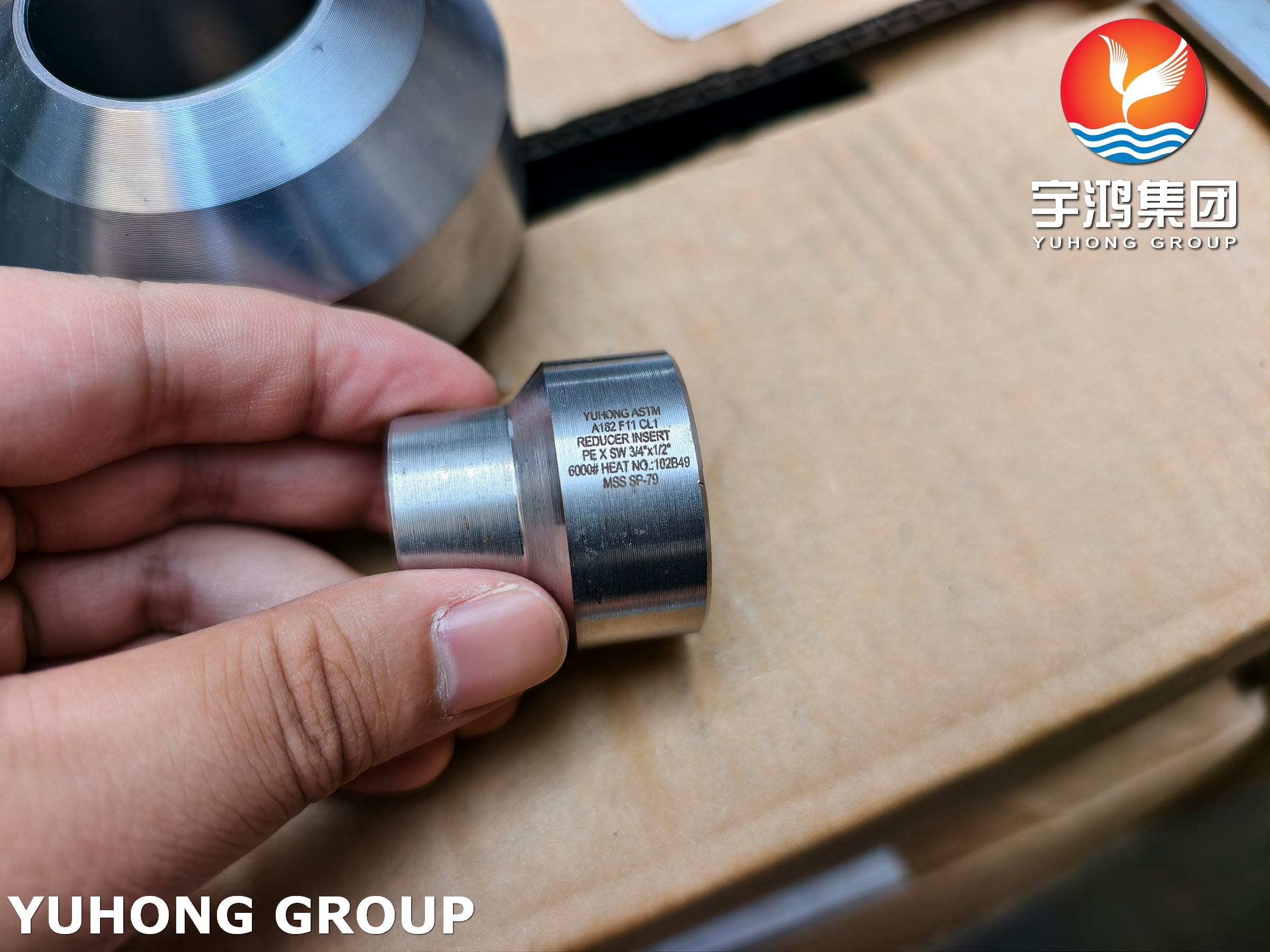
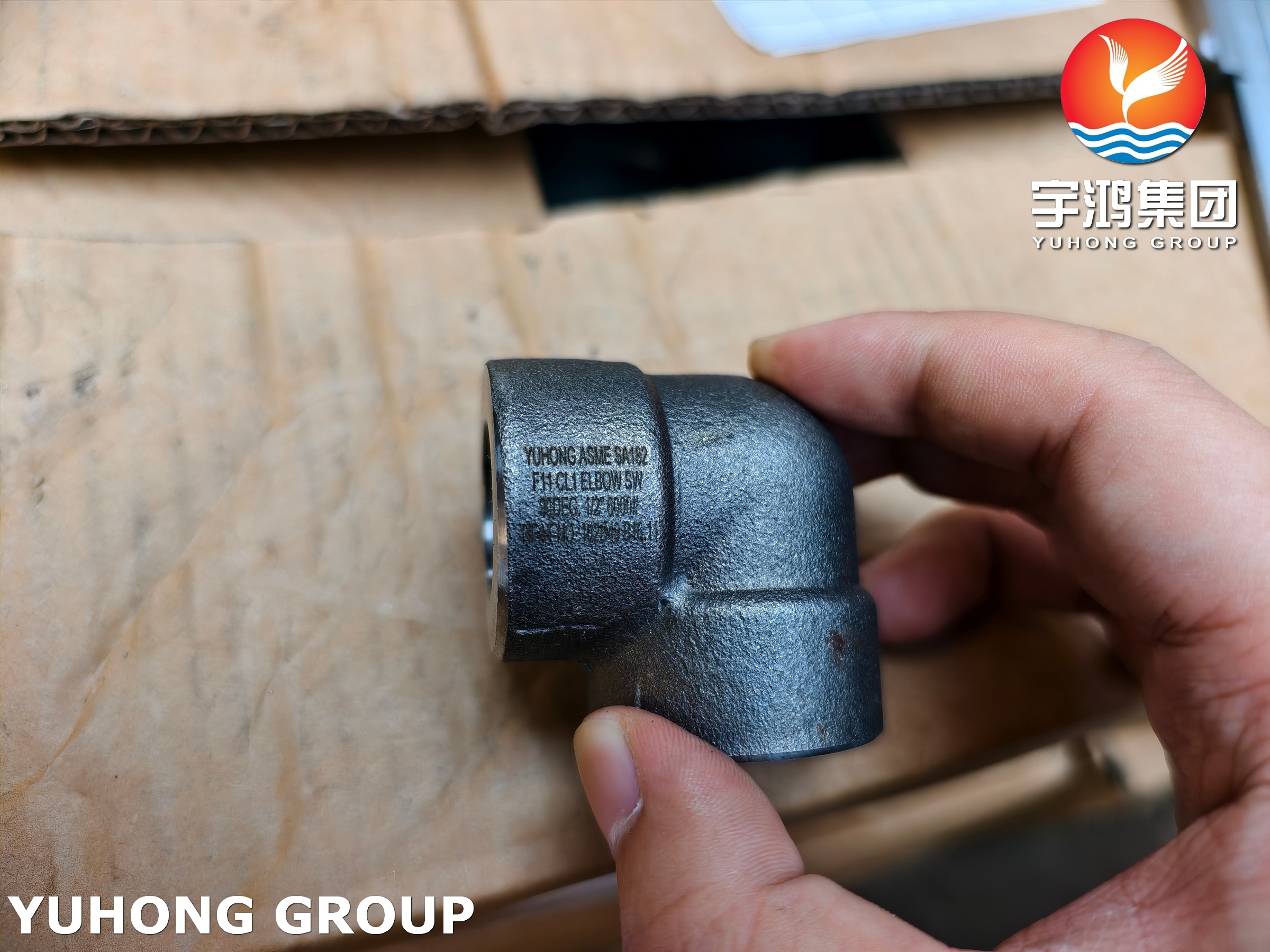
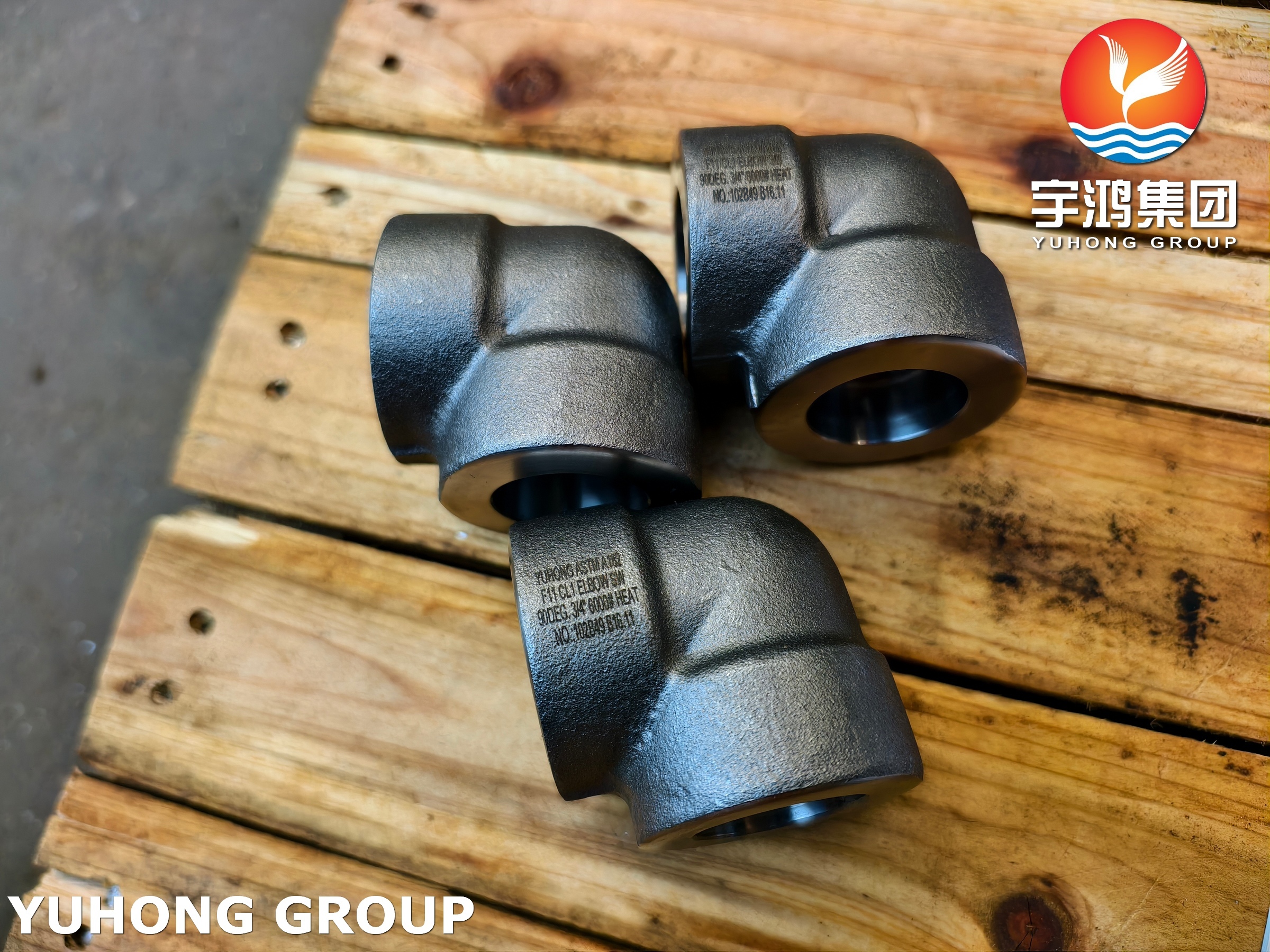
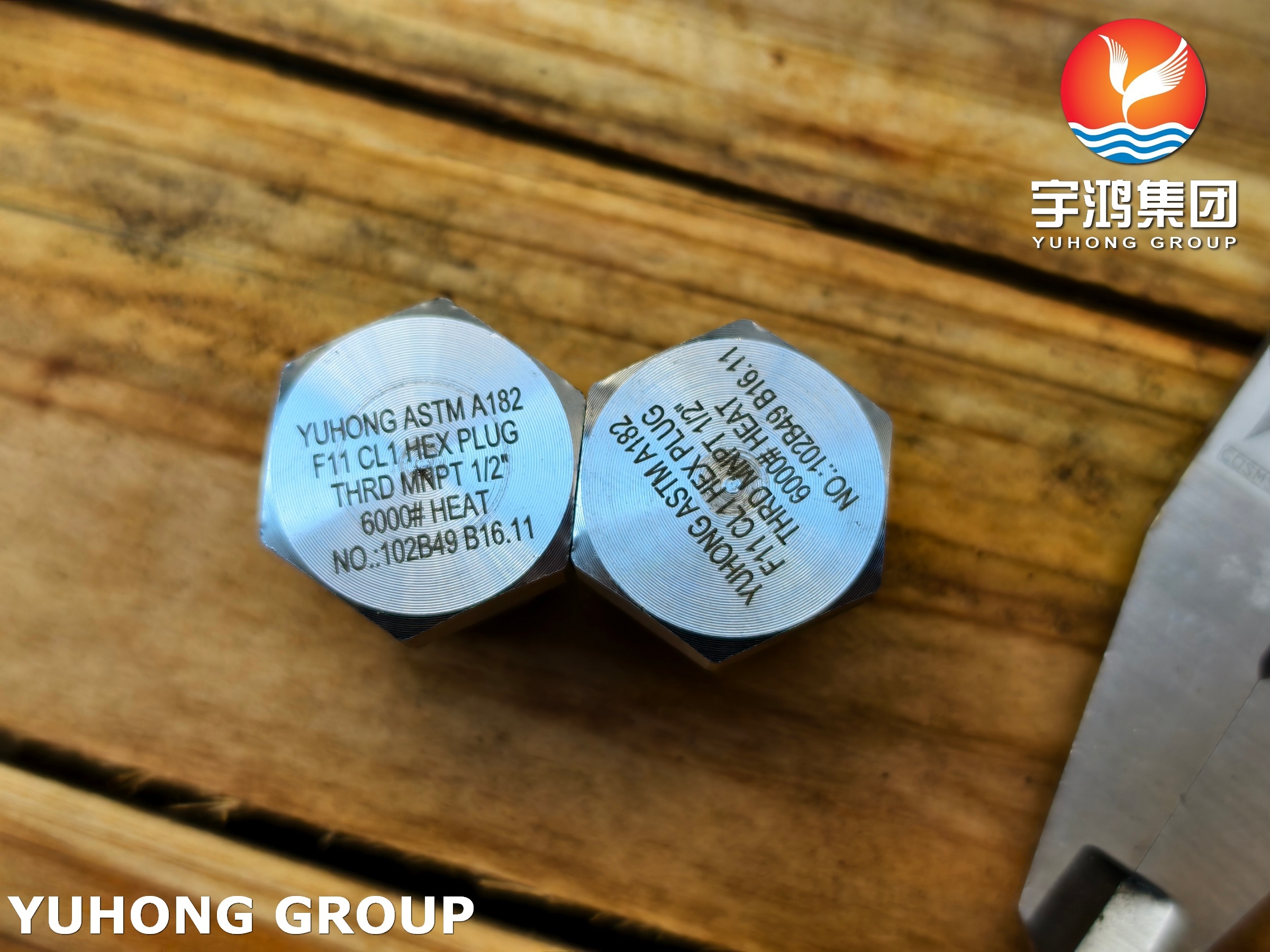
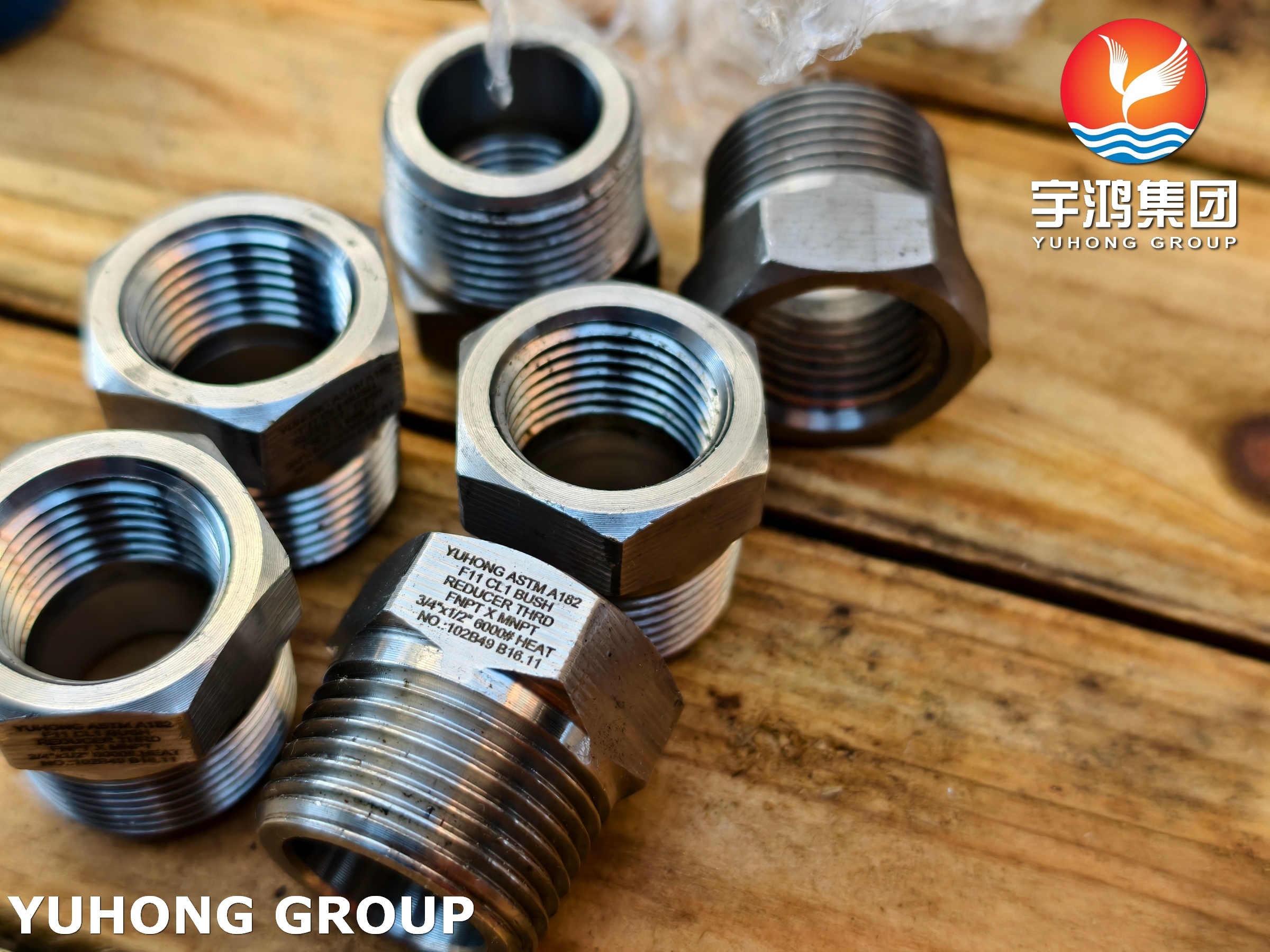
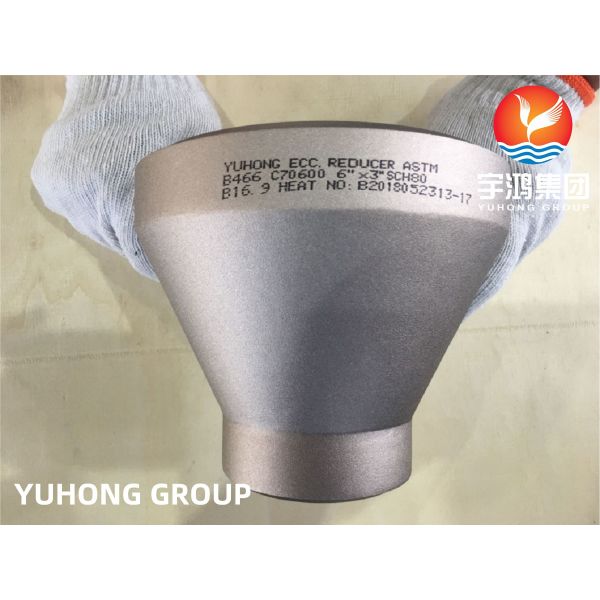
Alloy Steel Forged Fitting A182 F11 CL.1 REDUCER INSERT MSS SP-79 ASME B16.11 6000#
A182 F11 — it is 1.25Cr–0.5Mo chrome-moly alloy steel (UNS K11597), a heat-resistant/creep grade for refinery and power service.
A182 F11 Class 1 — chemistry & mechanicals
Chemical composition, %
| C |
Mn |
Si |
P |
S |
Cr |
Mo |
| 0.05–0.15 |
0.30–0.60 |
0.50–1.00 |
≤0.030 |
≤0.030 |
1.00–1.50 |
0.44–0.65 |
Mechanical properties, min
| Tensile |
Yield (0.2% offset) |
Elongation (2 in) |
Reduction of Area |
Hardness |
| 60 ksi / 415 MPa |
30 ksi / 205 MPa |
20% |
45% |
121–174 HBW |
Compare with F11 Cl.2 (C 0.10–0.20, 70 ksi / 485 MPa tensile, 40 ksi / 275 MPa yield, ~143–207 HBW) — your Cl.1 callout must be held; it controls weldability and hardness for PWHT.
3. SP-79 / B16.11 Class 6000 construction facts
- Size range, 6000: NPS 1/8 – 3 (DN 6 – 80), listed large size first, e.g. 3/4 × 1/2.
- Rating basis: Sch 160 pipe per ASME B36.10M; MAWP is derived from equivalent-material straight pipe, with service temperature limited by the governing piping code (B31.1/B31.3).
- Shank OD = Sch 160 pipe OD of the large end (e.g., 1/2″ = 0.840″, 3/4″ = 1.050″, 1″ = 1.315″, 1½″ = 1.900″, 2″ = 2.375″).
- Recommended assembly gap: ~0.06 in (1.5 mm) between insert shoulder and fitting socket bottom before fillet weld.
- Minimum socket/wall at weld end ≥ 1.25× the corresponding Sch 160 nominal wall.
- Concentricity bores ≤ 0.03 in (0.8 mm); axis alignment ≤ 0.06 in/ft.
- Type 1 vs Type 2: Type 2 has the longer shank/shoulder for deeper reductions; the table column on the PO must specify which.
- Marking: material grade, class (6000 or 6M), size, and "SP79" for full conformance.
4. Welding / service notes (important for F11)
- F11 requires preheat (~150–250°C / 300–480°F) and matching B2 filler (ER80S-B2 / E8018-B2); for creep/critical service apply PWHT ~720–760°C (1325–1400°F) after welding.
- Bore should be Sch 160 to match the 6000 rating — confirm the mating fitting and pipe are also Class 6000 / Sch 160.
A182 F11 — Class 1 vs Class 2 side by side
Same base alloy (1.25Cr–0.5Mo, Cr 1.00–1.50%, Mo 0.44–0.65%, Si 0.50–1.00%); the classes differ in carbon, strength, hardness and ductility — not in the Cr/Mo chemistry.
Chemical composition, wt.%
| Element |
F11 Class 1 |
F11 Class 2 |
| Carbon C |
0.05–0.15 |
0.10–0.20 |
| Manganese Mn |
0.30–0.60 |
0.30–0.80 |
| Silicon Si |
0.50–1.00 |
0.50–1.00 |
| Chromium Cr |
1.00–1.50 |
1.00–1.50 |
| Molybdenum Mo |
0.44–0.65 |
0.44–0.65 |
| Phosphorus P, max |
0.030 |
0.040 |
| Sulfur S, max |
0.030 |
0.040 |
Cl.1 runs leaner on C and Mn and has tighter P/S limits — the main reason it welds more cleanly.
Mechanical properties (room temp, min unless ranged)
| Property |
F11 Class 1 |
F11 Class 2 |
| Tensile strength |
60 ksi / 415 MPa |
70 ksi / 485 MPa |
| Yield strength Rp0.2 |
30 ksi / 205 MPa |
40 ksi / 275 MPa |
| Elongation (2 in / 4D) |
20% |
20% |
| Reduction of area |
45% |
30% |
| Brinell hardness |
121–174 HBW |
143–207 HBW |
| Typical condition |
Annealed, or Normalized + Tempered |
Normalized + Tempered (N+T / Q+T) |
Practical differences
- Strength: Cl.2 is ~17% higher tensile and ~33% higher yield — chosen for higher mechanical load, heavier sections, higher-pressure forgings and flanges.
- Ductility / toughness: Cl.1 keeps a larger RA (45% vs 30%) and sits lower on the hardness band, so it deforms and relieves stress more readily; more forgiving under bending and weld shrinkage.
- Weldability: Cl.1's lower C and Mn give a lower carbon equivalent, so it hardens less in the HAZ, needs lighter preheat, and has lower cold-crack risk — the usual pick for socket-weld/threaded fittings that get field-welded (your SP-79 insert case). Cl.2 needs more careful preheat (~150–250°C) and full PWHT; under-controlled heat input it can crack in the HAZ.
- Hardness ceiling: Cl.2 tops out at 207 HBW vs 174 HBW for Cl.1. Both sit below the NACE MR0175/ISO 15158 sour-service ceiling (22 HRC / 237 HBW) after PWHT, but Cl.2 has less margin.
- Heat treatment: Cl.1 may be supplied annealed (furnace cool) or N+T; Cl.2 is normalized ≥900°C then tempered ≥620°C, with hold time ~1 h per 25 mm section.
A Class 1 fitting still carries full 6000# rating; the material tier does not raise or lower the pressure class. Both must be declared on the MTC — grade F11, material class, and pressure class 6000 separately.
Which to pick
- Cl.1 — socket-weld fittings, small high-reduction inserts, field welds, sour service, sections where ductility and low HAZ hardness matter.
- Cl.2 — large flanges, heavy forgings, bolts/high-load parts where the extra yield is engineered; only use when the piping spec explicitly calls it out.