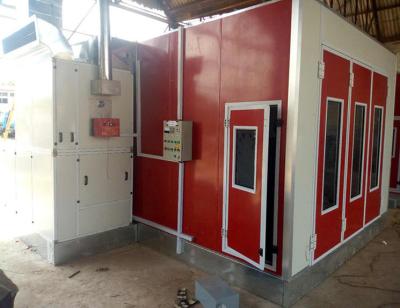
Water Curtain Spray Booth for Exhaust Parts — Spray, Flash-off and Cure at 150 °C
Product summary: A two-stage finishing system for long, heavy exhaust components such as mufflers, silencers and resonator shells. Parts are hung horizontally on a heavy-duty rack that travels on floor rails, sprayed in a water curtain booth, then pushed into a separate batch curing oven for a controlled 150 °C cure. The configuration suits steady but modest annual volumes, where a continuous automated line would be over-engineered.
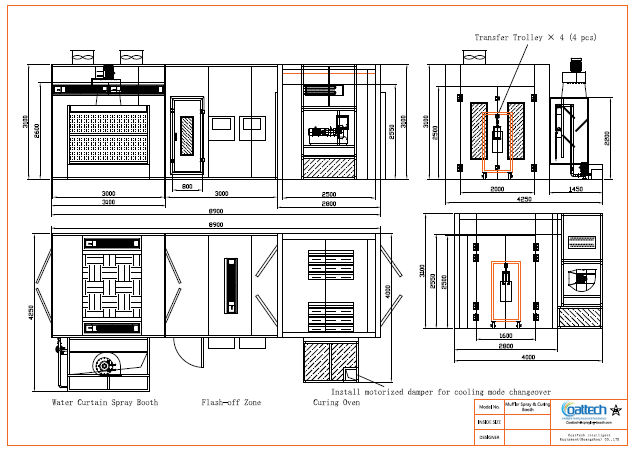
Water curtain spray booth — a stainless-steel water film on the rear wall captures overspray at source; a grating floor with downdraft extraction keeps the operator's breathing zone clean and stops paint mist settling back on the parts
Flash-off zone — a clean, dust-controlled area where the wet film levels before it enters the oven
Batch curing oven — electric heating brings the load to 150 °C and holds it for the cure the coating requires, with forced circulation for uniform temperature
Heavy-duty rack on floor rails — parts hang horizontally in tiers; the loaded rack runs on rollers along floor rails so one operator can move a full load safely
Control and safety — relay and push-button control with spray, pump interlock, curing timer, cooling, fault alarm and emergency stop
Efficient overspray capture — the water film traps paint particles and settles them in the basin, reducing airborne dust and filter loading
Stable airflow field — filtered supply from above with downdraft extraction below keeps mist away from the operator and off the finished surface
Built for long, heavy parts — the booth is sized for components up to 2,000 mm long, and the rack and rail system handles loads of several hundred kilograms
Horizontal hanging — keeps the load low and stable, allows parts to be tiered, and keeps booth height modest where headroom is limited
Fast, uniform curing — heating elements and a high-temperature circulation fan bring the load to temperature quickly and hold it evenly across the whole rack
Safe cooling changeover — a motorised damper switches the oven to cooling mode to discharge hot air at the end of the cycle
Batch operation — spraying and curing run in parallel in two units, instead of one cabin waiting to change mode
| Item | Specification |
| System | Two-stage finishing system: water curtain spray booth + batch curing oven |
| Booth model | CT-PQ-I-PLUS — water curtain spray booth |
| Booth internal dimensions | 3,000 × 2,700 × 2,600 mm (L × W × H); no pit required, installed directly on the floor |
| Booth airflow | Supply 9,000 m³/h via 2 explosion-proof axial fans (0.37 kW each); exhaust 9,000 m³/h via 1 explosion-proof fan (3 kW) |
| Booth filtration | G3 primary + F5 medium-efficiency supply filters, plus water curtain capture |
| Booth lighting | 16 × 22 W LED tubes in IP54 flameproof light boxes; illuminance ≥ 800 lux |
| Water system | SS304 water curtain cabinet with bottom basin, explosion-proof circulation pump, PVC piping and float-valve make-up |
| Oven model | CT-HQ-I-PLUS — batch curing oven |
| Oven internal dimensions | 2,500 × 2,300 × 2,500 mm (L × W × H) |
| Heating | SS304 electric heating elements, 18 × 3 kW = 54 kW; 20 °C → 150 °C in 10–15 minutes |
| Oven airflow | High-temperature circulation fan, 3,000 m³/h, 100 air changes per hour |
| Cooling | Motorised damper switches the circulation fan to discharge hot air |
| Workpiece example | Mufflers up to 320 × 423 × 1,972 mm; 60 kg each; 8 pcs per rack, ≈ 600 kg per load |
| Control | Relay + push-button control; spray, pump interlock, curing timer, cooling, fault alarm, emergency stop, pressure gauge |
| Power supply | 3 × 380 V / 1 × 220 V, 50 Hz as standard; adjustable to 400 V / 50 Hz for EU sites |
| Customization | Booth and oven dimensions, airflow, filtration, heating capacity, rack and rail layout to order |
* Dimensions, airflow and heating capacity are confirmed during layout engineering and depend on part size, coating type and required output. The workpiece figures above are one worked example.
This configuration is designed for exhaust and high-temperature components that are long, moderately heavy and produced in steady but modest volumes:
Automotive exhaust — mufflers, silencers, resonator shells and tailpipe assemblies
Industrial exhaust — generator and engine exhaust housings, industrial silencer bodies
Heat-resistant duty — parts coated with heat-resistant enamels that require a defined cure temperature and hold time
Stainless and steel fabrications — long welded shells, tubular housings and similar components up to roughly 2,000 mm long
Typical coatings include heat-resistant silver enamel, primer, topcoat and other solvent-based systems. Stainless-steel substrates should be degreased and blasted, or primed, before coating — we will advise on the pre-treatment route when you send us your coating data.
| Question | If this is your situation | Recommended |
| Water curtain or dry filter? | You spray solvent-based coatings and want efficient overspray capture with less filter replacement | Water curtain booth (this system). Dry filter booths suit lower volumes or where water handling is impractical |
| Batch oven or continuous tunnel? | Output is up to a few thousand pieces per year, or part sizes vary | Batch oven — lower investment, flexible loading. Continuous tunnels suit high, steady volume of one part type |
| Combined or separate units? | You want spraying and curing to run at the same time | Separate booth and oven (this system). A combined spray-and-bake cabin suits tight floor space and lower throughput |
| How to handle heavy loads? | A loaded rack weighs several hundred kilograms | Rack on floor rails with heavy rollers; transfer trolleys keep the zones working in parallel |
| Horizontal or vertical hanging? | Parts are long and workshop headroom is limited | Horizontal hanging in tiers — keeps load stable and booth height modest |
Proportionate investment — a batch system matches steady, modest volumes without paying for unused continuous-line capacity.
Cleaner finish — water curtain capture plus downdraft extraction keeps overspray off the wet film.
Safe heavy handling — rails and rollers move loaded racks instead of people carrying heavy, wet parts.
Repeatable cure — controlled ramp, hold time and forced circulation give even results across the whole load.
Flexible for mixed sizes — racks and programmes adapt as the product range changes.
Frequently Asked Questions
Q: What is a muffler spray booth? A: A spray booth sized and equipped for long exhaust components such as mufflers and silencers. In this system it is a water curtain booth: a flowing water film on the rear wall captures overspray before it can stay airborne.
Q: Why pair it with a separate curing oven? A: Because spraying and curing can then run in parallel — one rack is being sprayed while another is curing. That raises effective throughput without a larger single cabin.
Q: What temperature can the oven reach? A: The standard configuration reaches 150 °C and holds it for the cure time the coating requires, with forced circulation for uniform temperature. Higher set-points are available on request.
Q: How are heavy parts moved between zones? A: Parts hang horizontally on a steel rack that runs on heavy rollers along floor rails. One operator can move a full load, and transfer trolleys keep the booth, flash-off zone and oven working in parallel.
Q: Can it handle parts other than mufflers? A: Yes. Any long, moderately heavy metal component up to roughly 2,000 mm works — silencer bodies, exhaust housings, welded shells and tubular fabrications. Rack and rail layouts are made to your part.
Q: Can I choose dry filtration instead of a water curtain? A: Yes. Both are available. Water curtain suits solvent-based coatings and higher overspray loads; dry filter booths suit lower volumes or sites where water handling is impractical.
Q: Is it suitable for stainless-steel parts? A: Yes, but stainless needs preparation. Degrease and blast, or use a suitable primer, before coating. Send us your coating data sheet and we will advise on the pre-treatment route.
Q: Is CE documentation provided? A: Yes. We supply CE documentation, English manuals and explosion-proof fans and motors. ATEX classification is confirmed against your site and coating flash point before the specification is fixed.
Q: What information do you need for a quotation? A: Part dimensions and weight, coating type with TDS/MSDS, required cure temperature and time, annual output and shift pattern, available utilities, and the workshop layout with door sizes.

See it in action: read the case study of this system supplied to a European exhaust-systems manufacturer — water curtain spray booth, batch curing oven and floor-rail rack handling for heat-resistant muffler coating.
Contact Mr. Tim for a quotation: +86 189 8118 9424 · coattech@spraying-booth.com · www.spraying-booth.com
Send us your part dimensions, weight, coating data sheet and annual output — we will engineer the right spray booth and curing oven for your workshop.
Tags: #MufflerSprayBooth #WaterCurtainSprayBooth #CuringOven #ExhaustParts #HeatResistantCoating #BatchOven #CoatTech

Request a Quote for Your Region
Ready to elevate your painting efficiency? We supply fully customizable auto spray booths to clients worldwide. Whether you need standard 220V setups or specific adaptations for your country's regulations, our engineering team is here to help.