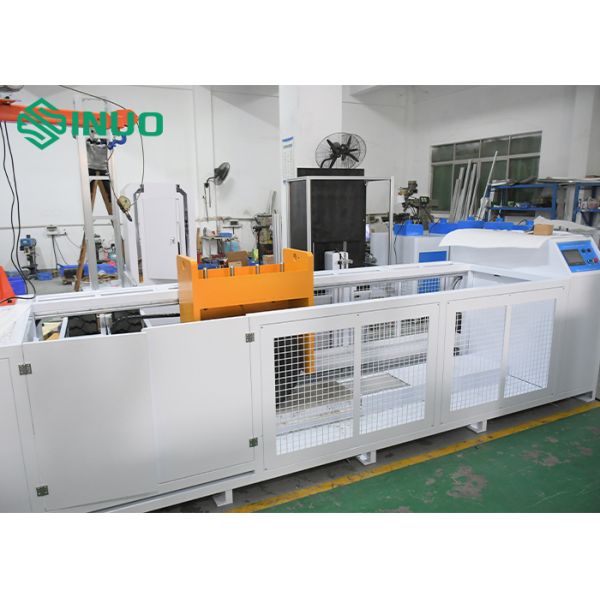
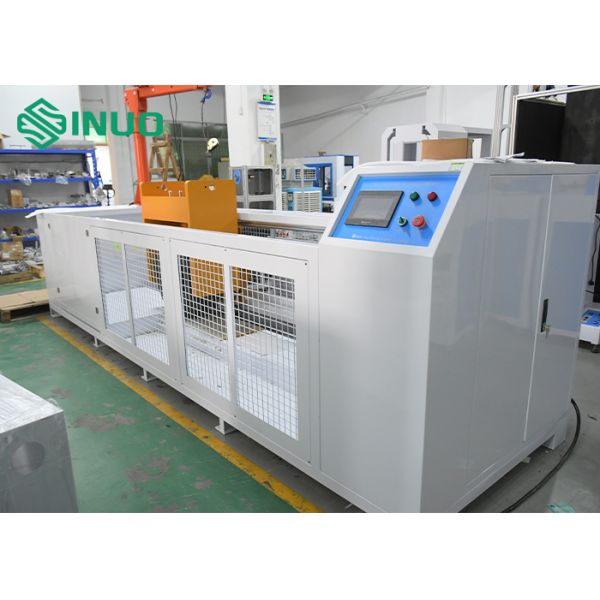
UL 2594 Drive Over Tire Load Test System for EV Charging Connectors with PLC Control
Product Overview:
The Vehicle Drive-Over Crushing Test System is designed to evaluate the mechanical resistance of electric vehicle plugs and vehicle connectors when subjected to accidental vehicle rolling. The equipment simulates real driving conditions in which a connector may be left on the ground and driven over by a vehicle, ensuring compliance with international safety standards.
This test system is suitable for laboratories, certification bodies, and manufacturers involved in EV charging accessories and related products.
Application & Test Purpose:
The equipment is used to verify whether plugs or vehicle connectors can withstand damage caused by being driven over by a vehicle, unless a cable management system is provided to prevent ground contact. The test ensures that the accessory maintains mechanical integrity under specified rolling forces and conditions.
Applicable Standards:
IEC 62196-1:2022, Clause 33
IEC 62752:2016, Clause 9.34
UL 2594:2016, Clause 58
Test Principle:
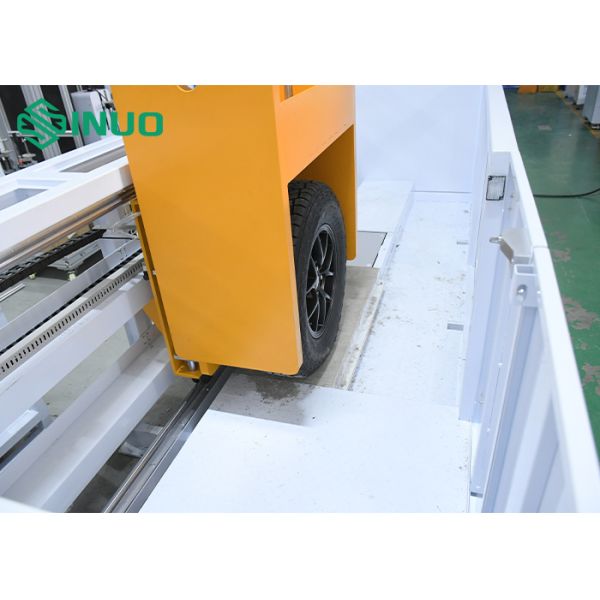
According to IEC and UL requirements, accessories wired with the minimum conductor size recommended by the manufacturer are placed on a concrete surface in a natural resting position. A defined crushing force is applied using a standard automotive tire mounted on a steel rim and inflated to the specified pressure.
The tire rolls over the test sample at a controlled speed, simulating real vehicle movement. Each sample is tested in different orientations while being securely fixed to prevent displacement. At no point is the applied force allowed to act directly on projecting pins, ensuring strict compliance with standard test conditions.
Mechanical Structure & Design:
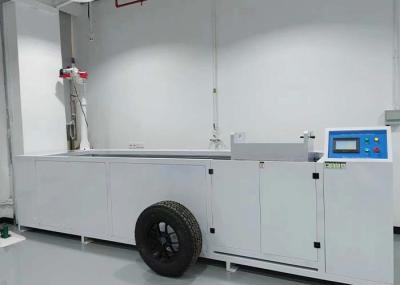
The equipment adopts a fully enclosed protective structure made of cold-rolled steel plates, with a Teflon-coated surface for durability and corrosion resistance. The test base simulates a concrete floor to reproduce realistic installation conditions.
The rolling mechanism allows the tire to freely move upward and downward when passing over the specimen, ensuring that the plug or connector experiences uniform pressure comparable to actual vehicle rolling. Key structural features include:
Heavy-duty linear guide rails supporting smooth roller movement
High-power motor combined with a worm gear reducer for stable speed and torque output
Stainless steel and aluminum core components for long-term reliability
Integrated specimen fixing and sliding system to meet standard positioning requirements
Rolling Force & Drive System:
The rolling load is generated by a counterweight system, allowing force adjustment between 5000 N and 11,000 N. Counterweights are safely installed and removed using a cantilever crane, ensuring accurate load application and convenient operation.
The system adopts a front-and-rear rolling drive mode. The motor’s forward and reverse rotation enables the tire to roll back and forth over the stationary specimen, realistically simulating vehicle forward and reversing movements.
Tire Configuration & Inflation:
5000 N Test Setup
Equipped with an ST225/75R15 tire and matching wheel hub, including an inflation interface and pressure gauge.
(ST225/75R15 is selected as an equivalent tire to P225/75R15.)
11,000 N Test Setup
Equipped with a dedicated high load-bearing tire and corresponding wheel hub.
Tire Inflation Pressure:
IEC 62196: 220 ±10 kPa
UL 2594: 218 ±13 kPa (32 ±2 psi)
A recommended inflation range of 205–230 kPa allows compatibility with both standards.
Control & Operation:
The system is controlled by an independent PLC control unit with a 7-inch color touchscreen interface. Operators can choose between manual operation or fully automatic program-controlled testing. All test parameters can be set precisely according to standard requirements, including rolling speed, stroke, and timing.
Safety & Protection:
Full protective fence to prevent accidental tire deviation
Leakage protection switch for electrical safety
Motor overload protection for stable long-term operation
Integrated braking mechanism to reduce impact and avoid rigid collisions
Technical Specifications:
Test Station: Single station
Control Method: PLC intelligent control with touchscreen operation
Operation Modes: Manual / Program-controlled
Rolling Stroke: 0–2.0 m
Rolling Speed: (8 ±2) km/h, adjustable
Crushing Force Options:
Power Supply: Three-phase AC 220V ±10%, 50/60 Hz
Installed Power: 15 kW
Overall Dimensions: Approx. W4700 × D1300 × H3000 mm
Net Weight: Approx. 2400 kg